
You have decided to sell on eBay seriously. Maybe you are sourcing products to resell. Maybe you already have a business and want to tap into eBay’s massive buyer base. Either way, you have landed on the right question: what are the eBay business account requirements? And the good news is that the process is more straightforward than most new sellers expect, as long as you know what to prepare before you start.
eBay has over 136 million active buyers worldwide as of 2026. That is a huge audience for any seller. But accessing it through a business account means going through eBay’s verification process with the right documents. But if you get it wrong, you will get delays, rejected applications, and selling limits that feel more like roadblocks than a runway.
Anyway, you don’t have to worry, as we have covered everything about eBay business account requirements in this comprehensive guide. Every document you need, every region-specific variation, what happens during verification, what to do if something goes wrong, and how to hit the ground running once your account is approved. Let’s get into it.
TL;DR: Key Takeways of eBay Business Account Requirements
| – Core requirements: valid email, business name and legal structure, business address and phone number, tax ID (EIN in the US, VAT number in the UK and EU), bank account, and government-issued photo ID. – Registered business required? No. Sole traders and self-employed individuals can open a business account without a formally registered company. – Verification timeline: typically 2 to 5 business days for most accounts. Complex cases may take longer. – Selling limits on new accounts: start lower and increase automatically based on seller performance over time. – eBay Store subscription: not required to open a business account but recommended for sellers listing frequently. |
What Is an eBay Business Account and Who Needs One?
An eBay business account is for sellers who sell commercially. That means selling products you bought specifically to resell, selling items on behalf of a company, or selling regularly as a meaningful source of income.
It is different from an eBay personal account, which is meant for casual and occasional selling of items you already own. The practical difference matters more than it might seem.
A business eBay account gives you higher selling limits, access to all of eBay’s seller tools, the ability to display the legal name of your business on listings, and eligibility for eBay Store subscriptions that can significantly reduce your fees. A personal account gives you none of those things beyond the basics.
Who Needs to Open an eBay Business Account?
Here is the honest answer. If any of the following descriptions sound like you, a business account is not just recommended. It is required by eBay’s policies.
- Resellers: If you buy products with the intention of selling them for a profit. This is commercial activity, and eBay’s terms require a business account for it, regardless of your volume.
- Multi-quantity sellers: If you list multiples of the same product and sell the same item in quantities of two or more is a signal of commercial activity.
- Registered businesses: If you represent a company, partnership, or corporation and want to sell under your business name.
- Sole traders: If you run a self-employed business, even without a formally registered company. Sole traders conducting commercial activity on eBay should use a business account.
- eBay Store subscribers: If you want access to eBay Store subscription plans, which reduce various fees and provide advanced selling tools. These are only available on business accounts.
- Brand builders: If you want your business name rather than your personal name to appear on your eBay listings.
If none of those apply to you and you are simply clearing out personal items you already own, an eBay personal account is fine. But if there is any commercial intent at all, start with a business account. Switching later is possible, but it is always easier to start correctly from the beginning.
The Complete List of eBay Business Account Requirements
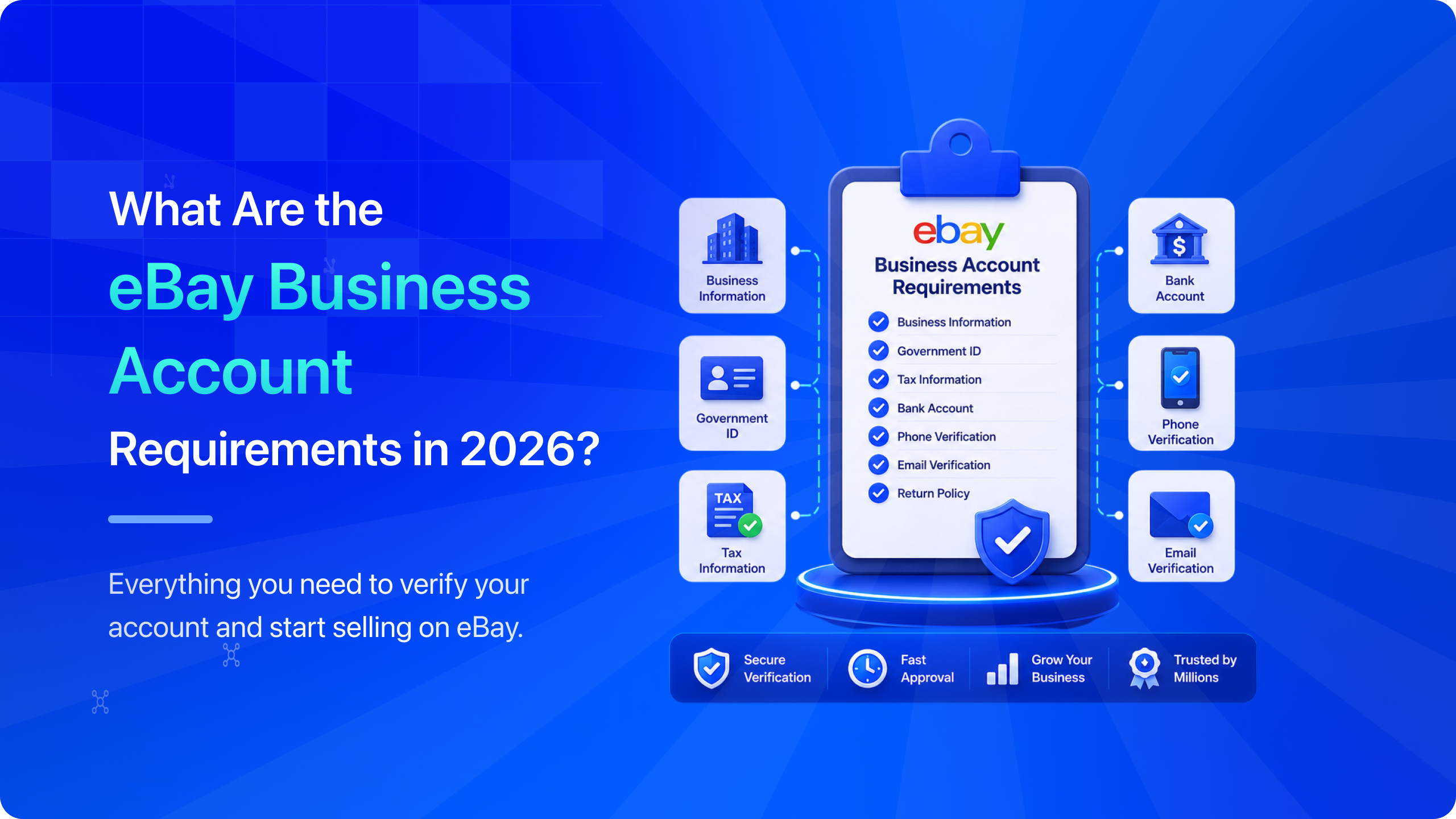
- A valid email address ideally separate from any personal account.
- Your business name and legal business structure.
- Your business address and a working phone number.
- Tax identification details appropriate for your region.
- A bank account to receive payments through eBay Managed Payments.
- Government-issued photo ID for identity verification.
- Business registration documents where applicable.
- Beneficial owner information for companies with multiple directors or shareholders.
Now, let us go through each one of these core eBay business account requirements in detail. Because knowing you need a tax ID is very different from knowing which tax ID, in what format, and what eBay actually does with it.
1. Valid Email Address:
Use a business email address if you have one. Something that reflects your business name looks professional to eBay during verification and to potential buyers when they see your eBay storefront. If you already have a personal eBay account, use a completely separate email for your business account. eBay does not allow two accounts linked to the same email address.
2. Business Name and Legal Structure:
Next, you will need to provide the name of your business trades and your legal business structure. eBay accepts sole traders, partnerships, limited companies, corporations, and non-profit organizations. If you are a sole trader using your own name as your trading name, that works.
But in case you trade under a separate business name, use that. The key is consistency: the name you provide should match your business registration documents and your tax records.
3. Business Address and Phone Number:
Your registered business address is required. For sole traders who work from home, your home address is acceptable as your business address. You will also need a working phone number where eBay can contact you if verification questions arise. These details appear in your seller profile and affect eBay buyer trust, so make sure they are accurate and current.
4. Tax Identification Details:
This is the requirement that varies most by region and the one that causes the most confusion. In the United States, you need either an Employer Identification Number (EIN) from the IRS or your Social Security Number if you are a sole trader without an EIN.
In the United Kingdom, you need your VAT registration number if you are VAT registered, or your National Insurance number and Unique Taxpayer Reference (UTR) if you are self-employed without VAT registration.
In Europe and other regions, a VAT ID, TIN, or GSTIN, depending on your country, is required. We will cover this in more detail in the region-specific section below.
5. Bank Account for eBay Managed Payments:
During registration, you’ll need to add a bank account so eBay can send your payouts. All eBay seller account payments are processed through eBay Managed Payments and deposited directly into the account you provide.
If you’re registering as a business, it’s recommended to use a bank account in your business name. Sole traders can typically use a personal account if it’s linked to their self-employed business.
The required banking details vary by country. In the US, you’ll enter your account and routing number. In the UK, you’ll provide your sort code and account number.
6. Government-Issued Photo ID
Identity verification is an important part of setting up an eBay business account. To verify your identity, eBay accepts documents such as a passport, national identity card, or driver’s license, provided the document is current and unexpired.
As you complete your registration, you may be asked to upload a clear photo or scanned copy of your ID. For a smooth verification process, ensure the image is legible, shows the entire document, and matches the personal information you provided during registration.
7. Business Registration Documents:
If you operate as a limited company, corporation, or registered partnership, eBay will ask for business registration documentation. This typically includes your certificate of incorporation, your Companies House registration number in the UK, or equivalent registration documentation in other countries. Sole traders who have not formally registered a business entity do not usually need to provide this but may need to provide evidence of self-employment, such as a tax registration document.
8. Beneficial Owner Information:
For businesses with multiple directors, shareholders, or partners, eBay requires information about the beneficial owners of the business. A beneficial owner is anyone who owns 25% or more of the business or who has significant control over it. You will need to provide their names, addresses, and identification details. This is a standard anti-money-laundering requirement, and eBay is legally obligated to collect it in most jurisdictions.
These are the main requirements you’ll need to meet before your eBay business account can be verified. While some details, such as your email address or bank account, are straightforward, others like tax information and business registration documents depend on your country and business structure. In the next section, we’ll look at eBay business account requirements by eBay account type.
eBay Business Account Requirements by Business Type
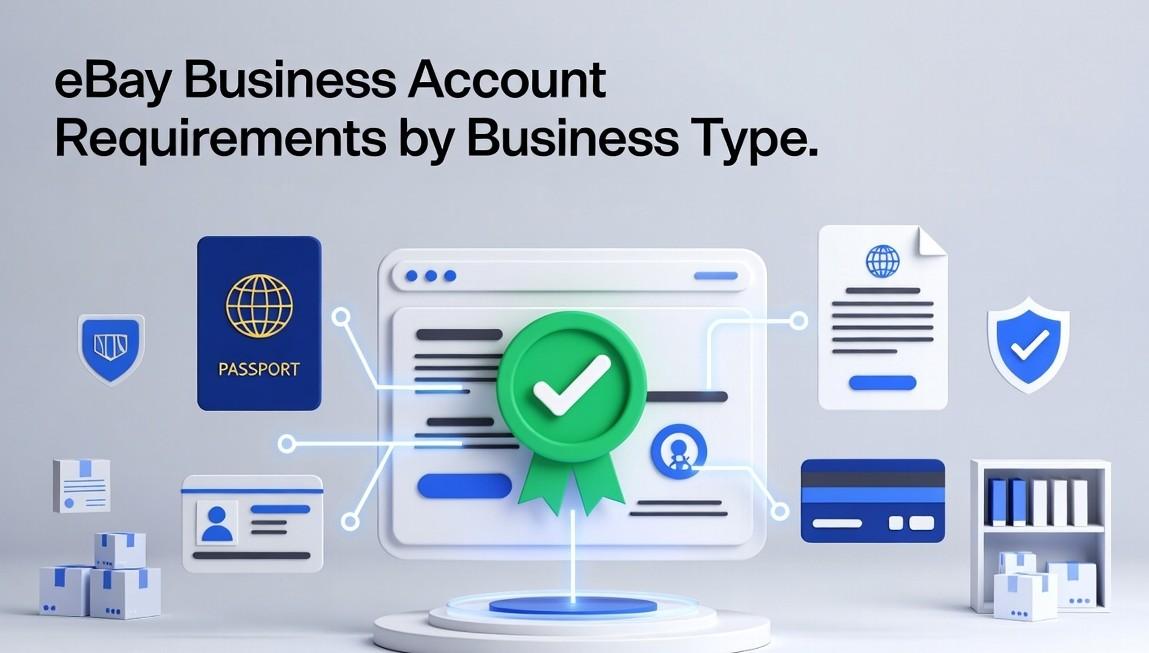
One of the most common questions we hear is whether you need a formally registered business to open an eBay business account. The short answer is no. But the requirements do vary depending on your business structure. Here is what each type of seller needs to know.
Sole Trader or Self-Employed Individual:
If you run a business under your own name or a trading name without a formal company registration, you are a sole trader. This is the most common structure for individual eBay sellers, and the good news is that eBay fully supports it. You do not need a registered company to open a business eBay account.
- Business name: You can sign up using your own name or your trading name.
- Tax ID: You’ll need your personal tax identification details, such as your National Insurance number and UTR (UK), or your Social Security Number (SSN) or Employer Identification Number (EIN) in the US.
- Bank account: A personal bank account is usually accepted if you’re a sole trader, although having a dedicated business bank account can make managing your finances much easier.
- Business registration documents: You won’t need to provide these unless you’ve officially registered your business or trading name.
- Beneficial owner information: Since you own the business yourself, there’s no need to provide separate beneficial owner details.
Partnership
If you run your business with one or more partners and haven’t formed a limited company, your business is considered a partnership. eBay allows partnerships to open business accounts, although you’ll need to provide a bit more information than a sole trader.
- Business name: Use the partnership’s trading name when creating your account.
- Tax ID: You’ll need the partnership’s tax reference number.
- Partnership documentation: eBay may ask for documents that confirm your partnership arrangement, depending on the verification process.
- Beneficial owner information: You’ll need to provide details for each partner who owns 25% or more of the business.
- Bank account: It’s best to use a bank account that’s registered in the partnership’s business name, as this helps make the verification process smoother.
Limited Company or Corporation
If your business is formally registered as a limited company or corporation, you have the most documentation requirements but also the most credibility with eBay’s verification team. A formally registered business demonstrates legitimacy and typically moves through verification more smoothly.
- Business name: Enter your registered company name exactly as it appears on your incorporation documents.
- Company registration number: You’ll need your Companies House registration number (UK) or the equivalent business registration number in your country.
- Certificate of incorporation: eBay will typically ask for a copy of your certificate of incorporation as part of the verification process.
- Tax ID: Provide your company’s tax identification number, such as your VAT registration number or the relevant tax ID for your country.
- Beneficial owner information: You’ll need to provide details for all directors and any shareholders who own 25% or more of the company.
- Bank account: A business bank account in the company’s registered name is required to complete the account setup and verification process.
Non-Profit Organization
If you’re opening an eBay business account for a non-profit organization, eBay supports charitable organizations and allows them to sell through business accounts. The exact requirements vary by country, but you’ll generally need to provide the following:
- Organization name: Use the registered name of your non-profit organization.
- Registration number: Provide your charity or non-profit registration number, if one is required in your country.
- Proof of charitable status: eBay may ask for documents that confirm your organization’s charitable or non-profit status.
- Authorized representative: You’ll need to provide the details of the person who is authorized to manage the eBay account on the organization’s behalf.
- Bank account: It is recommended to use a bank account registered in the organization’s name, as this can help make the verification process smoother.
| “The most common delay we see in eBay business account verification is a mismatch between the business name provided during registration and the name on the supporting documents. Before you start your application, lay out every document you plan to submit and make sure the business name is identical across all of them.” -Marija Bacelic, COO at QuickSync and Multichannel Ecommerce Expert |
eBay Business Account Requirements Depending on Regions
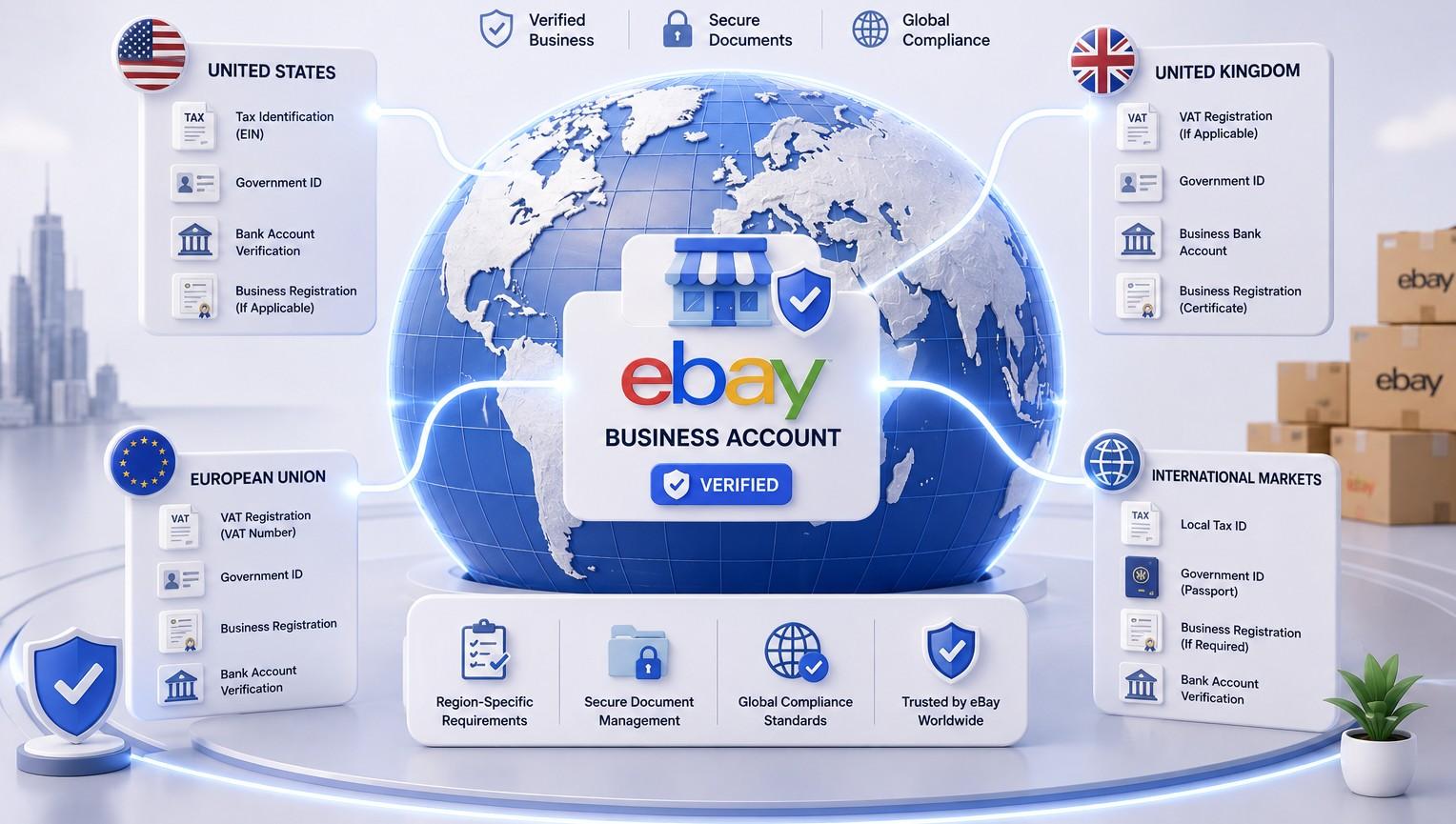
The requirements we’ve covered so far are based on your business structure, but that’s only part of the picture. Your location also plays an important role in the verification process.
While eBay follows a similar account setup process worldwide, the documents you’ll need, tax requirements, banking rules, and compliance obligations can vary from one country to another. Understanding these regional differences can help you avoid delays and make the verification process much smoother.
United States
The United States is eBay’s largest marketplace and home to millions of sellers. If you’re opening an eBay business account in the US, here’s what you’ll typically need:
- Tax ID: You’ll need an Employer Identification Number (EIN) if you’re registering as a business. If you’re a sole trader or sole proprietor without an EIN, you can use your Social Security Number (SSN). If you need an EIN, you can apply for one free of charge through the IRS.
- Bank account: You’ll need a US bank account with your account and routing numbers so eBay can deposit your payouts through Managed Payments.
- Sales tax: In most states, eBay collects and remits sales tax on behalf of sellers under marketplace facilitator laws. This means you usually won’t need to collect sales tax yourself, although it’s still a good idea to check your state’s specific requirements.
- 1099-K reporting: If your sales meet the IRS reporting thresholds, eBay will issue you a Form 1099-K. Keeping accurate financial records throughout the year using accounting software like QuickBooks or a similar platform can make tax reporting much easier.
United Kingdom
If you’re opening an eBay business account in the UK, you’ll need to meet a few requirements related to additional taxes and business registration. The exact documents you’ll need depend on whether you’re a sole trader or a limited company.
- VAT number: If your business is VAT registered, you’ll need to provide your VAT registration number. VAT registration becomes mandatory once your taxable turnover exceeds the current HMRC threshold. If you’re not VAT registered, you’ll typically use your unique taxpayer reference (UTR) and National Insurance number instead.
- Companies House registration: If you’re operating as a limited company, you’ll need your Companies House registration number. Make sure it matches your official registration documents exactly to avoid verification issues.
- UK bank account: You’ll need a UK bank account with a valid sort code and account number so eBay can send your payouts through Managed Payments.
- UK GDPR compliance: If you collect or process customer information, you’re responsible for complying with UK GDPR rules and handling personal data securely.
European Union
EU sellers face requirements that vary slightly by member state but share common elements across the bloc.
- VAT registration: Most commercial sellers in the EU are required to register for VAT. The registration threshold differs from one country to another, so it’s important to check the rules in your specific member state.
- EU bank account: You’ll need a bank account with a valid International Bank Account Number (IBAN) to receive payouts through eBay.
- GDPR compliance: If you collect or process personal information from EU customers, you must comply with the EU’s General Data Protection Regulation (GDPR), regardless of where your business is located.
- Country-specific tax IDs: In addition to VAT registration, many EU countries require their own business tax identification numbers. For example, businesses in Germany use a Steuernummer, while businesses in France use a SIRET number. Other EU countries have similar tax identification requirements.
Australia, Canada, and Other Markets
If you’re opening an eBay business account in Australia, Canada, or another country where eBay operates, the overall requirements are very similar. While the exact documents may vary by region, you’ll generally be asked to provide information that verifies your identity, business, and banking details.
How eBay Business Account Verification Works
Once you’ve gathered your documents and submitted your application, the next step is eBay’s verification process. This stage is where eBay reviews your information to confirm your identity, business details, and payment information.
Many sellers are unsure about what happens after clicking submit, how long approval takes, or why some applications are reviewed faster than others. Understanding the process can help you avoid common delays and know what to expect.
What eBay Checks During Verification
During verification, eBay reviews several details to make sure your account information is accurate and meets its requirements. This typically includes:
- Identity verification: eBay checks your identity against the documents you submitted.
- Business details: Your business name and registration information are reviewed against official records where applicable.
- Tax information: eBay may verify your tax identification details with the relevant tax authority.
- Bank account details: Your payment account information is checked to confirm it is valid and matches your records.
- Account history checks: eBay may review its internal records to ensure there are no issues with existing or previous accounts.
How Long Does eBay Business Account Verification Take?
This is the most searched question about the verification process and the honest answer is that it varies. For most straightforward applications with all documents complete and consistent, verification completes within 2 to 5 business days.
Some sellers see approval within 24 hours. Others with more complex business structures or documentation requirements wait 7 to 10 business days.
What to Do If Verification Takes Longer Than Expected
If you have not heard back within 5 business days and have not received any requests for additional information, you can check your verification status in your eBay account settings.
If eBay has sent a request for additional documents, respond promptly. Every day of delay in responding adds to your overall verification timeline. If you are stuck, eBay’s seller support team can provide an update on where your application is in the process.
| “The number one reason we see eBay business account verification take longer than it should is that sellers start listing products before verification is complete. eBay’s terms require that your account be fully verified before commercial selling activity begins. Starting early can trigger a review of your listings and, in some cases, a temporary restriction on your account that adds to the overall timeline.” – eBay Seller Center Official Policy Guidance |
How to Open an eBay Business Account in 2026?
Once your account is verified or you have all the required information and documents ready, you’re ready to complete the registration process. Opening an eBay business account only takes a few minutes, and following the steps in the correct order can help you avoid unnecessary delays.
Here is the exact process to open your eBay business account from start to finish.
1. Visit eBay’s registration page
Go to the eBay website and click Register at the top of the page. When prompted, choose Business Account instead of a personal account.
2. Enter your business name and email address
Provide your registered business name or trading name, along with a dedicated business email address. Then click Create Account to continue.
3. Add your business information
Enter your business address, phone number, and business structure. Double-check that these details match your official documents exactly.
4. Provide your tax information
Enter the tax identification number required for your country. This could be an EIN or Social Security Number (SSN) in the US, a VAT number or UTR in the UK, or another country-specific tax ID.
5. Link your bank account
Add the bank account where you want to receive your eBay payouts. eBay will verify these details as part of the Managed Payments setup, so make sure the information is accurate.
6. Upload your verification documents
Upload clear, high-quality copies of your government-issued ID and any business registration documents requested by eBay. Clear and readable documents can help speed up the verification process.
7. Review and submit your application
Before submitting, review all the information you’ve entered to make sure it is complete, accurate, and consistent with your supporting documents.
8. Monitor your verification status
Keep an eye on your email and eBay account for any updates. If eBay requests additional information or documents, responding promptly can help keep your application moving.
9. Set up your seller preferences
Once your account is approved, visit Seller Hub to configure your shipping options, return policy, payment preferences, and other seller settings before listing your first product.
10. Decide whether an eBay Store subscription is right for you
If you plan to sell regularly, consider upgrading to an eBay Store subscription. For many sellers listing around 100 to 150 items or more each month, the reduced fees and additional selling tools can easily offset the subscription cost.
Key Differences Between eBay Business vs Personal Account
Still weighing up whether an eBay business or personal account is right for your situation? We get it and understand that choosing the right account type from the beginning can make a big difference.
Especially if you plan to sell regularly or grow your eBay business over time, these two account types allow you to sell on eBay, but they are designed for very different types of sellers.
| Feature | Personal Account | Business Account |
| Who it is for | Casual sellers clearing personal items | Commercial sellers, businesses, and serious sellers |
| Name on listings | Your personal name | Your registered business name |
| Selling limits | Lower starting limits | Higher limits, scales with performance |
| eBay Store access | No | Yes, all five subscription tiers |
| Promotions Manager | Limited | Full access |
| Bulk listing tools | Not available | Available |
| Tax reporting tools | Not available | Available |
| Seller protection | Standard | Enhanced for business transactions |
| Third-party integrations | Limited | Full access |
| Business branding | Not available | Full business name and store branding |
| Best for | Occasional personal selling only | Any commercial or regular selling activity |
Overall, if you’re only selling your own products from your home, that just feels extra and of no use, then a personal account may be enough. However, if you plan to source products, build a brand, sell consistently, or generate income through eBay, a business account provides the tools and flexibility you’ll need to grow.
Common Mistakes to Avoid When Opening an eBay Business Account
Opening an eBay business account is straightforward when everything is prepared correctly. However, small mistakes during registration or verification can lead to unnecessary delays.
Let’s look at the mistakes sellers often make and how you can avoid them.
Using a Personal Account When a Business Account Is Required:
This is the most common mistake and also the riskiest. eBay’s policies require commercial sellers to use a business account. Sellers who use a personal account for commercial activity risk having their account restricted when eBay identifies the mismatch. Starting with the right account type from day one is always easier than switching later under pressure.
Providing Inconsistent Business Information:
If your business name is spelled differently on your registration form versus your incorporation certificate, eBay’s automated verification will flag it. Every piece of information you provide should match your supporting documents exactly. No abbreviations, no alternative spellings, no missing words.
Uploading Low-Quality Document Images:
A blurry photo of your passport taken on a bad camera in poor lighting will not pass eBay’s document verification. Scan your documents on a flatbed scanner if possible, or photograph them in good natural light with the entire document visible and all text clearly legible.
Starting to List Products Before Verification Is Complete:
It can be tempting to start creating listings while waiting for approval, but it’s better to wait until your account verification is finished. Beginning commercial selling before verification is complete may lead to additional reviews and slow down the process.
Using a Personal Bank Account When a Business Account Is Needed:
The type of bank account you use depends on your business structure. Sole traders can generally use a personal account, but limited companies and corporations typically need a business bank account registered in the company name. Using the wrong type of account can cause issues during the Managed Payments verification process.
Not Preparing Documents Before Starting the Application:
Starting your application without having your documents ready can leave your account setup incomplete and delay approval. Before you begin, gather all required documents so you can complete each step without interruptions.
Skipping the eBay Store Decision:
Many new business sellers ignore the eBay Store subscription decision entirely at setup and then get to know months later that they have been overpaying on fees. So take five minutes during your setup to calculate whether a basic store at around $27.95 per month makes financial sense for your planned listing volume. For most active sellers, it does.
What to Do If Your eBay Business Account Application Is Rejected
A rejected eBay business account application can be frustrating, especially if you were ready to start selling. Fortunately, a rejection does not always mean your application has been permanently declined.
In most cases, the issue can be resolved once you understand why the application was rejected and provide the correct information. By identifying the exact reason, you can make the necessary corrections and improve your chances of getting approved.
Common Reasons eBay Rejects Business Account Applications
- Poor document quality: Documents that are blurry, cropped, incomplete, or difficult to read cannot be verified properly. Always upload clear, high-resolution images or scans that show the entire document.
- Identity verification mismatch: The personal information you enter must match your government-issued identification exactly. Even a small difference in your name, date of birth, or other details can prevent successful verification.
- Tax ID verification issues: Your tax identification number must be valid and match the records maintained by the relevant tax authority. If the information is incorrect or cannot be verified, your application may not be approved.
- Existing account conflicts: If you already have an eBay account, particularly one with unresolved restrictions or policy violations, it may interfere with your new business account application. Resolving those issues is often required before applying again.
- Incomplete beneficial owner information: Businesses with multiple owners, directors, or partners must provide complete details for all required beneficial owners. Missing information can delay or stop the approval process.
- Bank account verification failure: The bank account linked to your application must meet eBay’s verification requirements. Incorrect account details or information that does not match your registered business records can result in a rejection.
How to Appeal an eBay Business Account Rejection
If your application is rejected, eBay will typically send an email explaining the reason. Read it carefully because the reason tells you exactly what to fix. Then follow these steps.
- Identify the specific reason for rejection. eBay’s rejection email will usually indicate which element failed verification.
- Gather the correct documentation. If documents were rejected for quality reasons, prepare new high-quality versions. If information was incorrect, prepare accurate versions.
- Contact eBay seller support. Use eBay’s official support channels to explain your situation and resubmit the correct documentation. Clearly reference your original application.
- Allow time for the appeal to be reviewed. Appeal reviews typically take 3 to 7 business days. Respond promptly to any follow-up requests.
If you have an existing eBay account with unresolved issues that is blocking your new application, resolving those issues first is the most direct path to getting your business account approved.
How QuickSync Helps New eBay Business Sellers Manage Their Operation
Getting your eBay business account approved is only the first step. As your business grows, managing inventory across multiple marketplaces becomes one of your biggest operational challenges.
Without real-time inventory updates, a product sold on eBay may still appear available on Shopify, Amazon, or Etsy. That can lead to overselling, cancelled orders, and a poor customer experience.
QuickSync automatically keeps every connected sales channel synchronized. As soon as a sale is made, inventory is updated across all platforms in real time, helping you stay organised and protect your seller performance.
The Bottom Lines
Summing it up, the eBay business account requirements are more straightforward than they first appear. You need your business details, your tax identification for your region, a bank account, and a government-issued ID. Prepare those documents before you start the application, and the process moves quickly.
Most sellers are verified and ready to sell within 2 to 5 business days. The two things that slow most sellers down are inconsistent information across documents and starting the application without everything ready. Fix both of those, and your path from application to active seller is smooth.
Once your eBay business account is open and verified, the next challenge is keeping your operation running accurately as you grow and add more sales channels. QuickSync handles that part seamlessly.


