When you start selling online, expanding to multiple platforms feels like a smart move. Shopify gives you full control over your brand, while Etsy brings access to an established marketplace of ready buyers. But managing both separately is where the real challenge begins.
What looks simple at first, listing products on two platforms quickly turns into daily double work. Inventory must be updated twice. Orders live in two dashboards. Product details slowly drift out of sync. As sales grow, these small inefficiencies turn into overselling, missed orders, and delayed fulfilment.
A Deloitte survey found 35% of medium and large retailers frequently suffer stock discrepancies when selling across multiple platforms. The good news? These issues are avoidable with the right Shopify–Etsy integration.
If you’re wondering whether Shopify integrates with Etsy and how it actually works, this guide breaks it down. You’ll learn what’s possible, where limitations exist, and how sellers manage both platforms.
Does Shopify Integrate With Etsy?
Shopify and Etsy are built as separate platforms. Each one manages its own orders, inventory, and product listings. Because of this, Shopify does not include a direct, built-in way to connect an Etsy store with a Shopify store and keep everything in sync automatically.
Instead, Shopify is designed to work with integration tools available through the Shopify App Store, like QuickSync. These tools help store owners connect Shopify to Etsy seamlessly.
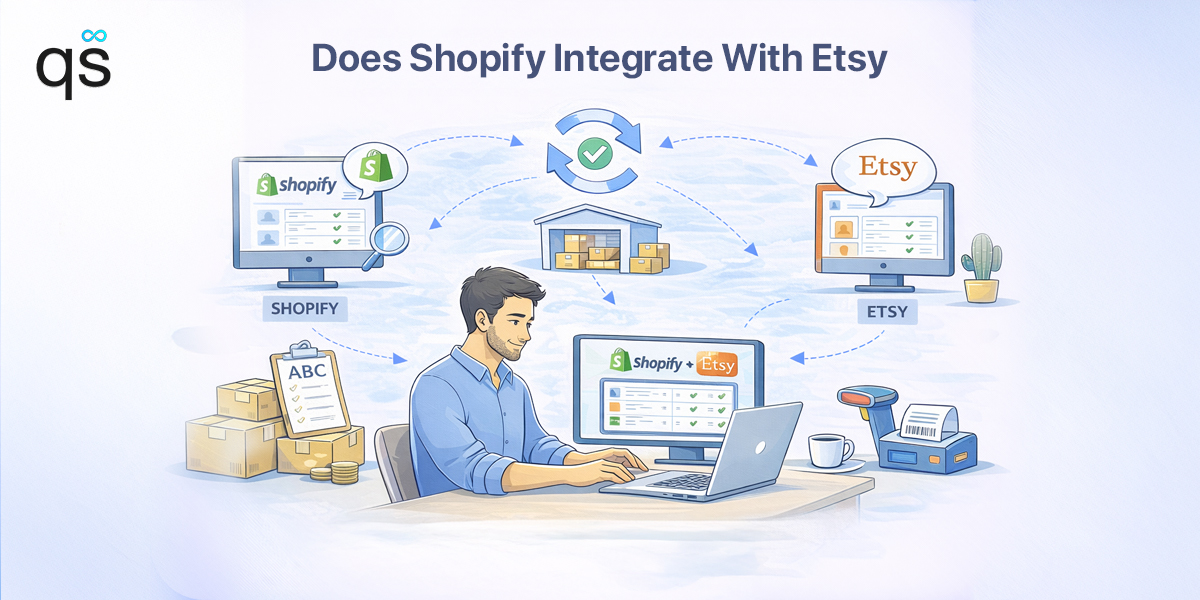
When the right integration app is used, Shopify and Etsy work together as a single workflow. After Shopify and Etsy integration with a reliable tool, Inventory updates, orders, and product changes move between both platforms automatically. This allows sellers to sell across multiple sales channels without losing control or doing extra manual work.
How Shopify and Etsy Work Together
Shopify and Etsy are two completely different sales channels. Shopify runs your own website, while Etsy is a marketplace. When Etsy and Shopify are managed separately, retailers are have to handle inventory, orders, and product updates twice.
Since there are no built-in features to connect Shopify with Etsy, retailers use advanced integration tools. The top Shopify and Etsy integration tools connect both stores seamlessly, and both platforms start working together. This removes manual work and keeps data consistent across both stores.
Once you link Shopify to Etsy, they work as a single central system.
- When a product sells on the Shopify store, the same stock is instantly reduced on the Etsy store.
- Shopify and Etsy orders from a single sales channel instead of switching between multiple dashboards.
- Merchants don’t need to update product titles, descriptions, images, or pricing separately on Shopify and Etsy. Any product detail updated in one store automatically reflects in the other.
With Shopify and Etsy working together, routine tasks are automated. Retailers save time, reduce operational stress, and can focus on marketing, customer experience, and scaling their business instead of fixing issues.
Shopify–Etsy Integration: What You Can and Can’t Do
Shopify and Etsy can work together, but not in the way many sellers expect. Understanding what’s actually possible and the limitations helps you avoid manual work, errors, and scaling issues as you grow.
The following table will help you get a better grasp of what’s possible with Shopify Etsy integration and what’s not.
Area | What You Can Do | What You Can’t Do |
Product Listing | List Shopify products on Etsy using third-party integration tools. Basic product details like title, description, price, and SKU can be pushed from Shopify to Etsy. | Shopify does not natively publish products to Etsy. Etsy listings still need to follow Etsy’s category rules, attributes, and handmade/vintage policies. |
Inventory Sync | Sync inventory levels between Shopify and Etsy so stock reduces automatically when a sale happens on either platform. This helps prevent overselling. | Real-time inventory sync is not available without an integration app. Without a tool, stock updates must be done manually on both platforms. |
Order Management | Receive Etsy orders inside Shopify through supported integration tools, making it easier to manage fulfilment and tracking from one dashboard. | Shopify cannot pull Etsy orders on its own. Without an app, Etsy orders stay completely separate and must be processed manually in Etsy. |
Pricing Control | Maintain consistent pricing across Shopify and Etsy by syncing prices from Shopify to Etsy through an integration tool. | Etsy fees, currency handling, and marketplace-specific pricing rules cannot be controlled from Shopify directly. |
Images & Media | Sync product images from Shopify to Etsy listings when supported by the integration tool. | Video uploads, image order control, and Etsy-specific media requirements may not sync fully and often need manual adjustment. |
Automation Level | Automate repetitive tasks like stock updates, order imports, and price syncing with the right integration tool. | Full automation is not possible without third-party software. Shopify and Etsy do not offer a built-in, native integration. |
Common Problems Sellers Face Without Shopify Etsy Integration

When sellers operate Shopify and Etsy without integration, daily operations become harder to manage. Manual work increases at every step, from inventory updates to order tracking. Over time, these inefficiencies slowly eat into profit margins and limit business growth.
Below are the most common challenges retailers face without a proper Shopify and Etsy integration.
Operational Problem | What Happens Without Integration | Measurable Business Impact |
|---|---|---|
Inventory Mismatches | Stock does not update in real time across Shopify and Etsy. Products sold on one platform remain active on the other. | Overselling can increase cancellations by 15–30% during peak sales. Each cancelled order can cost $8–$25 in refunds, payment fees, and support time, excluding reputation damage. |
Listings Out of Sync | Product titles, images, descriptions, and variants must be updated manually on both platforms. | Sellers spend 5–10 hours per week updating listings manually. Inconsistent listings can reduce conversions by 5–12%, directly impacting revenue. |
Price Differences | Price changes on Shopify are not reflected on Etsy. Manual updates are often missed. | Price mismatches can increase cart abandonment by 10–18% and trigger refund requests. Even a 2–5% pricing error rate can significantly affect monthly margins. |
Order Management Chaos | Orders remain in separate dashboards. Sellers must log into both platforms to track and fulfil orders. | Manual order handling adds 1–2 extra minutes per order. For 1,000 monthly orders, that’s 16–30 hours of additional work. Fulfilment errors can increase by 20–35%, leading to costly returns and negative reviews. |
Higher Staff Costs | Inventory, orders, and listings are handled manually across both platforms. | Manual processes can require 10–20 extra operational hours per week, increasing staffing costs by 15–25% annually without improving efficiency. |
What a Proper Shopify Etsy Integration Should Do
A proper Shopify Etsy integration should simplify daily operations, not add more manual work. It should connect both platforms in a way that inventory, orders, and product data stay aligned automatically as the business grows.
Here are some benefits that retailers gain after integrating Shopify with Etsy.
Real-Time Inventory Sync
A proper integration tool must sync inventory between Shopify and Etsy instantly. When a product sells on Etsy, Shopify stock should update automatically. The same applies in reverse. This is the core way to prevent overselling and maintain inventory accuracy.
Centralized Order Management
All Etsy orders should appear inside Shopify or vice versa. Sellers should not log into multiple channels daily to track orders. Centralised order management reduces mistakes. It also improves fulfilment speed and customer communication.
Product Catalog Consistency
Shopify products and Etsy products should share the same data. Titles, prices, descriptions, and variants must stay consistent on both Etsy and Shopify. Changes should update automatically across platforms. This removes repeated manual updates.
Accurate variant and SKU syncing
Each size, color, or variation must sync correctly between Shopify and Etsty. Poor variant handling leads to wrong stock counts. Proper SKU-level syncing ensures accurate availability. This is critical to avoid overselling specific variants.
Faster Scaling with Fewer Errors
A good integration supports growth without increasing workload. Sellers can add products without fear of inventory issues. Operations stay smooth during sales spikes. This creates a stable, scalable ecommerce workflow.

How Third-Party Tools Enable Shopify and Etsy Integration
Shopify and Etsy are independent platforms, and by default, they do not share data. Each platform manages its own products, inventory, pricing, and orders. This separation is the main reason sellers struggle to manage both stores together.
However, third-party tools bridge these gaps and connect Shopify to Etsy.
1. Creating the Connection
Integration tools use official APIs to securely connect your Shopify store with your Etsy shop. Without this connection layer, the platforms cannot exchange data.
2. Defining Data Flow Rules
Sellers choose how information moves. Shopify can act as the main source of truth, or Etsy can. The tool follows these rules to keep updates consistent.
3. Automatic Syncing
When stock, pricing, or product details change on one platform, the integration tool updates the other automatically, reducing manual work and errors.
4. Managing Platform Differences
Shopify and Etsy use different listing structures. Integration tools map product data correctly to meet Etsy’s marketplace requirements while keeping both stores aligned.
5. Supporting Growth
As order volume increases, the tool maintains sync accuracy. Sellers can scale without adding extra manual work.
Key Benefits of Integrating Shopify With Etsy
When Shopify and Etsy are connected using the right tools, the benefits go beyond basic inventory and order syncing. Integration improves control, visibility, and decision-making across both platforms. Retailers will avail the following benefits by syncing Shopify with the Etsy marketplace.
Time Savings in Daily Operations
Without integration, sellers spend time updating inventory, prices, and orders on both platforms. With automation in place, these updates happen automatically. Many retailers reduce daily operational work from tens of minutes to just a few minutes, even as order volume increases.
Stronger control over Brand Growth
Selling on Etsy brings marketplace visibility, while Shopify supports brand ownership. Integration allows sellers to operate both together efficiently. Etsy becomes a customer acquisition channel, while Shopify becomes the long-term brand and repeat sales channel.
Clear Visibility across Sales Channels
Integration gives sellers a single, accurate view of product performance across Shopify and Etsy. Retailers can easily see which products sell better on each platform. This visibility helps in planning promotions, pricing strategies, and restocking decisions.
Easier Expansion to New Sales Channels
Once Shopify and Etsy are integrated, the integration tool can support additional marketplaces. Sellers can expand to other platforms without rebuilding processes from scratch. This makes multichannel expansion faster and less risky.
Reduced Dependency on Manual Staff
When Shopify and Etsy are not integrated, sellers often hire extra staff just to handle uploads, updates, and order checks. Integration removes this dependency by automating routine tasks across both platforms. This reduces staffing costs, lowers human error, and allows teams to focus on growth, marketing, and customer experience instead of repetitive admin work.
How to Choose the Right Shopify Etsy Integration Tool

Choosing a Shopify Etsy integration tool is about long-term reliability, not just connecting two platforms. The right tool should support daily operations, marketplace rules, and future growth without adding complexity.
Ready for Scalability
The tool should handle inventory sync, product sync, and order sync together as your order volume grows. It must remain stable during sales spikes and higher traffic. Weak tools often fail when businesses start scaling.
Reliable tools like QuickSync are built specifically to support growing multi-channel sellers without performance breakdowns during high-volume periods.
Easy to Set up and Manage
A good integration should be quick to install and simple to configure. Sellers should be able to connect Shopify and Etsy, define sync rules, and go live without technical effort or long onboarding.
Tools like QuickSync offer easy onboarding with no technical skills required to get started. Complicated onboarding slows momentum. A clean dashboard and clear sync settings make daily management easier.
Supports Etsy Marketplace Rules
Etsy has specific listing requirements and policies. The integration tool should map Shopify data correctly to Etsy’s structure to keep listings compliant and visible on the marketplace.
Tools that are purpose-built for Shopify–Etsy workflows, such as QuickSync, ensure proper data mapping so sellers remain compliant while reducing manual corrections.
Reliable Support When it Matters
Because integrations affect live sales, responsive support is essential. Tools that offer ongoing assistance help sellers resolve issues quickly and maintain smooth operations.
Working with a provider that offers dedicated assistance like QuickSync’s ongoing seller support adds an extra layer of operational confidence.
Why do many sellers trust QuickSync?
If you’re looking for a stable, scalable, and seller-focused solution, QuickSync offers a practical way to connect Shopify and Etsy without operational complexity.
QuickSync covers all the essentials retailers actually need, like stable inventory, product, and order syncing, simple setup, and Etsy-compliant listings. It’s built for growing stores, backed by reliable support. It offers flexible plans with a 14-day free trial so sellers can test it before committing.
When Shopify Etsy Integration Makes Sense for Your Business
Shopify Etsy integration is not a requirement for every seller. Its value depends on how you sell, how often you update products, and how much manual work you handle daily. Understanding when integration helps and when it doesn’t prevents unnecessary tools and costs.
Integration makes sense if:
- You sell the same products on both Shopify and Etsy
- You manage shared stock across multiple platforms
- You want to use Etsy for discovery and Shopify for repeat customers
- You process more than 10 to 15 orders per day
- You frequently update prices, descriptions, or product variants
- You plan to scale sales volume without hiring extra operational staff
Integration may not be needed if:
- You sell one-of-a-kind or made-to-order items only
- You do not cross-list products between Shopify and Etsy
- You operate on a single sales channel
- Your order volume is low, and manual handling is still manageable
Many sellers start without integration and adopt it once manual work becomes unmanageable.
Conlusion
So, does Shopify integrate with Etsy? Yes, Shopify can be integrated with Etsy, but not fully on its own.
Shopify and Etsy can work together, but integration requires third-party apps like QuickSync. With QuickSync, retailers’ Shopify and Etsy inventory, orders, and product catalogues stay in sync across two platforms. It’s designed for growing retailers who want stability, accuracy, and scalability without technical complexity.
If you’re considering Shopify Etsy integration, the safest way to start is to test it before committing.