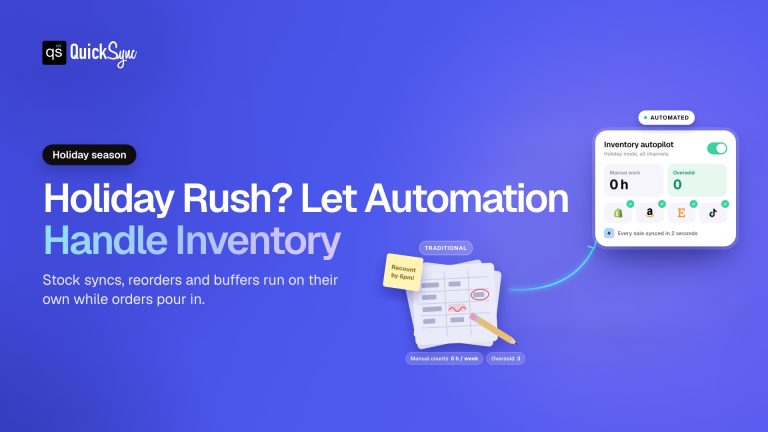
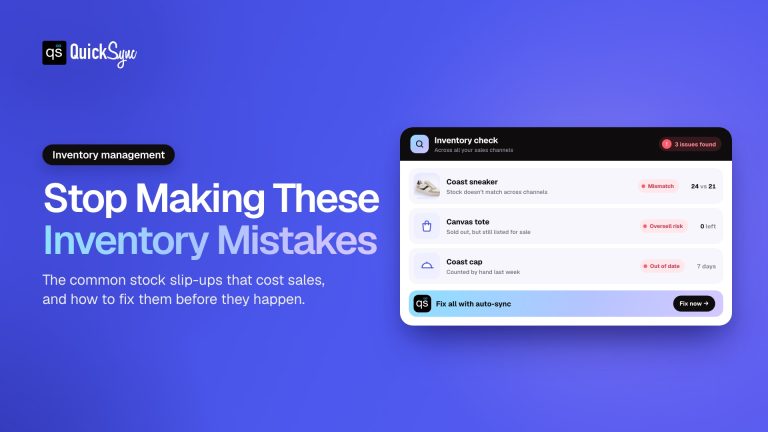
The holiday season brings two things for online sellers: huge sales and huge stress. Demand spikes, rushed fulfillment, and unpredictable traffic can turn Q4 into profit or loss.
Most brands don’t realize that inventory mistakes are the biggest cause of lost holiday revenue. Overselling leads to cancellations, bad reviews, lower rankings, and fewer sales—right when competition is highest.
Whether you sell on Shopify, Etsy, TikTok Shop, or Amazon, the holiday rush exposes every flaw in manual or disconnected workflows.
This blog reveals the 12 biggest holiday inventory mistakes and how to avoid them with smart syncing solution. Read on..
Most Common Holiday Inventory Mistakes: Brief Overview
Holiday sales surge fast and so do operational errors. The most common Holiday Inventory Mistakes happen when sellers underestimate demand, mismanage stock, or rely on manual processes that break under pressure.
Here are the most common mistakes that hurt sellers the most during peak season:
1. Not Analyzing Last Year’s Holiday Data for Inventory Management
2. Ignoring Seasonal Trends and Demand Forecasting
3. Overstocking Slow Sellers, Understocking Best Sellers
4. Relying on Manual Inventory Tracking During the Holiday Rush
5. Not Syncing Inventory Across Multiple Sales Channels
6. Delaying Stock Replenishment During the Holiday Season
7. Having No Backup Plan for Supply Chain Disruptions
8. Inaccurate SKU Mapping Leading to Excess Inventory
9. Missing Low-Stock Alerts and Losing Sales
10. Not Accounting for Returns, Exchanges & Cancellations
11. Poor Warehouse Organization Hurting Inventory Management
12. Not Using Automation for Peak Season Inventory Orders
These mistakes set the stage for revenue loss, customer complaints, and negative reviews — but all can be prevented with the right planning and systems in place.
Let’s explore these major mistakes and their solutions.
1. Not Analyzing Last Year’s Holiday Data for Inventory Management
The foremost mistake that many sellers jump into Q4 planning without reviewing historical sales data. What sold out, what stayed on shelves, when demand spiked, and which channels performed best. Without this data, forecasting becomes guesswork instead of strategy.
The Cost of This Mistake includes:
Understocking best sellers and losing thousands in missed revenue
Overstocking slow movers and getting stuck with dead inventory
Misjudging demand spikes, leading to overselling and customer frustration
Wasting ad spend on products that won’t convert during peak season
Chaotic, last-minute restocking decisions that hurt cash flow
The solution:
To overcome this mistake, ensure to study past historical data before making a single inventory decision. Identify top selling items, seasonal patterns, stockout dates, and revenue-driving SKUs. Use this historical insight to forecast accurately, allocate budget wisely, and prepare inventory levels that match real demand.
2. Ignoring Seasonal Trends and Demand Forecasting
Holiday shopping demand shifts every year so what sold well last season may not be the hero product this time. Trends move fast, categories rise and fall, and buyer behavior changes across platforms like TikTok Shop, Etsy, and Shopify. Sellers who don’t track these shifts end up planning inventory for a season that no longer exists.
What goes wrong:
Stocking products that no longer trend or convert
Running out of items that suddenly spike in popularity
Wasting inventory budget on slow-moving categories
Missing high-demand opportunities unique to this season
Falling behind competitors who adapt faster
The solution:
To avoid this problem, ensure to monitor platform-specific trends early — TikTok viral products, Etsy seasonal searches, Shopify category surges, and marketplace bestseller lists. Use this data to adjust forecasts, prioritize high-velocity SKUs, and shift inventory spending toward what shoppers are actually buying this year, not last year.
3. Overstocking Slow Sellers, Understocking Best Sellers
During the holiday shopping season, not all products perform equally, yet many sellers spread inventory evenly or rely on gut instinct instead of data. This leads to shelves filled with slow movers while the real money-makers sell out too early.
The cost of this mistake:
Cash gets locked in products that don’t sell
Best-selling items go out of stock during peak traffic
Lost revenue from shoppers who would’ve purchased instantly
Higher storage fees and post-season clearance losses
Poor cash flow right when you need it the most
The solution:
Identify your true best sellers using past trends, conversion rates, and past holiday performance. Allocate more stock, budget, and marketing to high-demand SKUs. At the same time, reduce quantities for slow movers or bundle them strategically to avoid dead inventory. Let data guide inventory distribution not assumptions.
4. Relying on Manual Inventory Tracking During the Holiday Rush
Many sellers still track stock using spreadsheets, manual edits, or delayed platform updates. During the holidays — when orders come in fast and from multiple channels manual tracking becomes impossible to keep up with, creating gaps, delays, and constant uncertainty.
Why this becomes a problem:
Inventory updates fall behind real-time sales
Overselling becomes almost guaranteed
Staff wastes hours updating numbers instead of fulfilling orders
Human errors slip in, causing mismatched quantities
Decisions get delayed because no one trusts the data
The solution:
Switch to real-time, automated syncing across all sales channels. Automated systems update stock instantly after every sale, remove human error, and give teams a single source of truth. This eliminates overselling, saves hours of manual work, and keeps inventory accurate even during peak holiday demand.
5. Not Syncing Inventory Across Multiple Sales Channels
When you’re selling on Shopify, Etsy, TikTok Shop, Amazon, or more, each platform tracks inventory separately unless you use a sync tool. Without real-time syncing, one channel might sell out while another still shows stock and creates instant problems.
The fallout:
Overselling across one or more channels
Forced order cancellations that frustrate customers
Negative reviews that hurt marketplace rankings
Lost sales because stock wasn’t updated in time
Hours wasted trying to manually fix quantity mismatches
The solution:
Use a real-time multi-channel inventory data sync that updates stock the moment a sale happens across every platform at once. This ensures consistent quantities, prevents overselling, maintains marketplace rankings, and keeps operations running smoothly even during peak holiday traffic.
6. Delaying Stock Replenishment During the Holiday Season
During Q4, suppliers get overwhelmed, shipping slows down, and lead times stretch far beyond normal. Many sellers make the mistake of ordering restocks too late, assuming turnaround times will stay the same — but holiday logistics never work that way.
Why it’s dangerous:
Best sellers go out of stock during peak sales days
Suppliers run out of raw materials or finished goods
Shipping delays turn a 7-day restock into 21+ days
Missed opportunities during traffic surges like Black Friday
Cash flow becomes unstable because revenue stalls in the middle of Q4
The solution:
Place restock orders earlier than usual — ideally 4–6 weeks before holiday seasonal demand peaks. Track lead times, communicate with suppliers proactively, and monitor sales velocity to know when to reorder. Early replenishment ensures your best sellers stay live through the entire season.
7. Having No Backup Plan for Supply Chain Disruptions
Even the best inventory planning can fail if the supply chain breaks down. Weather events, shipping delays, vendor shortages, or logistics bottlenecks can stop products from reaching your warehouse — leaving you scrambling mid-season.
The fallout:
Stockouts on high-demand items
Missed revenue opportunities during peak shopping days
Last-minute rush orders with higher costs
Frustrated customers and negative reviews
Increased stress and burnout for your operations team
The solution:
Develop a backup plan that includes alternate suppliers, secondary fulfillment centers, and contingency shipping options. Keep safety stock for top-selling items and monitor logistics closely. Planning for disruptions transforms potential crises into manageable hiccups.
8. Inaccurate SKU Mapping Leading to Excess Inventory
When selling across multiple platforms, mismatched or inconsistent SKUs create confusion. A single product can appear differently on Shopify, Etsy, TikTok Shop, or Amazon, making it difficult to track inventory, fulfill orders correctly, or sync stock automatically.
The fallout:
Overselling or underselling due to misaligned SKUs
Order fulfillment errors and wrong shipments
Increased customer complaints and returns
Wasted time fixing inventory issues manually
Loss of trust in internal data and workflow
The solution:
Implement a centralized SKU mapping system that aligns every product across all channels. QuickSync-style tools automatically detect conflicts, merge duplicates, and map missing items. Accurate SKU mapping ensures seamless inventory tracking, error-free fulfillment, and reliable reporting.
9. Missing Low-Stock Alerts and Losing Sales
Without proactive notifications, sellers often discover low inventory too late — sometimes after items have already sold out. Relying on manual checks or delayed reports makes it easy to miss restocking opportunities.
The fallout:
Stockouts during peak shopping periods
Lost sales and revenue on high-demand products
Frustrated customers and canceled orders
Last-minute rush orders that increase costs
Strain on the operations team is scrambling to fix shortages
The solution:
Set up automated low-stock alerts for every channel and SKU. These notifications give your team time to reorder or redistribute stock before it runs out. Staying ahead of inventory prevents overselling, keeps customers happy, and ensures smooth holiday operations.
10. Not Accounting for Returns, Exchanges & Cancellations
Holiday returns and cancellations spike far higher than usual often 2–3× normal rates. Sellers who don’t factor these into inventory planning or workflows risk stock discrepancies and inaccurate forecasting.
The fallout:
Products appearing out of stock when they are actually available
Overselling due to unreturned items being marked as sold
Frustrated customers waiting for refunds or replacements
Manual reconciliation taking hours of precious time
Missed opportunities to restock or resell returned items
The solution:
Build returns, exchanges, and cancellations into your inventory workflow. Automate restocking updates and track incoming returns in real-time. Accounting for these factors keeps stock levels accurate, prevents overselling, and maintains a smooth customer experience during the busiest season.
11. Poor Warehouse Organization Hurting Inventory Management
Even if inventory is accurate, a disorganized warehouse slows down fulfillment. Misplaced products, unclear bin locations, and inefficient picking processes cause delays — especially when order volume spikes during the holidays.
The fallout:
Slower order processing and delayed shipments
Increased errors in picking and packing
Higher customer complaints and negative reviews
Lost sales due to unfulfilled orders
Team frustration and burnout
The solution:
Implement a clear warehouse layout with labeled bins, optimized picking routes, and systematic storage. Use barcode scanning or inventory management software to track products in real-time. An organized warehouse ensures faster fulfillment, fewer errors, and happier customers, even during peak season.
12. Not Using Automation for Peak Season Inventory Orders
Manual processes can’t keep up when orders skyrocket during the holidays. Relying on spreadsheets, manual updates, or disconnected systems leads to bottlenecks, errors, and endless busywork.
The fallout:
Inventory mismatches and overselling
Hours wasted on repetitive tasks instead of growth activities
Increased stress and operational chaos for your team
Slower fulfillment, unhappy customers, and negative reviews
Missed sales opportunities during peak traffic
The solution:
Leverage automation tools to sync inventory, orders, and real-time data across all channels. Automate repetitive tasks, set rules for pricing and stock allocation, and let systems handle scaling.
Must-Have Features to Avoid Holiday Inventory Mistakes with Automation
Holiday inventory mistakes aren’t about effort — they’re about outdated manual processes. When orders spike, humans simply can’t update listings, track stock across multiple platforms, or fulfill orders without errors. Automation turns holiday chaos into control.
1. Real-Time Sync Prevents Overselling & Stockouts
Every sale updates across Shopify, TikTok Shop, Etsy, eBay, WooCommerce, and more — within a second on most channels, and within a few minutes on Etsy and eBay. Your stock is always accurate, best-sellers stay available, and out-of-stock products stop selling automatically.
2. Automated Order Routing Speeds Up Fulfillment
Send all marketplace orders to a single fulfillment hub. Reduce manual data entry, minimize mistakes, and accelerate shipments — keeping customers happy and reviews positive.
3. Centralized Product Updates Keep Listings Consistent
Update titles, images, stock, and pricing from one master source. Avoid duplicate errors, outdated info, and inconsistent listings across channels.
4. Automated Pricing Protects Your Margins
Holiday marketplace fees can eat profits. Automatically apply percentage or flat markups to protect margins and adjust prices across all platforms in one step.
5. Multi-Location Inventory Keeps Stock Accurate
Track inventory across warehouses, retailers stores, and fulfillment partners in real time. No more lost stock, miscounts, or confusion between locations.
QuickSync: The Smart Solution For Holiday Inventory Managment
When holiday traffic surges, you don’t need more spreadsheets, more staff, or more manual work — you need a system that keeps everything accurate, synced, and automated in real time.
That’s exactly what QuickSync delivers.
Built for multi-channel sellers, QuickSync integrates seamlessly with platforms like Shopify, TikTok Shop, Etsy, WooCommerce, Square POS, Clover, and more — ensuring everything stays perfectly aligned during the holiday rush.
Here’s how QuickSync directly addresses each mistake above:
Holiday Mistake | QuickSync Feature that Fixes It |
Poor demand visibility | Real-time inventory dashboard across all channels |
Stockouts & overselling | Instant inventory sync (0–2 seconds) |
Slow fulfilment | Automated order routing to fulfilment store |
No real-time accuracy | Live stock updates across all platforms |
Inefficient listing updates | Master Store → Multi-channel product sync |
Price inconsistencies | Automatic price modification rules |
Supply chain delays | Multi-location management with true stock clarity |
Manual workload | Zero-code automation that eliminates repetitive tasks |
Holiday Mistake
QuickSync Feature that Fixes It
Poor demand visibility
Real-time inventory dashboard across all channels
Stockouts & overselling
Instant inventory sync (0–2 seconds)
Slow fulfilment
Automated order routing to fulfilment store
No real-time accuracy
Live stock updates across all platforms
Inefficient listing updates
Master Store → Multi-channel product sync
Price inconsistencies
Automatic price modification rules
Supply chain delays
Multi-location management with true stock clarity
Manual workload
Zero-code automation that eliminates repetitive tasks
In short:
QuickSync gives holiday sellers what they need most: speed, accuracy, and complete control — without any manual work or technical setup.
Holiday Rush Got You Stressed? We’ve Got You Covered
If you’re preparing for the busiest shopping season of the year, QuickSync helps you:
Avoid stockouts
Prevent overselling
Speed up fulfilment
Reduce operational stress
Manage multiple stores effortlessly
Whether you sell on 2 platforms or 10, QuickSync keeps everything running smoothly.
Start your 14-day free trial — no credit card required.
Get fully set up in within an hour, automate your entire inventory workflow, and stay holiday-ready without stress.
Frequently Asked Questions
1. Why do inventory mistakes increase so much during the holiday season?
Because customer demand spikes fast, orders come from multiple channels, and manual processes can’t keep up — making overselling, stockouts, and fulfillment errors far more common during the busy holiday season.
2. What’s the biggest inventory mistake sellers make during Q4?
Relying on manual tracking instead of real-time inventory syncing. This leads to overselling, mismatched stock, and missed revenue during major sales and peak days.
3. How can I accurately forecast seasonal demand?
Use last year’s sales data, track seasonal trends on platforms like TikTok Shop, Etsy, and Amazon, and analyze velocity of best-selling SKUs to predict consumer demand for the holiday shopping season.
4. How do I prevent overselling across multiple sales channels?
Use a multi-channel inventory sync tool that updates stock instantly after every sale on Shopify, Etsy, TikTok Shop, Amazon, and other platforms. This ensures that loyal customers aren’t frustrated by product shortages and you avoid stockouts.
5. When should I reorder inventory for the holiday season?
4–6 weeks earlier than your normal restocking cycle, since supplier delays and slower shipping times are common in Q4. Demand planning early helps you stay ahead of seasonal challenges and keeps stock levels steady during the busiest time.
6. How do I avoid running out of stock on my best sellers?
Prioritize high-velocity SKUs, set low-stock alerts, track real-time data on sales, and allocate more budget and stock to proven best performers. This ensures you maintain consistent customer satisfaction and avoid stockouts of top-selling products.
7. What can I do if my supply chain faces delays during the holidays?
Have backup suppliers, keep safety stock for top SKUs, and use multi-location inventory to shift stock quickly when needed. Implement proactive measures to reduce product shortages and avoid missing out on major sales opportunities.
8. How does automation help during the holiday rush?
Automation handles real-time syncing, order routing, product updates, and low-stock alerts. It also eliminates manual work and prevent errors when order volume surges. This creates a seamless experience for both your team and customers, ensuring you can focus on growing your e-commerce business during the holiday shopping season.
The bottom Line
The holiday season can be a game-changer, but holiday inventory mistakes can quickly cause chaos. Stockouts, overselling, and slow fulfillment are common pitfalls that can hurt your sales and reputation.
With the right tools for holiday season inventory management, like QuickSync, you can automate updates, sync stock in real time, and speed up fulfillment keeping things smooth and stress-free.
Start your 14-day free trial today (no credit card required.)