
Before we start this comparison of Shopify vs eBay, ask yourself one question: Do you want to rent your store or own it? This is exactly where the Shopify vs eBay decision will come down.
On eBay, you rent and get instant traffic. But you pay rent on every sale. You cannot paint the walls. You cannot choose your customers. And your landlord can raise the rent or change the locks whenever they want.
On Shopify, you own it. Your store looks exactly how you want, and you keep every customer email. You set your own prices and policies. But you have to build the road to your door. No one shows up unless you invite them.
Neither choice is wrong. But one of them may be wrong for you right now. In this guide, we’ll break down fees, traffic, brand control, and inventory so you can confidently pick the right one. And if you want to integrate Shopify and eBay, we will break that down meticulously as well. Read on..
10 Essential Factors We Assessed For This Comparison
Every factor in this comparison was evaluated consistently across both platforms. Here is what we covered and why each one matters.
- Fees and total cost: Monthly fees, per-sale fees, listing costs, and any hidden charges that appear after sign-up.
- Traffic and buyer access: How many buyers each platform brings, and what you have to do to reach them.
- Brand control and customer ownership: Who owns the customer relationship, and how much control you have over your brand identity and marketing.
- Ease of setup: How quickly you can go from zero to your first sale on each platform.
- Product listing and management: How each platform handles product pages, descriptions, variants, images, and catalog organization.
- Inventory management: How stock levels are tracked, updated, and managed across products and locations.
- Payment processing: Which payment methods are supported, what the fees are, and how much flexibility you have.
- Seller protection and policies: How disputes are handled and what protections exist for sellers.
- Scalability: How well each platform supports growth in volume, channels, and product range.
- Integration with other tools: How easily each platform connects with accounting, shipping, marketing, and inventory tools.
Shopify vs eBay: Understanding What Each Platform Actually Is
Before comparing features and fees, there is one critical thing to understand. Shopify and eBay are not the same kind of platform. Comparing them without acknowledging this leads to the wrong decision. So first, let’s have a brief overview of both platforms.
Running both rather than choosing between them? The Shopify and eBay integration page covers what syncs across the two, and why an eBay sale takes up to two minutes to reach Shopify while the same change the other way takes a second.
What Is Shopify?
Shopify is an eCommerce platform that lets you build and run your own online store. It was founded in 2006 and today powers over 4.6 million businesses in more than 175 countries.
When you use Shopify, you are building something you own. Your store has its own domain, your own branding, your own checkout experience, and your own customer database. Every buyer who purchases from your Shopify store is your customer, and you can market to them again and again without restriction.
Shopify’s strength is flexibility and ownership. It connects with hundreds of apps, supports selling across social media, marketplaces, and in-person, and scales from a solo side hustle to a multi-million dollar operation without switching platforms.
Shopify: Our Assessment
- eCommerce integration: Shopify connects your online business store with in-store selling, social commerce, and marketplace channels from one dashboard. Everything stays in sync automatically.
- Brand ownership: Your store, your domain, your customer data. No platform middleman between you and your buyers.
- Scalability: Shopify grows from your first sale to your millionth without requiring a platform change. Shopify Plus serves enterprise-level brands.
- App ecosystem: Thousands of integrations covering accounting, shipping, marketing, loyalty, and fulfillment.
- Multi-channel selling: Sell products online on TikTok Shop, Instagram, Amazon, eBay, and in-store from one Shopify backend.
- Analytics: Deep reporting across products, customers, traffic sources, and sales channels.
What is eBay?
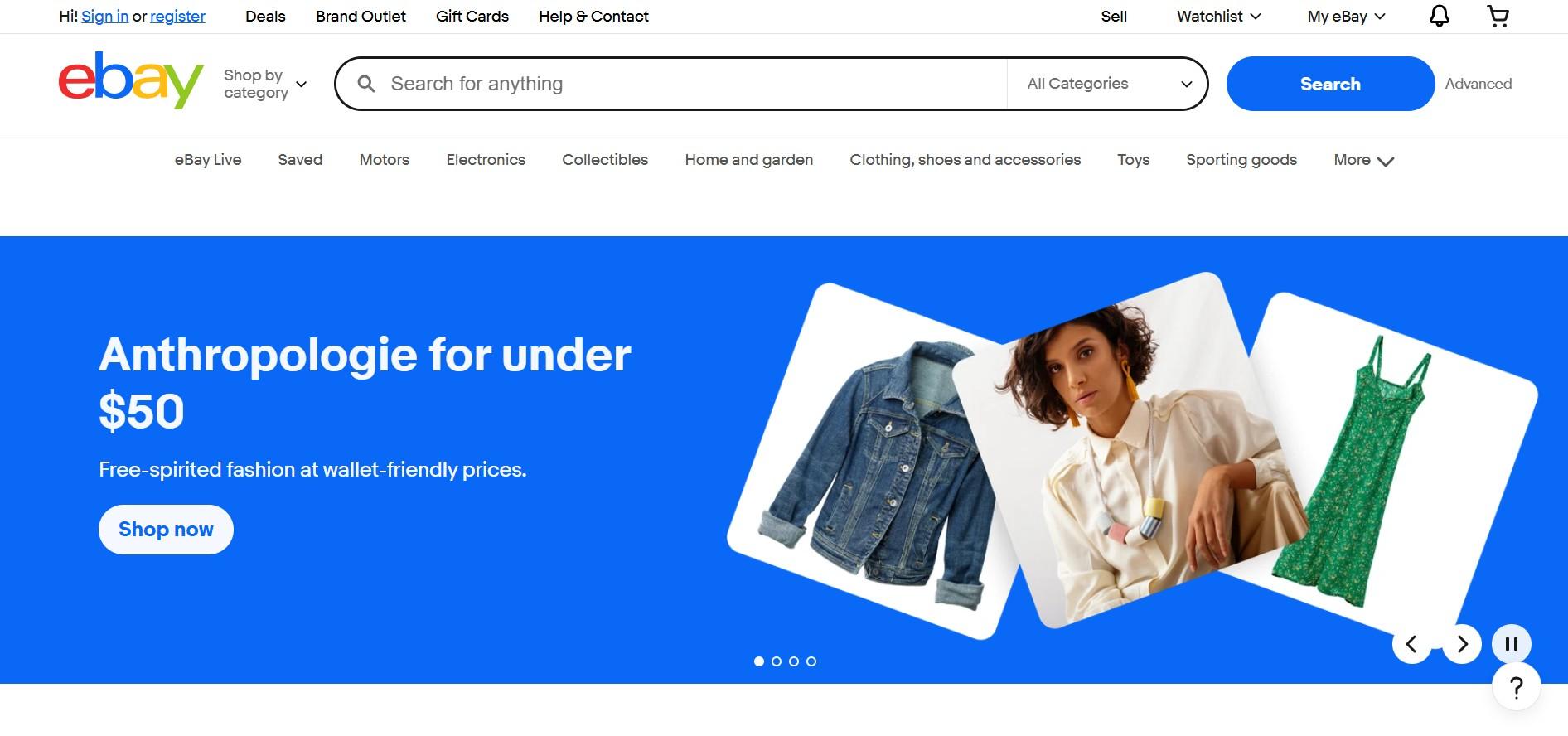
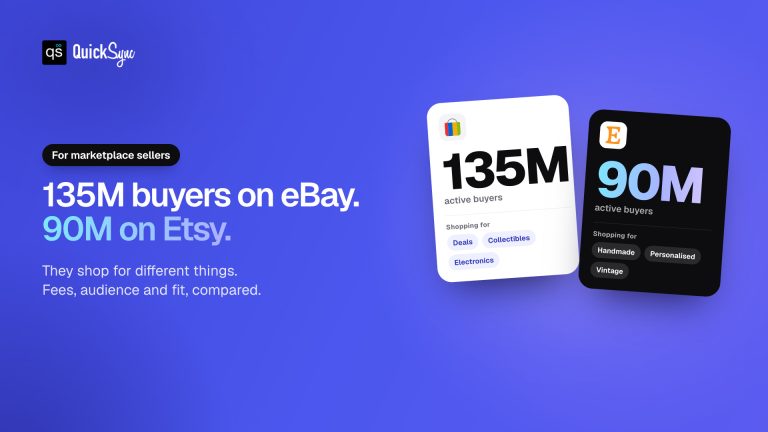
eBay is one of the world’s largest online marketplaces, founded in 1995. It hosts over 130 million active buyers and more than 1.5 billion product listings at any given time. For sellers, eBay means immediate access to a massive, ready-to-buy audience without building an audience from scratch.
eBay’s model is fundamentally different from Shopify’s. You are not building a store. You are listing products inside eBay’s ecosystem. eBay handles the traffic, the trust system, and the payment infrastructure. In exchange, you follow eBay’s rules and pay a percentage of every sale.
eBay’s strength is discoverability. Someone searching for a specific product on eBay is ready to buy. That buyer intent is immediate and real, and it does not require you to spend on advertising to reach them.
eBay: Our Assessment
- Built-in audience: Over 130 million active buyers searching every day. No marketing spend required to get your first sale in front of real buyers.
- Used and vintage goods: eBay is the dominant platform for pre-owned, collectible, vintage, and hard-to-find items. Nothing else comes close for these categories.
- Fast first sale: You can list a product and receive an offer within hours. For sellers who need revenue quickly, eBay delivers faster than any independent store.
- Auction format: eBay’s auction model can drive prices above retail for rare or in-demand items. No other major platform offers this.
- Global reach: eBay operates in over 190 markets. Cross-border selling is built into the platform without additional setup.
- Seller community: A large, experienced seller community with tools, forums, and resources specifically for eBay operations.
This difference matters because choosing between them is not just choosing between two selling tools. It is choosing between owning your business and renting space inside someone else’s.
Both have genuine advantages. Understanding which model fits your situation is extremely important.
| Shopify | eBay | |
| Type | Your own store. You own the brand, the customers, and the experience. | A marketplace you sell inside. eBay owns the traffic and the buyer relationship. |
| Traffic | You bring your own. No built-in audience. | 130 million+ active buyers already searching every day. |
| Fee Model | Fixed monthly subscription plus processing fees per transaction. | Listing fees, final value fees, and payment processing on every sale. |
| Brand Control | Full control over your store design, content, and customer experience. | Limited. You sell inside eBay’s platform under its rules and policies. |
| Customer Data | You own all customer data. You can market to past buyers directly. | eBay owns the buyer relationship. You cannot market directly to past customers. |
| Best For | Building a brand, growing long-term, selling across multiple channels. | Fast access to buyers, used goods, collectibles, liquidation, testing products. |
Selling the same stock on eBay and somewhere else? eBay tells no one when something sells, so QuickSync checks it every two minutes and corrects your Shopify, Etsy, Amazon or Square count in under a second. See how it handles eBay, or Start 14-day trial
Should You Trust This Shopify vs eBay Comparison?
We understand that there might be a bit of doubt when it comes to relying on the comparisons, and that’s fine, as there are so many articles out there that are written biasedly and for personal benefits. We get it, and we took a different approach.
This comparison is based on actual use and verified experiences:
- We personally tested both platforms across product listings, inventory management, payments, and order fulfillment.
- Insights were gathered from real sellers across various industries, including retail, collectibles, handmade goods, and liquidation.
- There is no affiliate relationship with Shopify or eBay, so all evaluations are impartial.
- Advantages are highlighted honestly, whether Shopify or eBay leads in a category.
The purpose is to give you actionable guidance, not to push you toward one platform unnecessarily.
Shopify vs eBay: A Detailed Comparison Based on 10 Important Factors
1. Fees and Total Cost
Fees are where the selling on eBay vs Shopify decision gets real. The fee structures are completely different, and which one costs you more depends entirely on your sales volume.
Shopify Fees
Shopify charges a fixed monthly subscription. You pay the same amount whether you sell one product or ten thousand. On the Basic plan, that is $39 per month. In addition, Shopify charges a payment processing fee on each transaction. But if you use Shopify Payments, there are no extra transaction fees beyond that rate. Because of this fixed structure, the more you sell, the lower your effective cost per sale becomes.
eBay Fees
eBay charges based on what you actually sell. Final value fees typically run between 10% and 15% of each sale, and this percentage depends on your product category. On top of that, you may pay listing upgrade fees, promoted listing fees, and international selling fees. eBay Store subscriptions reduce some of these costs but add a monthly charge. As a result, at high volume, eBay fees can consume a significant portion of your revenue.
Verdict: Shopify wins on per-sale cost at scale. eBay offers a lower barrier to entry for new sellers because you can start without an upfront monthly fee. However, the per-sale fees compound quickly as your volume grows, making Shopify the smarter financial choice for established businesses.
2. Traffic and Buyer Access
This is eBay’s single biggest advantage, and it is genuinely significant. Understanding it honestly is important before making a platform decision.
Shopify Traffic
Shopify gives you zero built-in traffic. Your store starts with no visitors. Every customer you get comes from your own marketing efforts: SEO, paid advertising, social media, email, influencers, or referrals. Building organic traffic takes months. Paid traffic costs money from day one. For sellers without an existing audience or marketing budget, this is a real challenge.
eBay Traffic
eBay has over 130 million active buyers who search the platform every day with genuine purchase intent. List a product in the right category with the right title, and real buyers will find it without you spending anything on advertising. For new sellers or sellers in specific categories like used goods, collectibles, or electronics, this built-in discovery is enormously valuable.
Verdict: eBay wins clearly on traffic and immediate buyer access. This is its strongest advantage and the main reason sellers choose it, especially when starting or selling in high-demand categories.
Also Read: eBay vs Amazon: Compare Fees, Profit, Traffic & Selling Experience
3. Brand Control and Customer Ownership
This factor determines whether you are building a business or just processing transactions for someone else’s platform.
Shopify Brand Control
On Shopify, you own everything. Your store has its own domain. Your branding, your colors, your product photography, your checkout flow, and your customer experience are entirely under your control. Every buyer who purchases from you becomes your customer. You have their email address, their purchase history, and the ability to market to them again without restriction or additional cost.
eBay Brand Control
On eBay, you are a seller inside eBay’s marketplace. Buyers trust eBay, not your store name. eBay owns the customer relationship, which means you cannot email past buyers directly, cannot build a brand they associate with you specifically, and cannot create the kind of repeat-purchase loyalty that turns one-time buyers into lifelong customers. If eBay changes its policies or suspends your account, you lose everything you built there overnight.
Verdict: Shopify wins decisively. Brand ownership and customer data are long-term business assets. eBay gives you neither.
4. Ease of Setup
How quickly you can go from signing up to making your first sale matters, especially if you need revenue fast.
Shopify Setup
Shopify is genuinely beginner-friendly. Most sellers can create an account, add products, connect a payment method, and have a store live within a few hours. The guided setup process is clear, and no technical knowledge is required for the basics. Building a polished, high-converting store takes more time, but the baseline setup is fast.
eBay Setup
eBay is even faster for a first listing. You can create an account and list your first item in under 30 minutes. The listing process is straightforward for most categories. However, building a credible eBay presence with a solid feedback score, professional listings, and competitive standing in search takes time. New accounts start with limited selling privileges until feedback is established.
Verdict: eBay gets you to your first sale faster. Shopify gets you to a proper business faster. Which matters more depends on where you are right now.
5. Product Listing and Management
How easy and flexible it is to manage your product catalog directly affects how much time you spend maintaining your listings.
Shopify Product Management
Shopify gives you full control over every aspect of your product pages. Rich descriptions, SEO-optimized titles, multiple product images, product videos, variants with individual SKUs and pricing, custom fields, tags, and collections are all available. Bulk editing, import via CSV, and third-party inventory tools make managing large catalogs efficient.
eBay Product Management
eBay listing templates are functional but more constrained. Category selection, required item specifics, condition requirements, and eBay’s search algorithm all influence how you structure listings. Bulk listing tools are available, but the interface is less intuitive than Shopify’s for managing large catalogs. Listing quality, including title keywords and item specifics, directly affects search visibility on eBay.
Verdict: Shopify wins on product management flexibility. eBay works but requires adapting to its own listing structure and rules.
6. Inventory Management
Keeping inventory accurate is one of the most operationally critical functions of any selling platform.
Shopify Inventory
Shopify’s inventory management is one of its strongest features. Products with multiple variants each have their own stock count. Multi-location inventory lets you track stock across warehouses, retail locations, and fulfillment centers from one dashboard. Low stock alerts, inventory transfers between locations, and real-time inventory sync across all selling channels prevent overselling and keep operations clean.
eBay Inventory
eBay handles inventory at the listing level. Each listing has a quantity, and that quantity decrements as items sell. For sellers with simple catalogs, this is adequate. For sellers with large SKU counts, multiple variants, or inventory spread across locations, eBay’s inventory management is basic, and managing it becomes increasingly manual as volume grows.
Verdict: Shopify wins significantly on inventory management, especially for sellers with large or complex catalogs.
7. Payment Processing
How you get paid and what it costs you per transaction affects your bottom line on every single sale.
Shopify Payments
Shopify’s built-in payment processor accepts all major credit cards, debit cards, Apple Pay, Google Pay, and Shop Pay. When you use Shopify Payments, you pay one processing rate with no additional transaction fee on top. Processing rates decrease as you move to higher Shopify plans. If you choose to use a third-party processor, Shopify charges an additional 0.5% to 2% transaction fee per sale.
eBay Managed Payments
eBay uses its own Managed Payments system, which is built into the platform. Sellers have no option but to use a different payment processor. Payment processing costs are bundled into the final value fee structure. Funds are typically available within a few business days, though eBay may hold funds for new sellers during an initial period.
Verdict: Shopify gives more control and often results in lower effective fees at volume. eBay’s payment processing is non-negotiable and bundled into its fee structure.
8. Seller Protection and Policies
Understanding how each platform handles disputes, account health, and seller rights is essential before committing.
Shopify Seller Protection
On Shopify, you set your own policies. Your return policy, your refund terms, and your dispute resolution process are entirely under your control. Chargebacks go through Shopify Payments’ dispute process, and Shopify provides some protection against fraudulent chargebacks. Account suspensions are rare and typically tied to clear policy violations.
eBay Seller Protection
eBay’s system is strongly buyer-focused. Buyers can open cases for items not received or not as described, and eBay often resolves these in the buyer’s favor even when the seller has evidence. Negative feedback from a single difficult buyer can affect your seller metrics. Account restrictions or suspension can happen quickly if metrics fall below eBay’s performance standards, and recovering a suspended account is not always straightforward.
Verdict: Shopify gives sellers more control and protection. eBay’s buyer-first system creates real risk for sellers, particularly at high volume.
9. Scalability
A platform that works well at low volume but becomes a liability as you grow is a problem you want to identify before it is too late.
Shopify Scalability
Shopify is built for long-term growth. You can add unlimited products, multiple store locations, new sales channels, and additional staff without switching platforms. Shopify Plus handles enterprise-level volume with dedicated support, custom checkout flows, and advanced automation. The fixed monthly fee structure means your costs do not scale proportionally with your revenue.
eBay Scalability
eBay scales in terms of listing volume, and eBay Store subscriptions reduce per-listing fees as you grow. But the fundamental economics of eBay work against high-volume sellers. As your revenue grows, your eBay fees grow at the same rate. The 10% to 15% final value fee on every sale becomes a high cost at scale. Most serious sellers who build volume on eBay eventually look for ways to move customers to a platform they own.
Verdict: Shopify wins on scalability. eBay’s fee structure works against you as volume increases.
10. Integration With Other Tools
No selling platform exists in isolation. The tools you connect it with determine how efficiently your entire operation runs.
Shopify Integrations
Shopify has one of the most comprehensive app marketplaces in eCommerce. Thousands of integrations cover accounting software like QuickBooks and Xero, email marketing tools like Klaviyo and Mailchimp, shipping platforms, loyalty programs, CRM systems, analytics tools, and fulfillment services. The Shopify API is well-documented and widely used by developers building custom solutions.
eBay Integrations
eBay has solid integrations with shipping carriers, multi-channel listing tools, and inventory management software. The eBay developer program and API support connections to third-party tools. However, the ecosystem is smaller than Shopify’s and more focused on the specific needs of marketplace sellers rather than building a complete commerce technology stack.
Verdict: Shopify wins on integration breadth and flexibility. eBay covers the essentials but has less depth for businesses building a full technology stack.
Shopify vs eBay: Pricing Information
Understanding the full cost of each platform requires looking beyond the headline monthly fee. Here is a transparent breakdown of what each platform actually costs across different scenarios.
| Pricing Area | Shopify | eBay |
| Monthly Store Fees | Basic: $39 per month Shopify: $105 per month Advanced: $399 per month Plus: Starting at $2,300 per month | No Store: Free for up to 250 listings per month, then $0.35 per extra listing Starter Store: $7.95 per month Basic Store: $27.95 per month Premium Store: $74.95 per month Anchor Store: $349.95 per month |
| Transaction Fees | 250 free listings monthly on the free plan. Additional listings: $0.10 to $0.35 each, depending on store tier | Final value fee: 0.5% to 15% of total sale amount, depending on the category Plus $0.30 per order processing fee included in final value fee. International fees apply for cross-border sales |
| Listing Fees | Unlimited products on all plans | POS Pro add-on for physical retail: $89 per location per month, Third-party app subscriptions, Custom theme or development costs |
| Hidden Costs | Final value fee: 0.5% to 15% of the total sale amount, depending on the category Plus $0.30 per order processing fee included in final value fee. International fees apply for cross-border sales | Promoted listing fees for advertising, listing upgrade fees for bold titles, subtitles, gallery plus, final value fees applied to shipping costs in some categories, and dispute resolution costs borne by sellers |
Key Pricing Takeaways
- For low-volume sellers: eBay is cheaper to start. You can list up to 250 items monthly without paying a subscription fee. Shopify charges a fixed monthly fee regardless of how much you sell.
- For high-volume sellers: Shopify becomes significantly cheaper per sale as volume grows. eBay’s 10% to 15% final value fees compound quickly at scale. With Shopify, you pay a fixed fee plus a small processing rate, so your margins improve as sales increase.
- The break-even point: At roughly $400 to $800 in monthly sales, Shopify’s fixed fee plus processing becomes competitive with eBay’s per-sale fees. Above that range, Shopify wins on cost.
- For large catalogs: eBay listing fees add up fast if you exceed your free monthly allowance. Shopify allows unlimited products on every plan with no extra listing charges.
- Hidden costs on both sides: eBay promoted listing fees and dispute costs can surprise sellers. Shopify app costs and third-party processor surcharges are worth budgeting for from the start.
Shopify vs eBay: Strengths and Weaknesses
Pros of Shopify
- Full brand ownership: Your store, your domain, your customer data. Nobody can take that away from you.
- No per-sale fees: Using Shopify Payments means one processing rate and nothing extra. Your margin does not shrink as you scale.
- Customer relationships you own: Build an email list, run loyalty programs, and market to past buyers without restriction.
- Multi-channel from one place: Sell on eBay shop, Amazon, TikTok Shop, Instagram, and in-store, all from your Shopify backend.
- Scales without hurting your margins: Fixed monthly cost means your fee structure improves as revenue grows.
Cons of Shopify
- Zero built-in traffic: You start with no audience and have to build or buy every visitor. This takes time and investment.
- Monthly fee regardless of sales: If you have a slow month, you still pay. eBay only charges when you sell.
- Takes time to build: A Shopify store takes months to develop momentum. eBay can generate sales within days.
Pros of eBay
- Immediate buyer access: 130 million active buyers means real purchase intent from day one, no marketing spend required.
- Purpose-built for used and collectible goods: No platform comes close to eBay for pre-owned, vintage, and collectible categories.
- Low barrier to entry: No monthly fee until you subscribe to a store. Anyone can list and sell immediately.
- Auction format for rare items: Competitive bidding can push prices above retail for in-demand products. No other major platform offers this.
Cons of eBay
- High per-sale fees: 10% to 15% on every sale erodes margins significantly, especially at volume.
- No customer ownership: eBay owns the buyer relationship. You cannot build a customer list or market to past buyers.
- Account suspension risk: One policy violation or a run of bad feedback can result in restrictions or suspension with limited recourse.
- Limited brand building: Buyers trust eBay, not your store name. Building repeat business is structurally harder in a marketplace.
Shopify vs eBay: Customer Support Comparison
Good support when things go wrong can make a real difference. Here is how both platforms handle it.
| Shopify | eBay | |
| Availability | 24/7 phone, email, and live chat for all plans | Phone, email, and live chat. Hours vary by issue type. |
| Knowledge Base | Comprehensive help center, guides, webinars, and community forums | Seller Center with guides, FAQs, and community forums |
| Specialized Help | Shopify Experts for custom development and setup | eBay for Business community and seller resources |
| Consistency | Generally consistent across plans. Higher tiers get faster response. | Variable. Some sellers report inconsistent support quality. |
| Known Limitations | Complex issues may need multiple follow-ups. Peak periods slow response. | Dispute resolution can favor buyers. Account issues hard to resolve quickly |
Shopify Customer Support
Pros: 24/7 support via phone, email, and live chat for all plan levels. Comprehensive help center with guides, webinars, and an active community forum. Shopify Experts marketplace for custom development and setup assistance.
Cons: Response times slow during peak periods. Complex technical issues sometimes require multiple interactions before resolution. Higher-tier plans receive priority support.
eBay Seller Support
Pros: Phone, email, and live chat support available. Extensive Seller Center with guides and FAQs. An active eBay for Business community with experienced sellers sharing knowledge.
Cons: Support quality is inconsistent, and some sellers report difficulty resolving account-level issues. Dispute resolution frequently favors buyers, which can leave sellers without adequate recourse. Account reinstatement after suspension can be slow and unpredictable.
Shopify vs eBay Comparison Overview: Who Actually Wins?
After comparing both platforms across ten factors, here is the complete ebay vs shopify breakdown in one place.
| Factor | Shopify | eBay | Winner |
| Monthly Fee | $39 to $399/mo fixed | $0 to $349.95/mo store fee | eBay (lower entry) |
| Per-Sale Fees | 0% with Shopify Payments | 10% to 15% on every sale | Shopify |
| Built-in Traffic | None, bring your own | 130M+ active buyers | eBay |
| Brand Control | Complete ownership | Very limited | Shopify |
| Customer Data | Full access and ownership | No access | Shopify |
| Inventory Management | Multi-location, robust | Basic per-listing | Shopify |
| Ease of First Sale | Hours to set up a store | Minutes to list an item | eBay |
| Long-term Scalability | Scales across channels | Fees scale against you | Shopify |
| Seller Protection | You set your own policies | Buyer-favored system | Shopify |
| Integration Depth | Thousands of apps | Solid but smaller ecosystem | Shopify |
| Analytics | Deep cross-channel reporting | Basic seller dashboard | Shopify |
| Used/Vintage/Collectibles | Possible but not optimized | Purpose-built for this | eBay |
| Using Both Together | Possible via QuickSync | Possible via QuickSync | Both + QuickSync |
eBay wins on traffic, immediate buyer access, and low entry cost. These are real advantages that matter, especially for new sellers or those in categories eBay dominates. But on almost every other factor that determines long-term business health, including cost at scale, brand ownership, customer data, inventory management, and scalability, Shopify is the stronger platform.
Which Platform Should You Use? Shopify vs eBay by Business Type
Choose Shopify if:
- You want to build a brand that customers recognize and return to directly.
- You sell new products with a consistent supply and predictable inventory.
- You have a marketing plan or budget to drive traffic to your store.
- Long-term margin and customer ownership matter more than quick initial sales.
- You want to sell across multiple channels, including social media, marketplaces, and in-store from one place.
- You are building a business with the intention of scaling beyond a marketplace selling.
Choose eBay if:
- You sell used goods, collectibles, vintage items, or hard-to-find products where eBay dominates.
- You need to start generating revenue immediately without building an audience.
- You want to test the demand for a product before investing in a full store.
- You are liquidating inventory and need access to a large buyer pool fast.
- You are a part-time or casual seller without plans for significant business growth.
- Your product category benefits from eBay’s auction format and competitive bidding.
Should You Use Shopify and eBay Together?
Using both Shopify and eBay can be a big advantage for growing sellers. Each platform has its strengths, and together they can help your business grow faster than using just one.
Here’s what to keep in mind:
- Get customers quickly: eBay puts your products in front of millions of shoppers right away.
- Build your brand: Shopify lets you design your store, collect customer info, and keep more of your profits.
- Avoid stock problems: If sales on eBay don’t update Shopify, you might sell items you don’t have.
- Ship orders smoothly: Orders from eBay need to go into one system, or shipping can get messy.
- Keep product info consistent: Changes on Shopify should appear on eBay too, or buyers can get confused.
- Use automation: Tools like QuickSync keep everything updated automatically, so you don’t have to do it manually.
The sellers who successfully run both platforms are not managing them manually. They are using a sync solution that keeps everything aligned automatically. That is where QuickSync comes in.
How to Sell on Both Shopify and eBay Using QuickSync
If using Shopify and eBay together gives your business the best of both worlds, the next question is how to manage both without adding extra work. The solution is automation.
QuickSync.pro makes selling on both platforms simple and stress-free:
- Push products automatically: Items listed on Shopify, including titles, descriptions, images, prices, and variants, appear on eBay without extra effort.
- Sync inventory in real time: A Shopify sale updates eBay within seconds. An eBay sale is picked up on the next check, a couple of minutes later, because eBay cannot notify us.
- Centralize orders: eBay sales go directly into Shopify, so you can manage everything from one dashboard.
- Automatic shipping updates: Tracking numbers and delivery updates are sent to eBay automatically.
- Eliminate manual work: No more checking stock, reconciling orders, or worrying about mismatched data.
Using QuickSync Shopify and eBay integration allows you to connect Shopify to eBay. You get the traffic and discoverability of eBay, the branding and control of Shopify, and the confidence that your business runs smoothly as it grows.
The Bottom Line: What Next?
In short, choosing between Shopify and eBay depends on your business’s requirements and what you want it to become tomorrow.
eBay gets you in front of buyers immediately. It is ideal for sellers who need fast revenue, operate in categories where eBay is strong, or want to test products before committing to a full store. Shopify helps you build a business you truly own. It is the right choice for sellers focused on long-term growth, brand recognition, and keeping more of their profits.
However, the most successful sellers do not see this as an either-or decision. They use both platforms together. With QuickSync.pro, setting up this multichannel system takes only minutes. Inventory updates automatically, orders are routed correctly, and you no longer have to worry about manual reconciliation or mismatched stock.