Choosing between Lightspeed vs Shopify is not just about picking an ecommerce platform or a POS system. It is about picking the platform that actually makes your work easier and fits your business type.
Lightspeed and Shopify both handle selling. Both process payments. Both track inventory. But they were built for fundamentally different reasons, and that difference shapes everything about how they work.
Lightspeed is built from the physical retail side. It gives retailers a strong Lightspeed POS system, retail POS features, vendor management, customer management, loyalty programs, and tools for managing complex inventory across retail locations.
Shopify was built the opposite way. Shopify is known for helping businesses build online stores. It gives you an online store builder, Shopify themes, Shopify payments, and discount codes.
So the real question is not only: “Which platform is better?”
The better question is: “Which platform fits the way your business actually sells?”
In this guide, I will compare Shopify vs Lightspeed across ecommerce, POS functionality, inventory management, pricing, retail features, integrations, and scalability. I will also explain when to choose Shopify, when to choose Lightspeed, and when both platforms make sense together.
What’s the Difference Between Lightspeed and Shopify?
Let me explain this simply. Shopify is an ecommerce-first platform. Lightspeed is a retail POS-first platform. This is the key difference.
Shopify starts with the online customer journey. Lightspeed starts with the retail counter. That starting point affects everything.
Shopify feels stronger when your business depends on online sales. Lightspeed feels stronger when your business depends on a physical store or multiple brick-and-mortar retail locations.
What is Shopify in Simple Words
Shopify is an ecommerce platform and online store builder. It helps you create a Shopify store, add products, accept payments, manage online orders, use Shopify themes, connect apps, and grow online commerce.
Shopify is strong for brands that want to grow online. If your business depends on ads, SEO, social media, email marketing, online checkout, and sales channels, Shopify is usually the stronger choice.
Shopify: Our Assessment
- Ecommerce focus: Shopify is built for businesses that want to sell online through a website, checkout, product pages, and digital sales channels.
- Online store control: It gives merchants tools to manage products, collections, payments, discounts, customer profiles, and online orders from one ecommerce backend.
- Growth flexibility: Shopify works well for brands that want to grow through SEO, ads, social media, email marketing, marketplaces, and other online channels.
- POS extension: Shopify POS helps online-first merchants add in-store selling, pop-ups, showrooms, events, or pickup locations without moving away from Shopify.
- Best fit: Shopify is a stronger choice if your business starts online and needs more flexibility for ecommerce, apps, marketing, and multichannel selling.
What is Lightspeed in Simple Words
Lightspeed is a retail POS and retail management platform. Lightspeed retail helps merchants manage in-store sales, inventory, suppliers, staff, customer purchase history, retail locations, sales reports, and point of sale workflows.
Lightspeed retail POS is strong for businesses that operate from physical stores. If your business depends on a brick-and-mortar store, outlet-level stock, register sales, supplier control, and retail reporting, Lightspeed is often the better fit.
Lightspeed: Our Assessment
- Retail-first setup: Lightspeed is built for businesses that sell mainly through a physical store, counter, register, or multiple retail locations.
- POS strength: It helps retailers manage in-store sales, product scanning, payments, returns, customer details, staff access, and register-level workflows.
- Inventory control: Lightspeed works well for retailers that need outlet-level stock visibility, supplier records, purchase orders, stock counts, and product cost tracking.
- Store operations: It supports daily retail tasks like staff management, customer purchase history, loyalty programs, sales reports, and physical store performance.
- Best fit: Lightspeed is a stronger choice if your business depends on in-store selling, retail POS, supplier control, inventory accuracy, and store-level reporting.
10 Key Factors We Assessed in This Shopify vs Lightspeed Comparison
Every factor in this comparison was reviewed across both platforms to understand where Shopify performs better, where Lightspeed performs better, and which platform fits different business models.
- Retail and POS features: How each platform supports in-store selling, checkout, register workflows, staff access, returns, discounts, and daily retail operations.
- Inventory management: How stock is tracked across products, variants, warehouses, outlets, fulfillment locations, and sales channels.
- Pricing and total cost: Monthly plans, POS add-ons, apps, integrations, hardware, payment processing, and the hidden cost of manual work.
- Customer management: How each platform handles customer profiles, purchase history, loyalty, VIP pricing, segments, and repeat customer data.
- Reporting and analytics: How each platform shows sales, inventory, staff performance, customer behavior, channel performance, and business growth data.
- Ease of use: How simple each platform feels for the team using it daily, whether that is an ecommerce team or in-store retail staff.
- Product and catalog control: How each platform manages SKUs, barcodes, variants, product pages, images, collections, supplier details, and catalog updates.
- Order and fulfillment management: How each platform handles in-store orders, online orders, returns, exchanges, shipping, pickup, delivery, and customer notifications.
- Multi-location management: How each platform supports stores, outlets, warehouses, pickup points, stock transfers, location-wise inventory, and sales visibility.
- Multichannel selling and integrations: How each platform connects with ecommerce tools, marketplaces, social channels, accounting, marketing, shipping, reporting, and sync solutions like QuickSync.
Lightspeed vs Shopify: A Detailed Comparison Based on 10 Factors
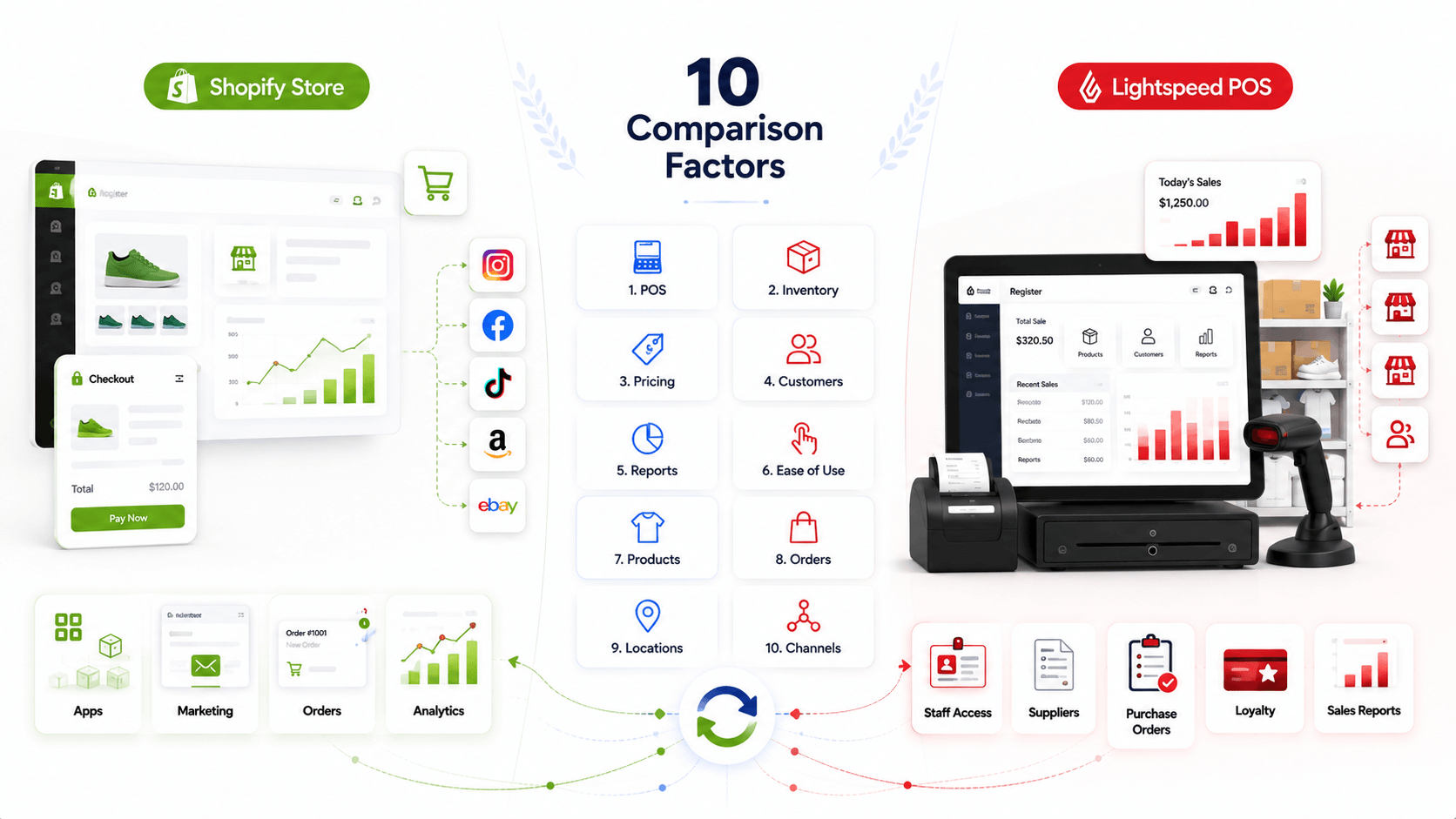
Let’s go through factors one by one and analyze where Shopify is best and where Lightspeed performs better.
1. Retail and In-Store Selling Features
Shopify and Lightspeed both offer POS systems, but they are built for different selling needs. Shopify POS is designed for merchants who already sell online and want to add in-person selling. Lightspeed POS is built for retailers who run daily store operations from a counter, register, or multiple outlets.
Lightspeed POS
Lightspeed POS is a better fit for retailers whose main sales happen inside a physical store. It helps staff scan products, apply discounts, check stock, add customer details, process payments, manage loyalty, and complete sales quickly at the register.
It works well for clothing stores, jewelry shops, gift stores, sporting goods stores, and other specialty retail businesses that need stronger in-store workflows and outlet-level inventory visibility.
Shopify POS
Shopify POS is a better fit for Shopify merchants who want to connect online and offline sales. It helps you sell in store, manage customer profiles, view online orders from the POS, support buy-online-pickup-in-store, and track Shopify inventory across locations.
It works well for ecommerce brands that run pop-ups, events, showrooms, small stores, or pickup locations and want everything managed from the Shopify dashboard.
Our Verdict: Lightspeed POS is a better choice for retail businesses that depend on in-store sales, staff workflows, customer pricing, loyalty, and outlet-level inventory. Shopify POS is a better choice for Shopify merchants who mainly sell online but also want to manage pop-ups, showrooms, events, or small retail locations.
CTA: Bring Lightspeed and Shopify Together
Stop choosing between a strong retail POS and a powerful online store. QuickSync connects Lightspeed and Shopify, so your products, inventory, orders, and sales stay synced across both.
Button: Connect Lightspeed and Shopify
2. Inventory Management Comparison
Inventory is where Shopify and Lightspeed start to feel very different. Both platforms track stock. Both can handle products, variants, and locations. But they think about inventory in different ways. Lightspeed is built around physical stock in physical stores. Shopify is built around stock that can sell across online, POS, social, and marketplace channels.
That difference matters a lot when your business grows.
Lightspeed Inventory
Lightspeed Inventory is a better fit for retailers that manage stock inside physical store locations. It helps you track outlet-level stock, manage product variants, move stock between stores, create purchase orders, store supplier details, run stock counts, and check stock at the register.
This works well for apparel, shoes, jewelry, sports goods, beauty products, and other retail businesses where stock moves through physical locations every day.
Shopify Inventory
Shopify inventory is a better fit for businesses that sell across online and offline channels. It helps manage stock across Shopify store, Shopify POS, warehouses, fulfillment locations, social channels, and connected marketplaces.
This works well for merchants that need one ecommerce inventory view across online orders, product variants, POS sales, and multichannel selling workflows.
Our Verdict: Lightspeed is better for retailers that need stronger physical stock control, outlet-level inventory, supplier records, purchase orders, and register stock checks. Shopify is better for merchants that sell across online stores, Shopify POS, social channels, marketplaces, and fulfillment locations.
So, choose Lightspeed if your inventory lives mostly in retail stores. Choose Shopify if your inventory sells across multiple online and offline channels.
3. Pricing and Scalability
Pricing is where many store owners get surprised. The monthly plan is only one part of the cost. You also need to think about POS add-ons, payment processing, apps, registers, hardware, integrations, and staff time. So, when comparing Shopify vs Lightspeed pricing, do not only ask: “Which one is cheaper?” Ask: “Which one fits my growth model?”
Shopify Pricing
Shopify pricing is mainly built around ecommerce growth. Its main plans start from $29/month for Basic, $79/month for Grow, and $299/month for Advanced on yearly billing. On monthly billing, Basic is $39/month, Grow is $105/month, and Advanced is $399/month. Shopify Plus starts from $2,300/month. Shopify POS Pro costs $89/month per location.
You choose a Shopify plan based on your store size, team needs, reporting needs, and checkout requirements. Then you can add Shopify POS Pro, paid apps, premium themes, integrations, accounting software, inventory tools, and custom development as your store grows.
Shopify is usually cheaper to start if your main goal is launching an online store. But the cost can increase when you add paid tools and advanced features.
Lightspeed Pricing
Lightspeed pricing is more retail-focused. Its Retail POS plans start from $89/month for Basic, $149/month for Core, and $289/month for Plus. Each plan includes one register, and extra locations or additional registers can increase the final cost.
Lightspeed may cost more than Shopify at the starting point, but it gives retailers POS, inventory management, integrated payments, retail location tools, purchase workflows, supplier management, customer management, loyalty, and reporting from day one.
This makes Lightspeed a better fit when your main business runs through a physical store, and your team needs stronger tools for registers, outlets, staff, stock control, and retail operations.
Our Verdict: Shopify looks cheaper at the start because Basic starts from $29/month on yearly billing. Lightspeed looks more expensive because its Retail POS starts from $89/month. But the real cost depends on how your business sells. Shopify may be smarter for online stores. Lightspeed may be smarter for physical retail stores.
4. Customer Management
Customer management is important for both online and offline businesses. But Shopify and Lightspeed manage customers from different angles. Shopify focuses more on online customer profiles and buying journeys. Lightspeed focuses more on in-store customer history and retail relationships.
Lightspeed Customer Management
Lightspeed is useful for retailers that want to manage customer details at the register. It helps store customer purchase history, customer groups, loyalty activity, and retail buying behavior. This works well for stores that depend on repeat customers, VIP pricing, loyalty programs, and personalized in-store service.
Shopify Customer Management
Shopify customer management is stronger for ecommerce brands. It helps you manage online customer profiles, order history, email marketing data, customer segments, and buying behavior across your Shopify store. This works well for brands that want to run marketing campaigns, personalize offers, track repeat buyers, and connect customer data with online sales channels.
Our Verdict: Lightspeed is better for retailers that need customer data for in-store selling, loyalty, VIP pricing, and retail purchase history. Shopify is better for ecommerce brands that need customer profiles, order history, segmentation, and marketing data.
5. Reporting and Analytics
Reporting helps you understand what is selling, where sales are coming from, and how your business is performing. Both Shopify and Lightspeed offer reports, but their reporting focus is different.
Lightspeed Reporting
Lightspeed reporting is built around retail performance. It helps you track register sales, staff performance, inventory movement, outlet-level sales, customer activity, and retail store performance. This works well for retailers that need clear reports for physical locations, staff, products, stock, and daily store operations.
Shopify Reporting
Shopify reporting is built around ecommerce performance. It helps you track online sales, orders, conversion trends, customer behavior, product performance, marketing performance, and sales channel activity. This works well for online brands that need to understand ecommerce growth, checkout performance, customer activity, and sales across different channels.
Our Verdict: Lightspeed is better for retail reporting across registers, outlets, staff, inventory, and in-store sales. Shopify is better for ecommerce analytics, online orders, customer behavior, marketing performance, and sales channel reports.
6. Ease of Use
Ease of use depends on how your team sells every day. Shopify may feel easier for online store owners. Lightspeed may feel easier for retail staff working at the counter.
Lightspeed Ease of Use
Lightspeed is easier for retail teams that work with registers, barcode scanning, stock checks, customer details, staff access, payments, and in-store workflows. This works well when your staff spends most of the day inside the POS system and needs quick access to retail tools.
Shopify Ease of Use
Shopify is easier for merchants who want to build and manage an online store. It helps you add products, create collections, manage orders, edit pages, connect apps, run discounts, and view store activity from one dashboard. This works well for ecommerce teams that want a simple backend for online selling, marketing, apps, and order management.
Our Verdict: Lightspeed is easier for retail teams that need a POS built around daily in-store selling. Shopify is easier for ecommerce teams that need a simple dashboard for online store management.
7. Product Management and Catalog Control
Product management becomes important when you sell many products, variants, SKUs, prices, images, and product details across different channels. Shopify and Lightspeed both help manage products, but they are built for different catalog needs.
Lightspeed Product Management
Lightspeed product management is better for retailers that manage products inside physical stores. It helps with SKUs, barcodes, variants, supplier details, cost tracking, purchase orders, and outlet-level product availability. This works well for retail stores that need strong product control at the register and across physical locations.
Shopify Product Management
Shopify product management is better for merchants that sell products online. It helps with product pages, descriptions, images, variants, collections, SEO fields, pricing, inventory, and online sales channels. This works well for ecommerce brands that need clean product pages, better online merchandising, and products ready for website, social, and marketplace selling.
Our Verdict: Lightspeed is better for retail product control, supplier-linked products, barcode workflows, and store-level catalog management. Shopify is better for ecommerce product pages, online merchandising, collections, SEO, images, and multichannel product selling.
8. Order and Fulfillment Management
Order management is where Shopify and Lightspeed serve different types of sellers. Lightspeed focuses more on in-store transactions, while Shopify focuses more on online orders and fulfillment workflows.
Lightspeed Order Management
Lightspeed is better for retailers that handle orders mainly through the register. It works well for in-store purchases, customer returns, exchanges, customer records, receipts, and store-level sales tracking. This is useful when most orders happen inside a physical store, and your team needs fast POS workflows.
Shopify Order Management
Shopify is better for online order management. It helps merchants manage online orders, payments, shipping, fulfillment, pickup, delivery, customer notifications, refunds, and order tracking. This works well for ecommerce brands that receive orders from websites, social channels, marketplaces, and other online sales channels.
Our Verdict: Lightspeed is better for in-store order handling, returns, exchanges, receipts, and register-based sales. Shopify is better for online orders, fulfillment, shipping, pickup, delivery, and customer notifications.
9. Multi-Location Store Management
Multi-location management matters when your business runs more than one store, outlet, warehouse, or fulfillment location. Shopify and Lightspeed both support locations, but their strengths are different.
Lightspeed Multi-Location Management
Lightspeed is stronger for retailers that manage multiple physical outlets. It helps track stock by store, move inventory between outlets, manage register-level sales, control staff access, and view location-wise retail performance. This works well for retail businesses that need clear visibility across stores, counters, staff, inventory, and daily sales operations.
Shopify Multi-Location Management
Shopify supports multiple locations for inventory, fulfillment, Shopify POS, warehouses, and pickup points. It helps merchants assign stock, fulfill online orders, manage pickup, and track inventory across ecommerce and POS locations. This works well for ecommerce brands that use stores, warehouses, pop-ups, or fulfillment centers to support online orders and customer pickups.
Our Verdict: Lightspeed is better for retailers that need stronger outlet-level control, register visibility, staff workflows, and stock movement between physical stores. Shopify is better for merchants that need location support for online fulfillment, Shopify POS, warehouses, pickup points, and ecommerce operations.
10. Multichannel Selling
This is where the difference becomes very clear. Shopify is built for ecommerce expansion. Lightspeed is built for retail operations. So, when it comes to apps, integrations, and multichannel selling, Shopify usually has the bigger advantage. But Lightspeed still works well if your main business is in-store.
Lightspeed Integrations
Lightspeed integrations are more focused on retail needs. It can connect with tools for accounting, ecommerce, payments, marketing, loyalty, reporting, and store operations.
This works well if your main goal is to support your retail POS system. But if you want to sell the same products on Shopify, eBay, Amazon, TikTok Shop, and other online channels, you may need extra syncing to avoid overselling, wrong stock, refunds, and manual updates.
Shopify Integrations
Shopify has a large app ecosystem. This is one of its biggest strengths. You can connect tools for accounting, marketing, shipping, returns, reviews, loyalty, customer service, inventory, analytics, marketplaces, and social sales channels.
Shopify works better when you want to sell across multiple channels from one ecommerce platform. You can start with a simple online store, then add more apps, sales channels, and integrations as your business grows.
Where QuickSync Fits
Many retailers do not want to choose only one platform. They want Lightspeed for retail POS and Shopify for ecommerce. That setup makes sense, but only if both systems stay connected. QuickSync connects Lightspeed with Shopify and helps sync products, inventory, orders, customer data, and locations between both platforms.
Our Verdict: Shopify is better if your business depends on online sales, apps, marketplaces, social channels, and multichannel ecommerce growth. Lightspeed is better if your business is mainly retail and your integrations support POS, inventory, reporting, accounting, loyalty, and store operations.
So, choose Shopify for online expansion. Choose Lightspeed for retail operations. Use QuickSync if you need both systems connected.
This table shows where each platform performs better across ecommerce, POS, inventory, pricing, and integrations.
| Factor | Shopify Store | Lightspeed POS | Better Choice |
|---|---|---|---|
| Main focus | Built for online stores, checkout, apps, and digital sales channels. | Built for retail counters, POS workflows, staff, outlets, and store operations. | Depends on business model |
| Best for | Ecommerce brands that want to grow online sales and multichannel reach. | Retail stores that need strong POS, inventory, supplier, and staff control. | Depends |
| Ecommerce selling | Strong online store builder with themes, checkout, payments, and marketing tools. | Supports ecommerce, but mainly for retailers already using Lightspeed POS. | Shopify |
| POS system | Good for Shopify merchants adding in-person selling. | Stronger for daily register sales, returns, discounts, and staff workflows. | Lightspeed |
| Inventory management | Better for online, POS, warehouses, fulfillment, and connected channels. | Better for outlet stock, suppliers, purchase orders, and retail inventory. | Depends |
| Customer management | Strong for online profiles, segments, order history, and marketing data. | Strong for in-store purchase history, loyalty, VIP pricing, and customer groups. | Depends |
| Reporting | Better for ecommerce sales, online orders, marketing, and channel reports. | Better for register sales, staff, outlets, stock, and retail performance. | Depends |
| Product management | Better for product pages, SEO, images, collections, and online merchandising. | Better for SKUs, barcodes, supplier details, costs, and store catalog control. | Depends |
| Order management | Better for online orders, fulfillment, shipping, pickup, and notifications. | Better for in-store purchases, returns, exchanges, receipts, and register sales. | Depends |
| Multi-location management | Better for warehouses, pickup points, fulfillment, and ecommerce locations. | Better for outlets, stock transfers, register sales, and store-level control. | Lightspeed |
| Multichannel selling | Stronger for marketplaces, social channels, apps, and ecommerce expansion. | Works well for retail-first selling, but may need syncing for online channels. | Shopify |
| Using both together | Runs your ecommerce store and online sales channels. | Runs your retail POS and physical store operations. | QuickSync |
Which Is Better: Shopify or Lightspeed?
There is no one better platform for every business. The right choice depends on how your business sells, where most of your revenue comes from, and how your team works every day.
There is no one better platform for every business. The right choice depends on how your business sells, where most revenue comes from, and how your team works daily.
Choose Shopify if:
- You want to build and grow an online store.
- Most orders come from your website, social channels, or marketplaces.
- You need ecommerce tools for checkout, product pages, discounts, apps, and marketing.
- You want to sell through Shopify store, POS, social media, marketplaces, and pickup locations.
- You care about SEO, paid ads, email marketing, product pages, and online conversions.
- You want to start small and add apps, integrations, and channels later.
- You are building an ecommerce-first brand, D2C store, or multichannel business.
Choose Lightspeed if:
- You run a physical retail store where most sales happen at the register.
- Your team handles scanning, payments, stock checks, returns, and customers in store.
- You need stronger POS tools for staff, discounts, loyalty, and register control.
- You manage multiple outlets and need store-level stock and sales visibility.
- You depend on supplier records, purchase orders, barcodes, and stock counts.
- You want retail tools built into the platform, not added through many apps.
- You run a boutique, jewelry store, clothing store, gift shop, salon, or specialty store.
Consider using both Shopify and Lightspeed if:
- You want Lightspeed’s retail POS strength with Shopify’s ecommerce power.
- You use Lightspeed in store but want to grow online with Shopify.
- You sell on Shopify but need stronger retail POS operations.
- You sell online and in store and want both systems connected.
- You do not want to update products, inventory, orders, and customers twice.
- You want to reduce overselling, stock errors, wrong product data, and disconnected reports.
- You want QuickSync to connect Lightspeed and Shopify into one smoother workflow.
Should You Use Shopify and Lightspeed Together?
Yes, you can use Shopify and Lightspeed together if you want to increase your revenue and attract more customers. Here is why selling on both Shopify and Lightspeed POS is a better option.
- More sales channels: Shopify helps you sell online, while Lightspeed helps you sell in store. Together, both platforms let you reach customers across more buying points.
- Higher customer reach: Shopify can help you reach online shoppers through your website, social media, marketplaces, SEO, ads, and email marketing.
- Less dependency on one platform: Using both platforms means your business is not limited to only online sales or only in-store sales. You can grow from both sides.
- Better growth opportunities: Shopify gives you ecommerce growth, while Lightspeed gives you retail control. Together, they help your business sell beyond one channel.
- Connected product management: With the right integration tool, your products, SKUs, prices, variants, and images can stay aligned across Shopify and Lightspeed.
- Easier inventory control: Instead of checking stock separately, integration helps keep inventory synced across your online store and physical retail locations.
- Smoother order management: Shopify orders and Lightspeed sales can stay connected, so your team does not have to copy order details manually.
Best fit: This setup works best when you want Shopify for online growth, Lightspeed for retail POS, and QuickSync to manage both platforms from one smoother workflow.
How to Sell on Both Lightspeed and Shopify? Here’s What QuickSync Fits
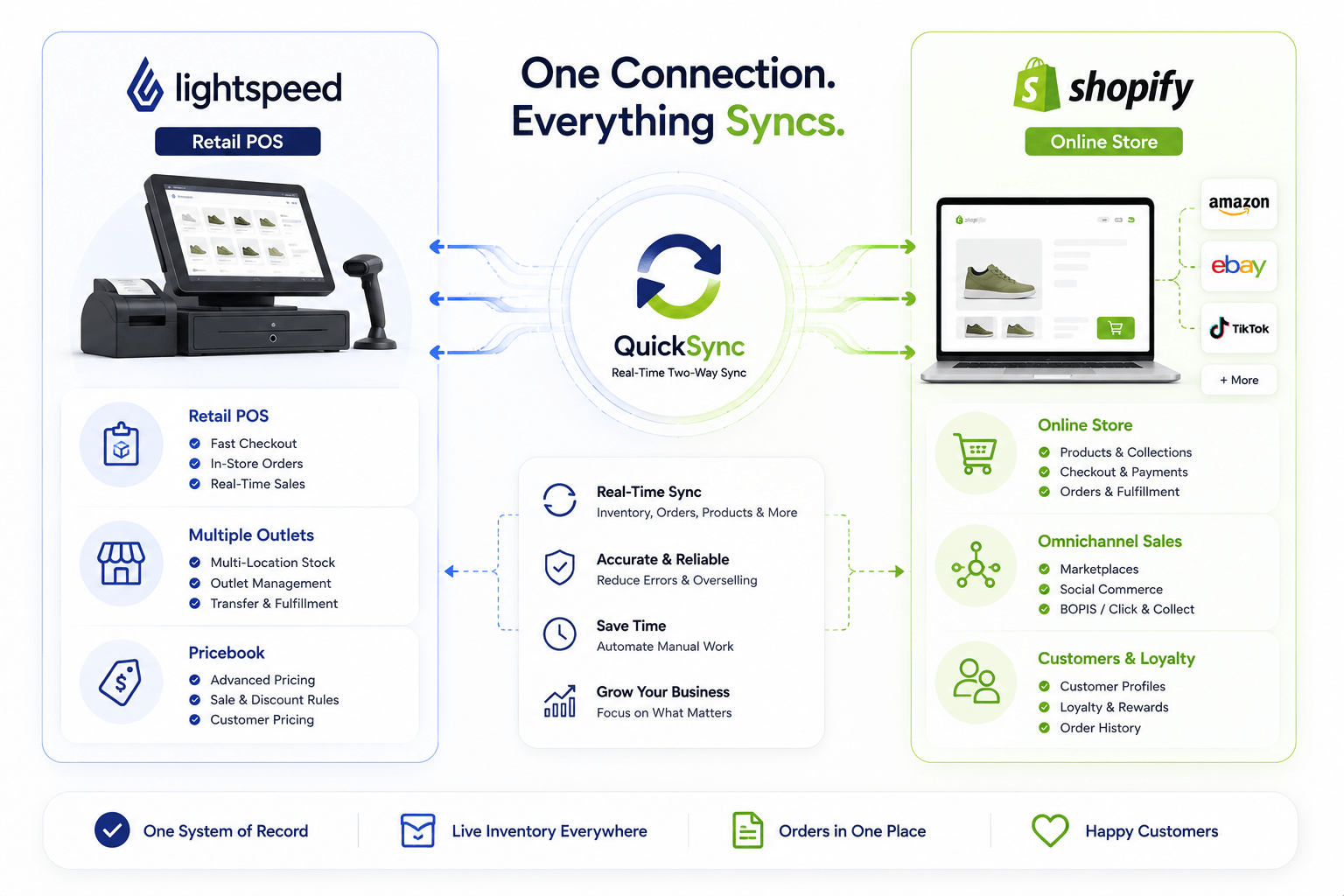
Many retailers do not want to choose only one platform. They want Lightspeed for retail POS. They want Shopify for ecommerce and online channels.
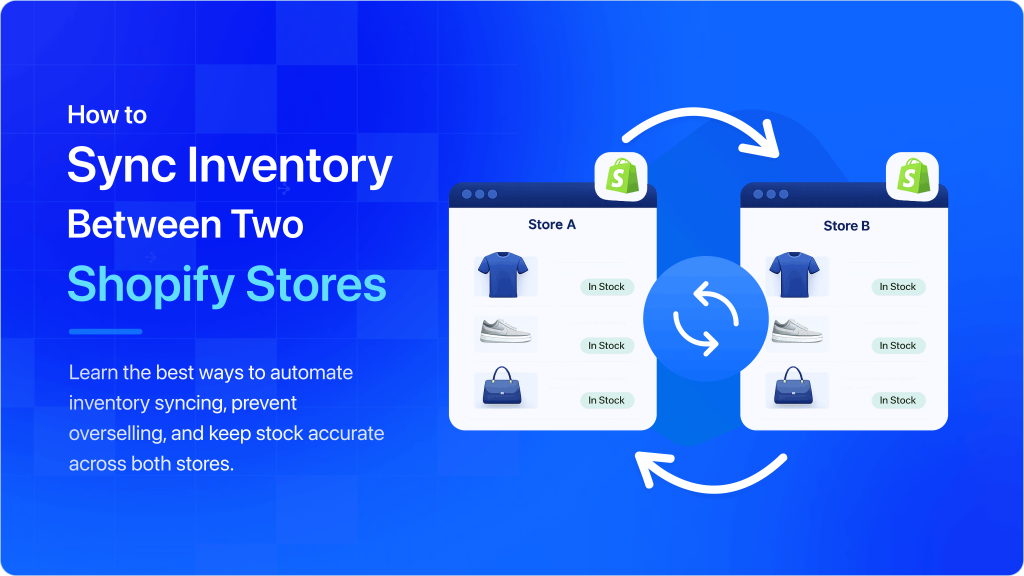
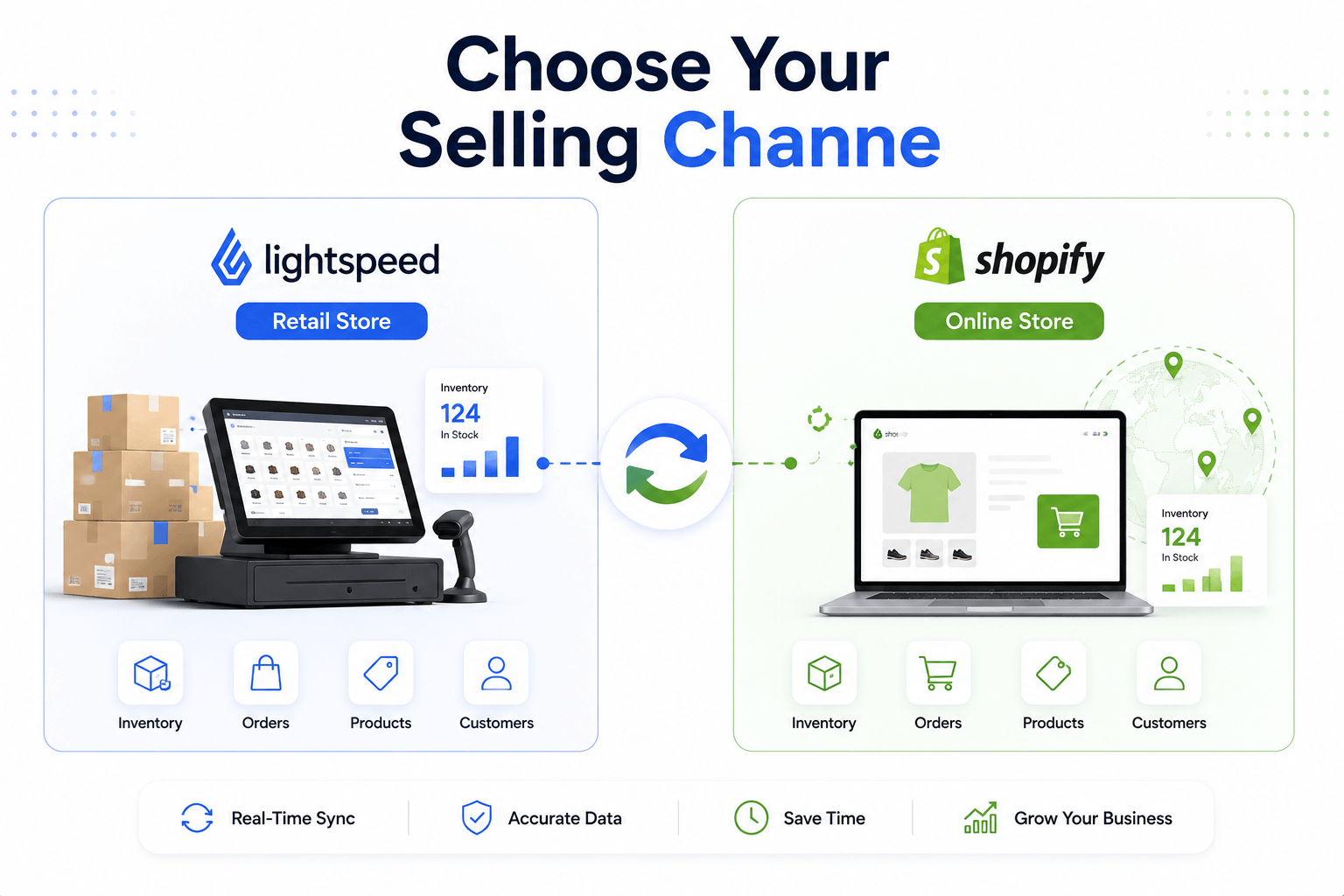
That setup makes sense. But only if both systems stay connected. That’s where an integration tool makes a difference. An integration tool like QuickSync easily connects Lightspeed with Shopify and gives you a unified dashboard to manage all the operation.
QuickSync helps sync products, inventory, orders, customer data, and locations between Lightspeed and Shopify. This means you can run Lightspeed at the register and Shopify online without manually updating both platforms.
What QuickSync Actually Does
QuickSync is the sync layer that turns Lightspeed and Shopify into one system:
Product Catalog Sync: Change a price in Lightspeed, and Shopify updates. Update a product title, description, or image in Shopify, and Lightspeed stays aligned. Your team manages one connected catalog instead of updating the same product details in two places.
Real-Time Inventory Sync: QuickSync offers a real-time inventory sync feature. With QuickSync, your inventory automatically updates after every sale, return, or exchange made in Lightspeed and Shopify. No need to update stocks manually. No more overselling.
Variant Architecture Translation: Lightspeed and Shopify structure variants differently. QuickSync translates Lightspeed’s SKU-based variant setup into Shopify’s parent-variant product structure, so sizes, colors, SKUs, barcodes, prices, and options stay correctly mapped without duplicate products or broken dropdowns.
Multi-Location Stock Sync: If you have multiple Lightspeed outlets and Shopify locations, QuickSync maps stock between them. Each store, warehouse, or fulfillment location can show the right stock, so your team knows where inventory is available before accepting or fulfilling orders.
Shopify Orders Flow to Lightspeed: When a customer places an order on Shopify, QuickSync automatically sync order into Lightspeed with the right products, customer details, and payment information. Staff can pick, pack, and fulfill without copying order details manually.
Lightspeed Sales Sync to Shopify: When a sale happens at the Lightspeed register, QuickSync can sync that sale back toward Shopify. This gives you better visibility across online and in-store revenue, instead of checking two separate systems to understand total sales.
Sale Price and Promotion Sync: Run a promotion or pricebook sale in Lightspeed, and Shopify can reflect the discounted price online. Your website can show the correct sale pricing without separate manual updates, helping reduce pricing mistakes and customer complaints.
Loyalty Points Sync: Customers can earn loyalty points through Lightspeed and stay connected when they shop through Shopify. This helps create one loyalty experience across both online and in-store channels, instead of treating the same customer like two different people.
Gift Card Sync: QuickSync helps connect gift card workflows between Lightspeed and Shopify. A customer can buy or use a gift card across channels more easily, which makes your online and in-store shopping experience feel more connected.
Customer Data Sync: QuickSync helps keep customer details connected between Lightspeed and Shopify. Your team can work with cleaner customer records, purchase history, and channel activity instead of dealing with split data across two separate systems.
Why This Works
QuickSync doesn’t replace either platform. Lightspeed stays your POS. Shopify stays your online store. QuickSync just makes them talk to each other in real time.
This is powerful because:
- You keep the POS system your team already knows
- You get Shopify’s powerful eCommerce capabilities
- Everything stays in sync automatically
- No manual double-entry work
- One inventory, one catalog, two selling channels
Conclusion
The Lightspeed vs Shopify decision comes down to how your business sells. Shopify is the stronger choice if your main focus is online sales, ecommerce growth, apps, checkout, and multiple sales channels. Lightspeed is the stronger choice if your business depends on in-store sales, retail POS, inventory control, staff workflows, supplier management, and physical store operations.
But for many growing retailers, the best answer is not choosing one over the other. You may need Lightspeed to run your register and Shopify to grow your online store. That setup works well only when both systems stay connected.
This is where QuickSync helps. It connects Lightspeed and Shopify, so your products, inventory, orders, customer data, and sales channels stay aligned. Instead of managing two disconnected systems, you get one smoother workflow for online and in-store selling.