Sellbrite does a specific job well: it lists one catalogue on Amazon, eBay, Walmart, Etsy and Google, pulls the orders into one place, and prints the labels. Sellers start looking for an alternative for three reasons that have nothing to do with that job: stock syncs on a 15-minute timer, the bill is metered on orders, and there’s no way to connect a till, TikTok Shop or QuickBooks.
This guide compares seven alternatives on the things that decide whether you oversell and what you pay: how stock moves, what sets the price, which channels connect, and what each tool can’t do. QuickSync is one of the seven and we say where it doesn’t fit.
Why sellers look for Sellbrite alternatives
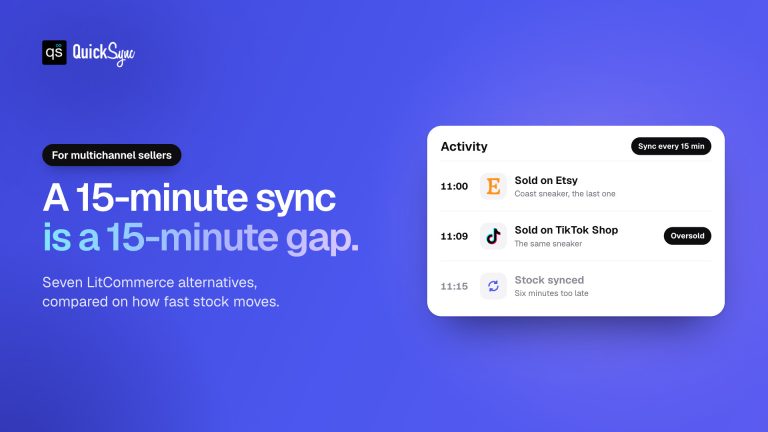
Stock moves every 15 minutes
Sellbrite publishes its sync cadence on the plan sheet rather than the homepage: inventory and orders update every 15 minutes on paid plans and every 2 hours on Forever Free. In that window the unit you just sold on eBay is still for sale on Amazon. For a slow-moving catalogue that’s fine; for a last-unit business it’s where the cancellation email comes from.
Orders meter the bill
Pro 100, Pro 500 and Pro 2K are named for the marketplace orders they include each month. Cross the line and Sellbrite moves you to the next tier mid-cycle. A good December costs more than a quiet March, which is the opposite of what most sellers want a fixed cost to do.
No till, no TikTok Shop, no QuickBooks
Sellbrite connects marketplaces and carts. It doesn’t connect Square, Clover or Lightspeed, it doesn’t list on TikTok Shop, and it doesn’t post to QuickBooks. A shop with a counter and a website is outside what it’s for.
Who owns Sellbrite
GoDaddy acquired Sellbrite in 2019. The product is still sold standalone and as Sellbrite for Shopify, with two different price lists. Reviews on the Shopify App Store sit at 3.9 stars across 110 reviews, with 15% at one star, and the recurring themes are setup effort and support response time.
Sellbrite pricing in 2026
| Plan | Standalone (billed annually) | Sellbrite for Shopify (billed annually) | Includes |
|---|---|---|---|
| Forever Free | $0 | $0 | Up to 30 orders a month, 2-hour sync |
| Pro 100 | $29/mo | $19/mo | Up to 100 marketplace orders a month, 15-minute sync |
| Pro 500 | $79/mo | $59/mo | Up to 500 orders a month |
| Pro 2K | $179/mo | $99/mo | Up to 2,000 orders a month |
| FBA integration | +$19/mo | +$19/mo | Add-on on any paid plan |
The alternatives at a glance
| Tool | From | What sets the bill | How stock moves | Till support | Trial |
|---|---|---|---|---|---|
| QuickSync | $19/mo, two shops | Catalogue size × shops; orders never meter it | Under a second on 8 of 11 channels; eBay, Etsy and Squarespace stock checked every 2 min | Square, Clover, Lightspeed | 14 days, no card |
| LitCommerce | $29/mo | Channels × listings | Every 15 minutes | None | 7 days |
| Trunk | $35/mo | Orders per month, eight bands | Real-time on orders | Square | 14 days, no card |
| Nembol | $39/mo | Products and seats | A split second to a minute | Square | 14 days, no card |
| Zoho Inventory | $29/mo billed annually | Orders, users, locations | Interval; none published | None | Free to 50 orders; 14 days |
| Veeqo | Free shipping; inventory from $19/mo | Orders imported per month | Claimed real-time; disputed in reviews | None | Free plan |
| Linnworks | Quote only | Order volume plus modules | Claimed real-time | None native | Demo only |
The 7 best Sellbrite alternatives
1. QuickSync: the count, priced on the catalogue
QuickSync keeps one stock count across up to eight shops from eleven channels: Shopify, Amazon, Etsy, eBay, WooCommerce, Square, Clover, TikTok Shop, Squarespace, Lightspeed and QuickBooks. When a channel tells it something sold, it writes the new quantity to every other connected shop in under a second. Eight of the eleven channels push changes to it; eBay, Etsy and Squarespace stock are read every two minutes because those platforms don’t send stock events, and Etsy orders every five.
Pricing is by variation count and shop count. Lite is $19 a month for 1,000 items and two shops, Pro $29 for 2,500, Ultra $69 for 10,000, Ultra+ $99 for 20,000; each shop after the second adds the plan price again. Three thousand orders a month costs the same as thirty.
Where it doesn’t fit: it isn’t a listing publisher and it doesn’t print labels. Eight connected shops is a hard cap on every plan. If Sellbrite’s templates and shipping desk are why you bought it, QuickSync replaces the sync half, not the whole. QuickSync and Sellbrite side by side.
2. LitCommerce: listing-first, 15+ channels
LitCommerce is the closest like-for-like: bulk listing templates, per-channel price and quantity rules, eBay auto-relist and AI listing tools across Amazon, eBay, Etsy, Walmart, TikTok Shop, Temu, Faire and more, from Shopify, Wix, BigCommerce or WooCommerce. It starts at $29 a month for three channels and 1,000 listings and scales with both. Orders are unlimited. It holds 4.8 stars on 908 Shopify reviews.
Where it doesn’t fit: stock, price and orders sync on the same 15-minute cycle as Sellbrite, so it doesn’t fix the timing problem. No till support and no QuickBooks. Source: litcommerce.com/pricing.
3. Trunk: order-event sync with bundles, metered on orders
Trunk syncs stock on order events across 20+ channels, including Shopify, Square, Squarespace, Etsy, eBay, Amazon, Faire, TikTok, QuickBooks Online and Xero, and its Pro plan handles bundles and kits, which is rare at this price. Essential starts at $35 a month for up to 100 orders and steps through eight bands to $279 at 10,000; Pro runs $39 to $329. 4.9 stars on 391 Shopify reviews.
Where it doesn’t fit: the bill moves with every order band, there’s no listing creation or order routing, and no Clover. Source: help.trunkinventory.com, pricing plans article.
4. Nembol: marketplaces plus social, priced on products
Nembol lists and syncs across Amazon, eBay, Etsy, TikTok Shop, Shopify, WooCommerce, Squarespace, Square, Wix and the social feeds, priced by product count: Basic $39 for 500 products, Pro $49 for 2,000, Enterprise $79 for 5,000, Enterprise+ $129 for 15,000, with 25% off annually. Its help centre puts stock pushes at a split second to a minute.
Where it doesn’t fit: no Clover, BigCommerce, QuickBooks or Walmart, and support hours are European. 4.2 stars on 54 Shopify reviews. Source: nembol.com/pricing.
5. Zoho Inventory: for businesses already on Zoho
Zoho Inventory adds purchase orders, serial and batch tracking and multi-warehouse to Shopify, Amazon, eBay, Etsy and WooCommerce, with native Zoho Books and QuickBooks Online sync. The free plan covers 50 orders a month; Standard is $29 a month billed annually for 500 orders, then $79, $129 and $249.
Where it doesn’t fit: no Square, Clover, TikTok Shop or Squarespace, marketplace support varies by regional edition, and no sync interval is published. US prices are confirmed through third-party listings because the official page shows local currency by region. Source: zoho.com/inventory/pricing, capterra.com.
6. Veeqo: free shipping from Amazon, paid inventory
Veeqo, owned by Amazon, is free for shipping with unlimited orders, users and warehouses, and earns on label commission. Inventory sync is a paid plan from $19 a month on an order scale, with a high-volume tier from $350. Channels include Amazon, Shopify, eBay, Etsy, Walmart, TikTok Shop, BigCommerce, WooCommerce and Wix; it’s US and UK only.
Where it doesn’t fit: reviewers dispute the real-time claim, there’s no Square, Clover or QuickBooks, and the order bands behind the inventory price aren’t published as a table. 4.0 stars on 125 Shopify reviews. Source: veeqo.com/pricing.
7. Linnworks: the warehouse-scale option
Linnworks is an order and warehouse management platform with listing, 70+ carriers, bins, pick paths and 3PL support across 100+ claimed channels. It’s the right direction for a business shipping thousands of orders a day with staff to run it. Pricing is by quote, on order volume, with paid modules and an onboarding fee; third parties cite entry points around $449 a month.
Where it doesn’t fit: no published price, no self-serve trial, no Square or Clover, and G2 reviews recur on learning curve and add-on costs. Linnworks alternatives, compared.
Which alternative, by how you sell
- Shopify and Etsy maker: Trunk if you sell bundles; QuickSync if you want the bill to ignore order volume. Etsy doesn’t push stock events to anyone, so ask any vendor how often it checks. Shopify + Etsy.
- Counter and website: Sellbrite can’t connect a till. QuickSync connects Square, Clover or Lightspeed to up to seven more shops from $19. POS inventory management.
- Amazon, eBay and Walmart at volume, listing-first: LitCommerce, accepting the same 15-minute cycle. Nembol if social channels matter.
- Warehouse with staff: Linnworks or Zoho, depending on whether you’re already in the Zoho suite.
- Budget first: Sellbrite Forever Free to 30 orders, Zoho free to 50, or QuickSync Lite at $19 with no order cap.
Moving off Sellbrite without overselling
- Export your SKUs and make them unique. Every tool here matches products by SKU across channels. Two listings sharing a SKU can’t sync; fix that in Sellbrite before you leave.
- Connect the new tool with sync switched off. Let it read every channel and show you what it matched and what it couldn’t. QuickSync lists the unmatched items before anything is written.
- Pick the source of truth. Usually the channel with the most accurate count today. The first sync pushes that number everywhere.
- Run both for a day. Sellbrite still syncing every 15 minutes and the new tool reading only. Compare counts on your twenty best sellers.
- Switch the new tool on, then disconnect Sellbrite. Not the other way round. Safety stock of one unit on Etsy listings covers the polling gap while you watch.
Frequently asked questions
If the count is the problem, connect two of your shops and watch QuickSync correct them for two weeks. Start 14-day trial Or book a walkthrough.
Sellbrite is one of nine tools compared on price, sync speed and channel list in our guide to multichannel inventory management software.