On this page
- Key Takeaways of AI Inventory Management at a Glance
- What Is AI Inventory Management?
- Difference Between Traditional and AI-Powered Inventory Management
- Real-World Applications of AI in Inventory Management
- Benefits of AI Inventory Management For Commerce Sellers
- Common Challenges of Implementing AI Inventory Management
- What Is Generative AI Inventory Management and Its Benefits?
- What Is Agentic AI in Inventory Management?
- What to Look for in AI Inventory Management Software
- How to Implement AI Inventory Management Successfully
- QuickSync: The Most Crucial Software for AI-Powered Inventory Management
- Final Words
- Frequently Asked Questions
Inventory management is no longer just about counting products. It’s about predicting what happens next. Modern businesses need systems that can anticipate demand, detect supply chain disruptions, and recommend inventory decisions before problems affect customers.
This is where AI inventory management comes to solve all this. Rather than reacting to inventory problems after they happen, AI continuously monitors stock levels, analyzes demand patterns, and adjusts decisions in real time. The result is fewer stockouts, less excess inventory, and better fulfillment process accuracy without manual work.
This guide covers what AI in inventory management actually means, how it is applied across the core use cases, what generative AI adds beyond standard machine learning, the real benefits and honest challenges, what to look for in AI inventory management software, and so on.
Key Takeaways of AI Inventory Management at a Glance
- AI shifts inventory management from reactive to predictive. It forecasts demand, automates routine decisions, and identifies inventory issues before they happen.
- AI is only as good as the data behind it. Accurate, real-time inventory data is essential for reliable forecasts and recommendations.
- Real-time inventory sync improves AI accuracy. Connected inventory across all sales channels helps reduce stockouts, overstocking, and inventory errors.
- Generative AI makes inventory insights easier to understand. It lets teams ask questions, generate reports, and make faster decisions using natural language.
- Successful AI adoption starts with connected systems. Clean data and reliable integrations matter more than having the most AI features.
What Is AI Inventory Management?
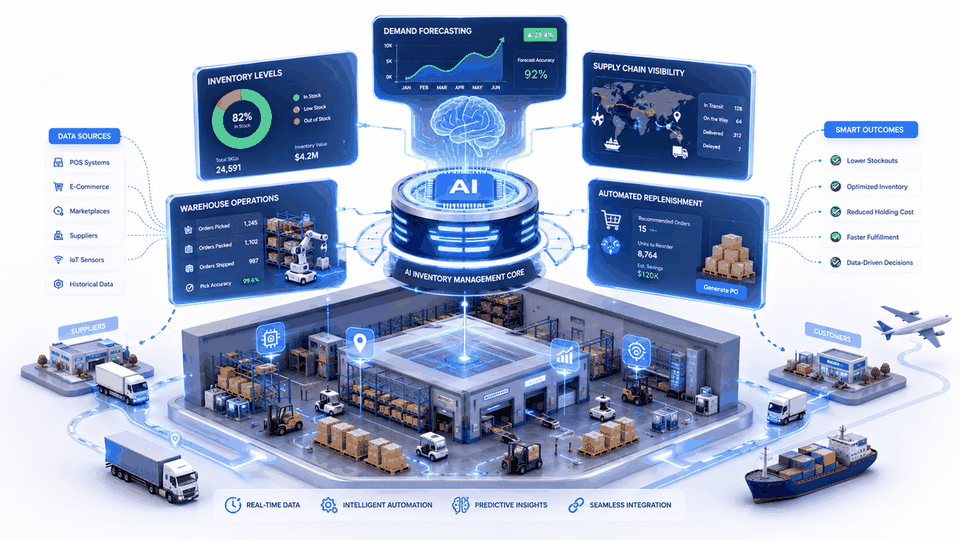
Most businesses already know their inventory management could be better in 2026, but still they are facing problems like-
- Stock runs out at the wrong time.
- Reorder decisions are made based on outdated information.
- Manual processes that worked at lower volumes start breaking down as the catalog grows.
The question is not whether to improve inventory management but how far current tools can actually take you. This is where AI inventory management changes the picture.
AI for inventory management uses artificial intelligence to help businesses manage inventory more efficiently. It uses technologies like machine learning and predictive analytics to track stock, forecast demand, and improve inventory decisions. Instead of simply showing what inventory you have, AI can predict future needs, spot potential problems early, and even automate routine decisions.
Difference Between Traditional and AI-Powered Inventory Management
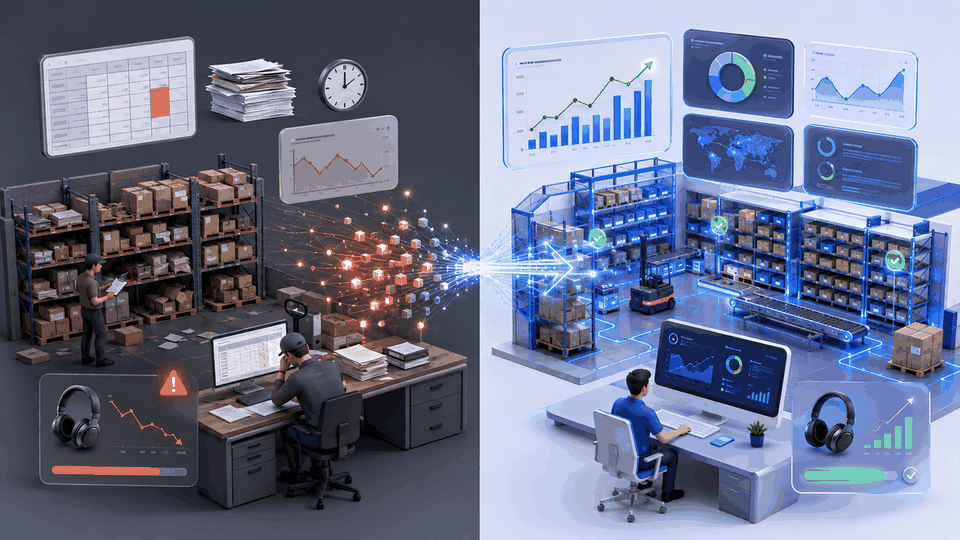
A traditional inventory management system tells you what happened. It records a sale, updates a count, and generates a report you review later. An AI-driven inventory management system tells you what is likely to happen next and recommends or executes the appropriate response before the problem arrives.
The practical difference looks like this.
A traditional inventory system shows you ran out of stock yesterday. An AI system tells you three days in advance that a product is likely to run out based on current sales velocity, seasonal demand patterns, and supplier lead times.
This shift from reaction to prediction helps businesses manage inventory more proactively and avoid costly disruptions. AI adoption in supply chain and inventory management has been accelerating.
According to McKinsey, companies that have adopted AI in their supply chain operations report a 15% reduction in logistics costs and a 35% reduction in inventory levels compared to industry averages. Those gains do not come from implementing AI everywhere at once. They come from applying AI to the specific inventory decisions where better data and faster analysis make the most difference.
Real-World Applications of AI in Inventory Management
AI is not a single tool that replaces your entire inventory system. It is a set of capabilities that address specific inventory problems more accurately and more consistently than manual processes can. Each use case below solves a distinct operational challenge that businesses consistently face.
Demand Forecasting:
Knowing how much inventory to order is difficult when demand keeps changing. Traditional forecasting relies on past sales data, but it often misses factors like seasonal market trends, promotions, market changes, and customer behavior.
AI improves demand forecasting by analyzing historical data and real-time signals to predict what customers are likely to buy next. It helps businesses avoid overstocking, prevent stockouts, and prepare for demand spikes before they happen.
Automated Restocking:
Knowing when to reorder inventory is critical, but manual processes often react too late. Businesses may discover low stock only after there is not enough time to receive new shipments.
AI-powered restocking continuously analyzes inventory data and automatically recommends or creates reorder actions based on demand, supplier lead times, and stock requirements.
The result is a smarter restocking process that reduces shortages, lowers excess inventory, and keeps operations running smoothly.
Automatic Error Detection:
Missing stock, counting errors, incorrect shipments, and fulfillment issues can remain hidden for weeks when businesses rely on manual checks.
AI helps detect these problems by continuously monitoring inventory activity and identifying unusual patterns in real time. It can spot issues like unexpected stock drops, inventory mismatches, unusual sales activity, or differences between ordered and received quantities.
By finding problems earlier, AI helps businesses reduce inventory losses, improve order accuracy, and prevent small issues from becoming costly disruptions.
Supplier Performance Monitoring:
Supplier reliability directly affects inventory availability. Late shipments, damaged products, or inconsistent delivery times can lead to delays and stockouts.
AI analyzes supplier data to identify patterns in delivery times, product quality, and order reliability. With these insights, businesses can address supplier issues earlier and make more informed procurement decisions.
Scenario Planning and What-If Analysis:
Inventory problems often happen because businesses are not prepared for unexpected changes. A sudden demand increase, supplier delay, or shipping issue can quickly create stock shortages.
AI runs what-if scenario planning to know how specific events would affect inventory availability. How would a 20% demand spike affect stock levels across all channels? What happens to fulfillment if a key supplier delays shipment by two weeks? AI inventory management solutions that include scenario planning give teams time to adjust orders, rebalance stock across locations, or communicate proactively with customers before problems arrive rather than after.
Warehouse Operations Optimization:
Inefficient warehouse layouts, long pick paths, and poor storage allocation slow down fulfillment and increase labor costs. These inefficiencies compound as order volume grows and catalog size expands.
AI optimizes warehouse layouts and picking routes to improve efficiency by analyzing historical order patterns and identifying the storage configurations and pick sequences that minimize travel time. Integrating AI with IoT sensors enhances tracking and accuracy of inventory across every location in the facility, creating a continuous feedback loop between physical inventory movements and digital records.
Benefits of AI Inventory Management For Commerce Sellers
AI inventory management helps businesses make smarter inventory decisions using real-time data and predictive analytics. Instead of relying on manual planning or historical sales alone, AI continuously analyzes demand, stock levels, and supply chain activity to optimize inventory levels. Let’s look at the key benefits of AI in inventory management below.
More Accurate Demand Forecasting:
AI improves demand forecasting by analyzing large volumes of sales data, seasonal trends, customer behavior, and market changes. Unlike traditional forecasting methods, it updates predictions automatically as new data becomes available.
According to Gartner, AI-powered demand forecasting can reduce forecast errors by 20-50% compared to traditional methods. Better forecasts help businesses maintain the right inventory levels, reducing both lost sales from stockouts and excess inventory.
Reduced Stockouts and Overstock:
AI helps reduce both stockouts and overstock by continuously monitoring inventory levels and adjusting reorder points based on real-time demand instead of relying only on historical sales data.
Unlike traditional inventory management, which often reduces one problem by creating another, AI balances inventory more effectively. It keeps enough stock to meet customer demand while preventing excess inventory that increases storage costs and ties up capital.
Lower Inventory Carrying Costs:
AI reduces excess inventory and lowers carrying costs by aligning inventory levels more precisely with actual customer demand patterns. According to the IHL Group, inventory distortion from overstocks and out-of-stocks costs retailers more than $1.77 trillion each year.
AI-driven inventory management directly manages both sides of that number by reducing the overstock that generates unnecessary carrying costs and the stockouts that generate lost sales and emergency restocking expenses.
Real-Time Inventory Visibility:
AI enhances real-time inventory visibility into locations and movements across every channel, warehouse, and supplier relationship simultaneously. By combining inventory data with IoT devices and connected systems, businesses always know where products are and how inventory is moving.
With up-to-date information, businesses can respond faster to demand changes, avoid inventory shortages, and make better purchasing decisions.
Better Customer Experience:
AI also enhances customer satisfaction by reducing fulfillment delays and improving product availability. When customers consistently find products in stock and orders arrive on time, repeat purchase rates improve.
For ecommerce sellers, where seller ratings directly affect search visibility and platform performance, this benefit has a compounding effect on revenue beyond the direct impact of each fulfilled order.
| “The biggest mistake businesses make is judging AI by its features instead of its results. Success isn’t measured by how much AI does, but by lower stockouts, reduced carrying costs, and more accurate inventory decisions.” – Marija Bacelic, Inventory Sync & Inventory Management Expert. |
Common Challenges of Implementing AI Inventory Management

AI inventory management can improve forecasting, reduce costs, and streamline operations. However, successful implementation depends on more than choosing the right software. Businesses need quality data, proper system integration, employee adoption, and a clear implementation plan to get the best results.
So here are the key challenges businesses should address before implementing AI for Inventory Management.
Data Quality and Integration:
AI relies on accurate, connected data to make reliable inventory decisions. If your inventory information is spread across ERP systems, ecommerce platforms, POS systems, and warehouse software, AI may struggle to generate precise demand forecasts.
For the best results, businesses should centralize inventory data so every sales channel updates from a single, synchronized source.
Upfront Costs and Implementation:
Implementing AI can require an upfront investment in software, system integration, data cleanup, and employee training. For small and growing businesses, adopting AI gradually often makes more financial sense than replacing existing processes all at once.
Fortunately, many modern AI inventory solutions are cloud-based SaaS platforms, making implementation faster and more affordable than in the past.
Resistance to Change:
Implementing AI often changes how inventory decisions are made. Teams that have relied on manual processes may initially be hesitant to trust AI recommendations. Introducing AI gradually, providing practical training, and maintaining human oversight for important decisions can make the transition smoother and improve adoption.
Limited AI Expertise:
Many businesses don’t have in-house experts with experience in both AI and inventory management. Instead of building custom AI systems, many business owners choose AI-powered inventory software that handles the technical complexity and includes vendor support. This makes AI more accessible, even for businesses without dedicated AI engineers.
Data Privacy and Security:
AI inventory management systems process significant amounts of sensitive business data, including sales history, supplier contracts, pricing structures, and customer demand patterns.
Understanding how a platform handles data storage, access controls, and compliance requirements is an essential part of any software evaluation, particularly for businesses operating in regulated industries or across multiple jurisdictions.
What Is Generative AI Inventory Management and Its Benefits?
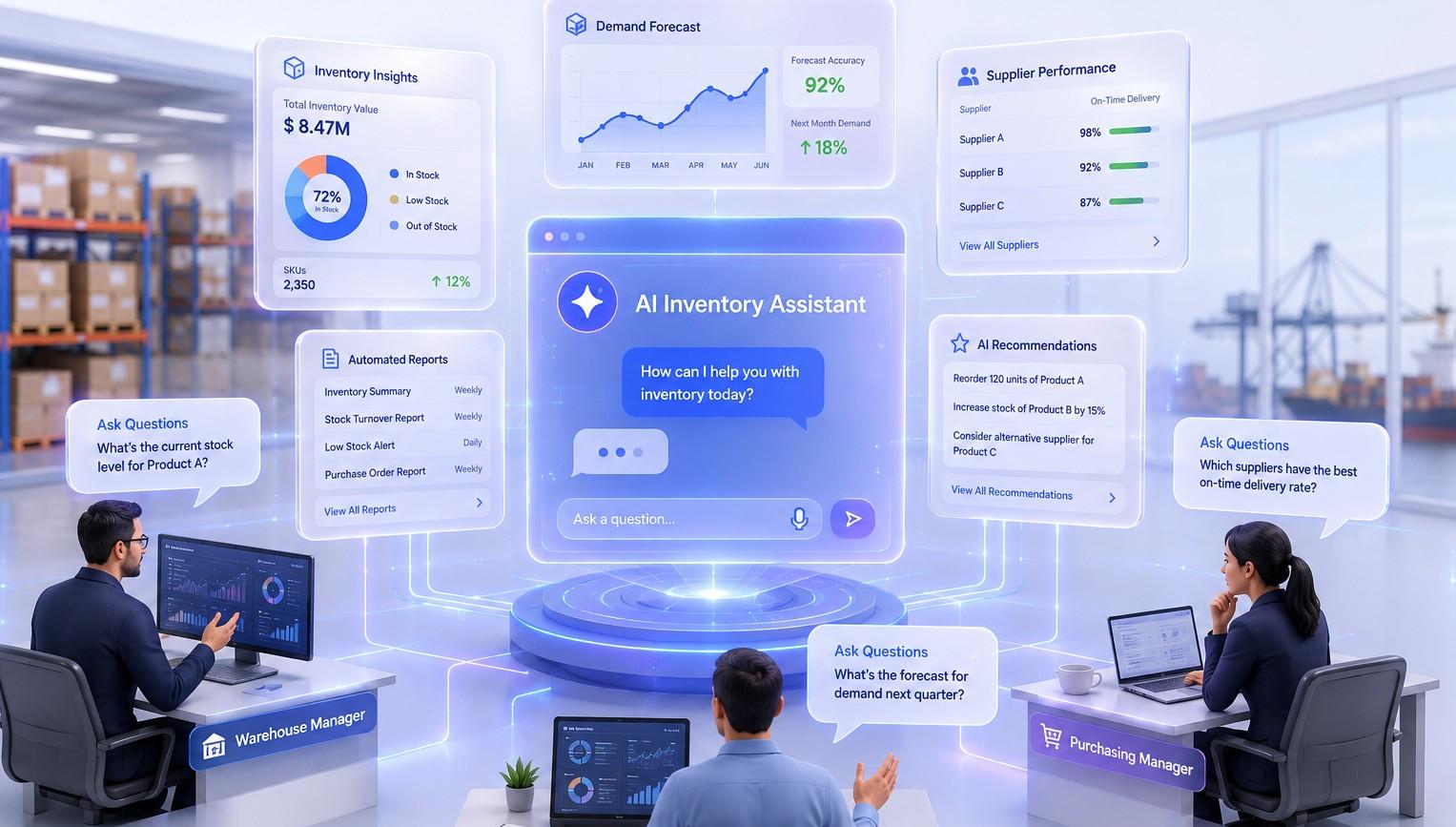
When most people talk about AI inventory management, they are typically describing machine learning: algorithms that analyze historical patterns to make predictions about future demand, flag errors, and automate restocking decisions.
Generative AI in inventory management is a different and newer capability that adds a distinct layer of value on top of what machine learning already provides.
Machine learning predicts and decides. Generative AI, which is powered by large language models, understands and generates human language. That distinction opens up capabilities in inventory management that machine learning alone cannot deliver. Here is what separates it from AI inventory management systems.
You can ask questions in plain language:
Instead of searching through reports or dashboards, users can simply ask questions like:
- Which products are likely to run out of stock next week?
- How much inventory do we have for our best-selling SKUs?
- Why did fulfillment performance drop last month?
Generative AI analyzes inventory data and provides clear, instant answers. This allows teams across purchasing, warehouse, and operations to access valuable insights without advanced technical skills.
According to the 2024 U.S. Chamber of Commerce AI and Small Business Report, 58% of small businesses already use generative AI in some capacity, making conversational AI one of the fastest-growing business applications.
You can generate inventory reports automatically:
Creating inventory reports often requires reviewing data and manually summarizing key findings. Generative AI automates this process by turning inventory data into easy-to-read reports. It can highlight inventory trends, supplier performance, demand changes, and potential risks, helping managers spend less time reporting and more time making decisions.
You can use AI as an inventory assistant:
Generative AI can act as a virtual inventory assistant that answers questions instantly. For example, a warehouse employee can ask about products currently in transit, while a purchasing manager can check which supplier has the most reliable delivery history.
Instead of searching multiple systems, users receive accurate answers through a simple conversation.
You can turn data into actionable recommendations:
Traditional AI provides forecasts and numbers. Generative AI explains what those numbers mean and recommends the next steps.
For example, instead of simply reporting higher-than-expected demand, it can explain that seasonal buying patterns are changing, recommend increasing reorder quantities, and identify suppliers that can meet the additional demand.
This makes AI insights easier to understand and act on, even for teams without data analysis expertise.
Today, generative AI works best alongside machine learning. It helps teams understand inventory data, create reports, and make better decisions, while machine learning handles forecasting and optimization. Fully automated inventory management is still developing.
What Is Agentic AI in Inventory Management?
All the AI capabilities covered so far, whether demand forecasting, error detection, or generative AI reporting, provide recommendations or insights that inventory managers review and then act on.
Agentic AI goes beyond all that, executing routine inventory decisions autonomously within boundaries the business defines, without waiting for human approval on each action. Gartner projects that 40% of enterprise applications will include task-specific AI agents by the end of 2026.
In inventory management, agentic AI allows systems to handle routine, low-risk decisions automatically while giving human teams more time to focus on complex decisions that require judgment and expertise.
How Agentic AI Works in Inventory Management
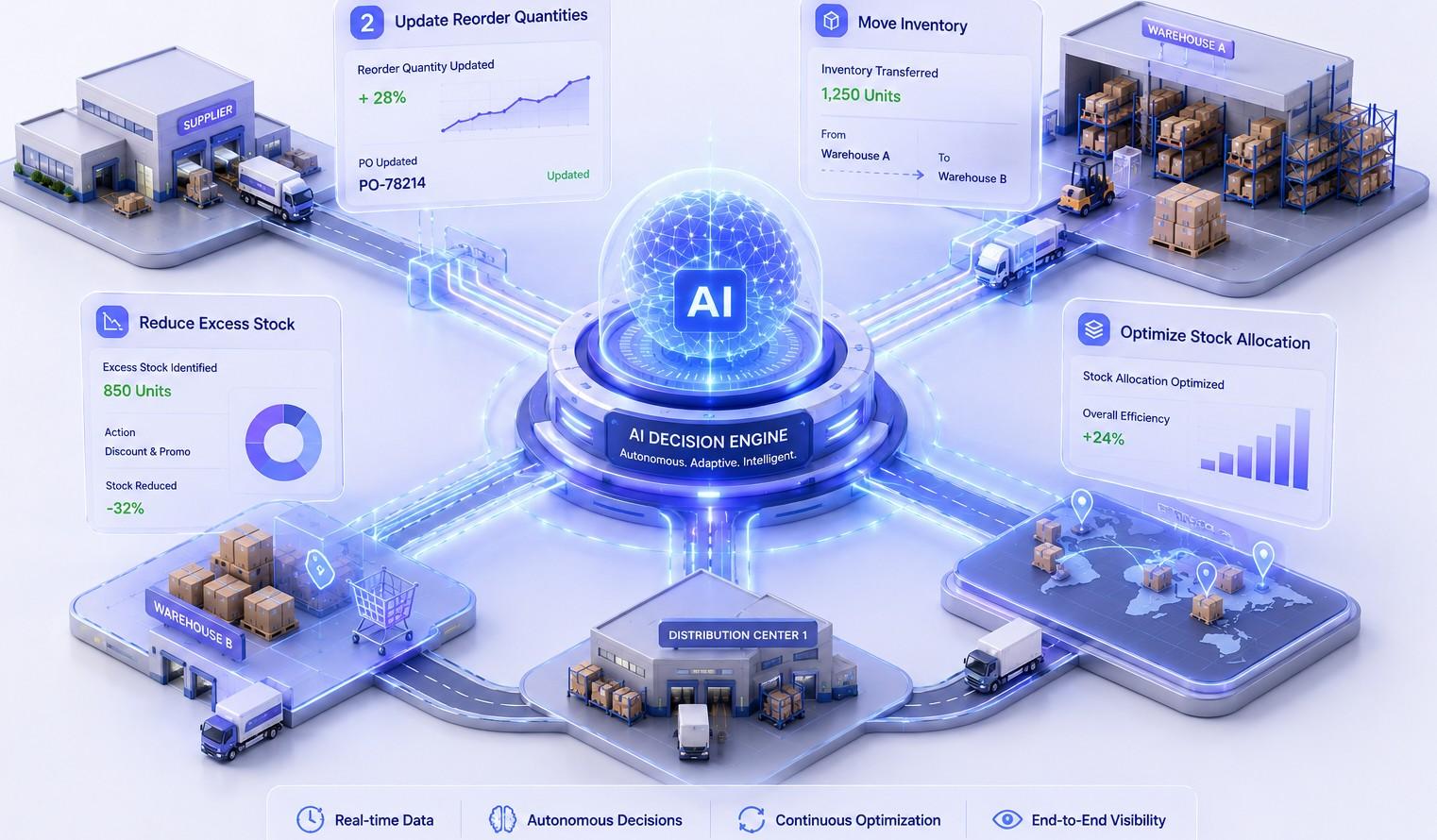
Agentic AI takes inventory automation a step further by allowing systems to not only analyze data but also take action based on predefined rules and real-time conditions. Instead of waiting for manual approvals, AI agents can identify inventory issues, recommend solutions, and complete routine tasks automatically.
Examples of agentic AI in inventory management include:
- Moves inventory automatically: If one location is running low and another has extra stock, AI can rebalance inventory to reduce shortages.
- Updates reorder quantities: AI adjusts purchase orders based on changing demand, supplier timelines, and current stock levels.
- Reduces excess Stock: AI identifies slow-selling products and recommends markdowns before inventory becomes difficult to sell.
- Improves stock allocation: AI directs incoming shipments to locations with the highest demand instead of relying on fixed allocation methods.
Agentic AI is still developing, but it represents the next step in inventory automation. Businesses are beginning with repetitive, low-risk decisions while keeping human oversight for strategic inventory planning.
What to Look for in AI Inventory Management Software
Choosing the right AI inventory management software requires looking beyond features and marketing claims. While many platforms now offer AI capabilities, their performance can vary significantly. The best solutions provide real operational value by improving forecasting, automating inventory decisions, and helping businesses manage stock more efficiently.
Real-Time Inventory Data Processing:
AI inventory management depends on accurate, up-to-date information. Software that relies on delayed batch updates may miss important changes in stock levels, sales activity, or customer demand.
So, it’s better to look for platforms that integrate with your sales channels, warehouses, and inventory systems through real-time data feeds to ensure AI recommendations are based on the latest information.
Accurate and Transparent Demand Forecasting:
Demand forecasting is one of the most important capabilities of AI inventory management software, but accuracy varies between platforms. Choose a platform that explains how forecasts are created, shows the data behind predictions, and improves over time using your actual sales history.
The best AI models learn from your products, sales channels, and customer demand patterns instead of relying only on generic industry data.
Automated Inventory Restocking Intelligence:
Automated restocking is more than simply reordering products when stock reaches a minimum level. The best AI inventory management platforms analyze demand patterns, supplier lead times, safety stock requirements, and inventory velocity to determine the right products, quantities, and timing for restocking.
Multichannel and Multi-Location Support:
For multichannel sellers across multiple channels and locations, AI inventory software should provide a unified view of all inventory. The platform should connect with ecommerce stores, marketplaces, warehouses, and fulfillment locations to keep stock data synchronized.
This prevents overselling, improves inventory accuracy, and ensures every decision is based on complete information.
Integration With Existing Systems:
Your AI inventory platform should connect with the tools you already use, from Shopify and marketplaces to ERP and warehouse inventory management systems. Strong integrations create a single source of inventory data, helping AI generate more accurate forecasts and recommendations.
Automated Inventory Problem Detection:
AI inventory software should do more than track stock levels. It should identify potential inventory issues before they affect operations. Look for platforms that detect unusual stock movements, inventory mismatches, and unexpected demand changes while providing clear explanations and recommended actions.
How to Implement AI Inventory Management Successfully
By now, you’ve seen what AI inventory management can do and what to look for when choosing the right software. The next step is making sure it’s implemented the right way. Even the best AI platform cannot deliver accurate forecasts or automate inventory effectively if your inventory data is incomplete or your systems aren’t connected.
That’s why successful implementation starts with building the right foundation before relying on AI to make inventory decisions. These six best practices will help you implement AI inventory management more effectively and avoid common mistakes along the way.
Audit Your Inventory Data:
Start by checking the quality of your inventory data. Make sure your stock information is accurate, complete, and consistent across every sales channel and inventory location.
AI can only make good decisions when it has reliable data. Therefore, cleaning up your inventory records before implementation helps improve forecasting, automation, and overall inventory accuracy.
Identify Your Biggest Inventory Challenge:
Don’t try to solve every inventory problem at once. Start with the challenge that has the biggest impact on your business, whether it’s stockouts, overstocking, inaccurate forecasts, or manual inventory management.
Focusing on one high-impact area makes implementation easier, delivers quicker results, and creates a strong foundation for future AI adoption.
Create a Single Source of Inventory Data:
For ecommerce and multichannel sellers, this means implementing real-time inventory sync across every platform before layering AI decision-making on top.
AI inventory management tools improve demand forecasting accuracy, but only when the inventory data they are analyzing reflects actual stock levels across all channels in real time.
Prioritize Integrations Over Features:
A long list of AI features doesn’t always mean better performance. What matters most is how well the software connects with the systems you already use.
Choose a platform with reliable integrations for your ecommerce stores, marketplaces, POS platforms, and warehouse systems. Better integrations provide better data, helping AI deliver more accurate forecasts and smarter inventory decisions.
Start Small and Expand Gradually:
You don’t need to implement AI across your entire inventory operation at once. Start with one or two high-impact use cases, such as demand forecasting or automated restocking, and measure the results before expanding.
A phased approach gives your team time to adapt while allowing the AI to learn from your inventory and sales data. As the system gathers more data, its forecasts and recommendations become more accurate.
Keep Humans Involved in Important Decisions:
AI can automate many inventory tasks, but human judgment is still important for major decisions. The best AI inventory systems combine automation with human review where it matters most.
Routine tasks like replenishing popular products can often be automated. However, decisions involving high-value inventory, new product launches, or major supplier changes should still include human oversight.
QuickSync: The Most Crucial Software for AI-Powered Inventory Management
As we already mentioned in the above sections, AI inventory management depends on one critical foundation: accurate and connected inventory data.
Even the most advanced AI tools can only make reliable predictions when they have access to real-time information about your actual stock levels. If inventory data is delayed, incomplete, or spread across multiple platforms, AI recommendations may not reflect what is really happening in your business.
This is where inventory sync becomes essential, and this is where QuickSync steps in.
QuickSync helps ecommerce sellers create a connected inventory system by keeping stock levels updated across multiple sales channels, including Shopify, Amazon, eBay, Etsy, WooCommerce, TikTok Shop, Square, and Clover.
Every sale, inventory adjustment, and stock update is automatically reflected across connected channels, helping businesses maintain accurate inventory records without relying on manual updates. So you should check out QuickSync before the 14-day free trial ends.
Final Words
The future of inventory management is predictive, connected, and increasingly automated. AI inventory management gives businesses the ability to move beyond reacting to stock problems and start making smarter decisions before those problems occur.
But AI only works as well as the data behind it. Accurate, real-time inventory data across every sales channel is the foundation that enables better forecasting, smarter replenishment, and more efficient operations.
For ecommerce sellers managing multiple platforms, building this connected inventory foundation is the first step toward unlocking the full value of AI.