If you’re planning to start selling online, one of the first questions you’ll face is choosing between eBay and Amazon. Both online marketplaces have millions of active buyers, but they work very differently when it comes to seller fees, competition, fulfillment, branding, and the types of products that perform best.
The best platform between Amazon and eBay isn’t simply the one with the most buyers; it’s the one that fits your products, budget, and long-term business goals.
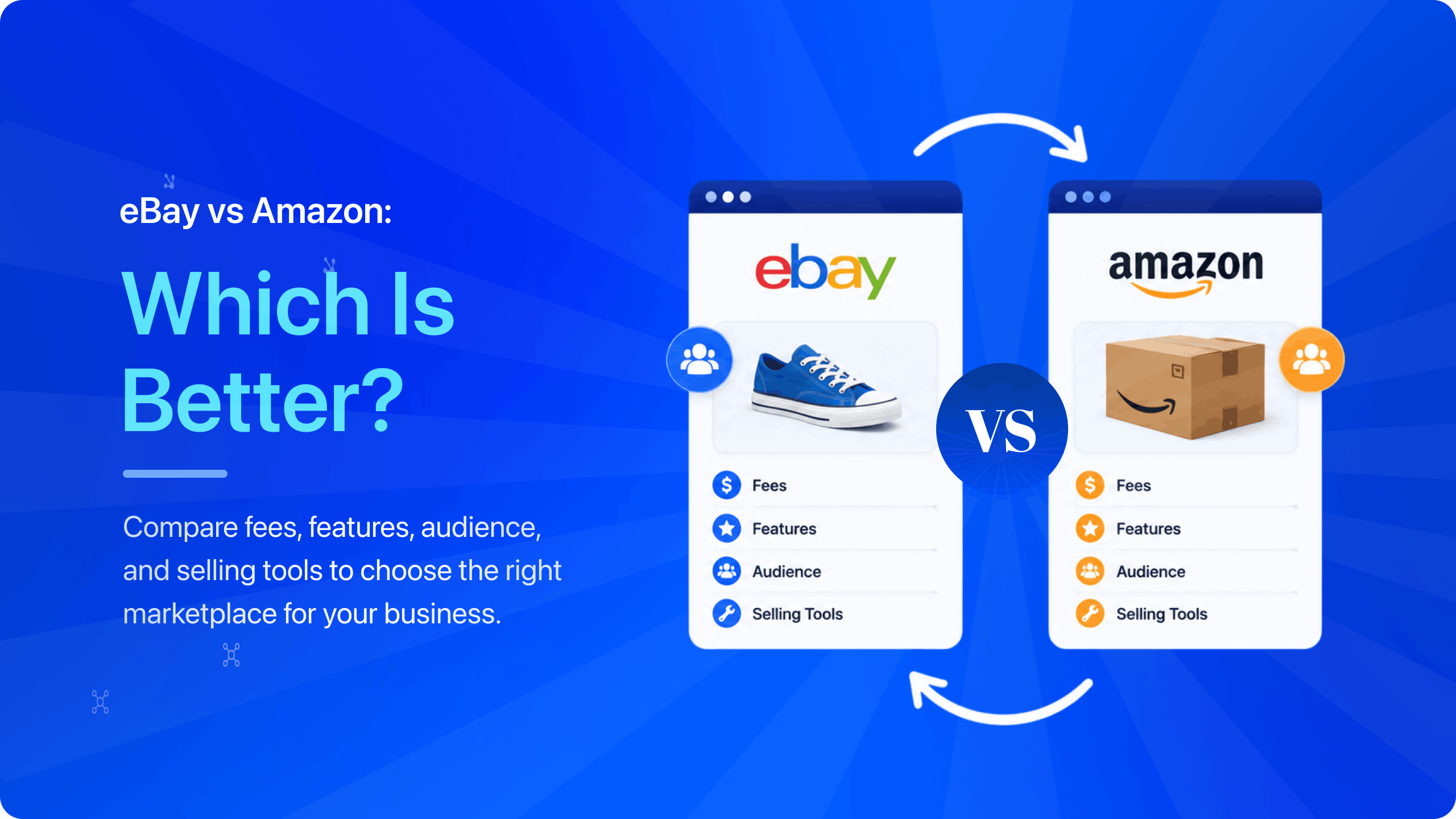
In this guide, we’ll compare eBay vs Amazon across pricing, selling fees, audience size, shipping, product categories, marketing tools, international selling, customer support, and profit potential. By the end, you’ll know which marketplace is the better fit for your business.
What Is the Difference Between eBay and Amazon?
Although both eBay and Amazon platforms let businesses sell products online, they follow completely different selling models.
eBay is a marketplace that gives individual sellers and businesses greater control over pricing, listings, and customer interactions. It is especially popular for used goods, collectibles, refurbished products, automotive parts, and unique items that aren’t easily available elsewhere.
Amazon is a retail-focused marketplace designed for fast, convenient shopping. Sellers compete on shared product listings, and customers expect quick shipping, competitive pricing, and consistent service. Businesses that use Fulfillment by Amazon (FBA) can outsource storage, packing, shipping, and customer service, making it easier to scale.
In simple terms:
- Choose eBay if you value flexibility, lower upfront costs, and niche selling opportunities.
- Choose Amazon if your goal is higher sales volume, automation, and long-term business growth.
What is eBay in Simple Words
eBay is an online marketplace that allows individuals and businesses to sell products directly to customers. Sellers can create their own listings, set prices, choose between auction or fixed-price formats, manage shipping, and build their own storefronts. The platform is especially popular for used goods, collectibles, refurbished electronics, automotive parts, vintage products, and other niche items.
eBay is strong for businesses that want greater flexibility over pricing, listings, branding, and customer interactions. If your business sells unique, second-hand, refurbished, or specialty products, eBay is often the stronger choice.
eBay: Our Assessment
Marketplace focus: eBay is built for sellers who want flexibility over product listings, pricing, shipping methods, and customer interactions.
Seller control: It gives merchants greater control over branding, storefront customization, return policies, and listing optimization.
Product strength: eBay performs well for used goods, collectibles, refurbished electronics, automotive parts, vintage products, and niche categories.
Selling flexibility: Sellers can choose between auction-style listings and fixed-price listings depending on their selling strategy.
Best fit: eBay is a stronger choice for small businesses, resellers, collectors, and merchants looking for lower upfront costs with greater selling flexibility.
What is Amazon in Simple Words
Amazon is an ecommerce marketplace that helps businesses sell products to millions of customers worldwide. Sellers can list products, process payments, manage orders, advertise products, and use Fulfillment by Amazon (FBA) to outsource storage, packing, shipping, customer service, and returns.
Amazon is strong for businesses that want to sell new and branded products at scale. If your business depends on high sales volume, fast fulfillment, automation, and long-term ecommerce growth, Amazon is usually the stronger choice.
Amazon: Our Assessment
Marketplace focus: Amazon is built for businesses that want to sell branded and high-demand products through one of the world’s largest ecommerce marketplaces.
Customer reach: It provides access to hundreds of millions of customer accounts with strong buying intent and high consumer trust.
Fulfillment strength: Amazon FBA helps merchants automate storage, packing, shipping, returns, and customer service.
Growth potential: Amazon supports business growth through advertising, Brand Registry, Prime eligibility, and international selling programs.
Best fit: Amazon is a stronger choice for brands, wholesalers, private-label sellers, and businesses focused on scaling ecommerce operations.
12 Key Factors We Assessed in This eBay vs Amazon Comparison
Every factor in this comparison was reviewed across both marketplaces to understand where eBay performs better, where Amazon performs better, and which platform fits different business models.
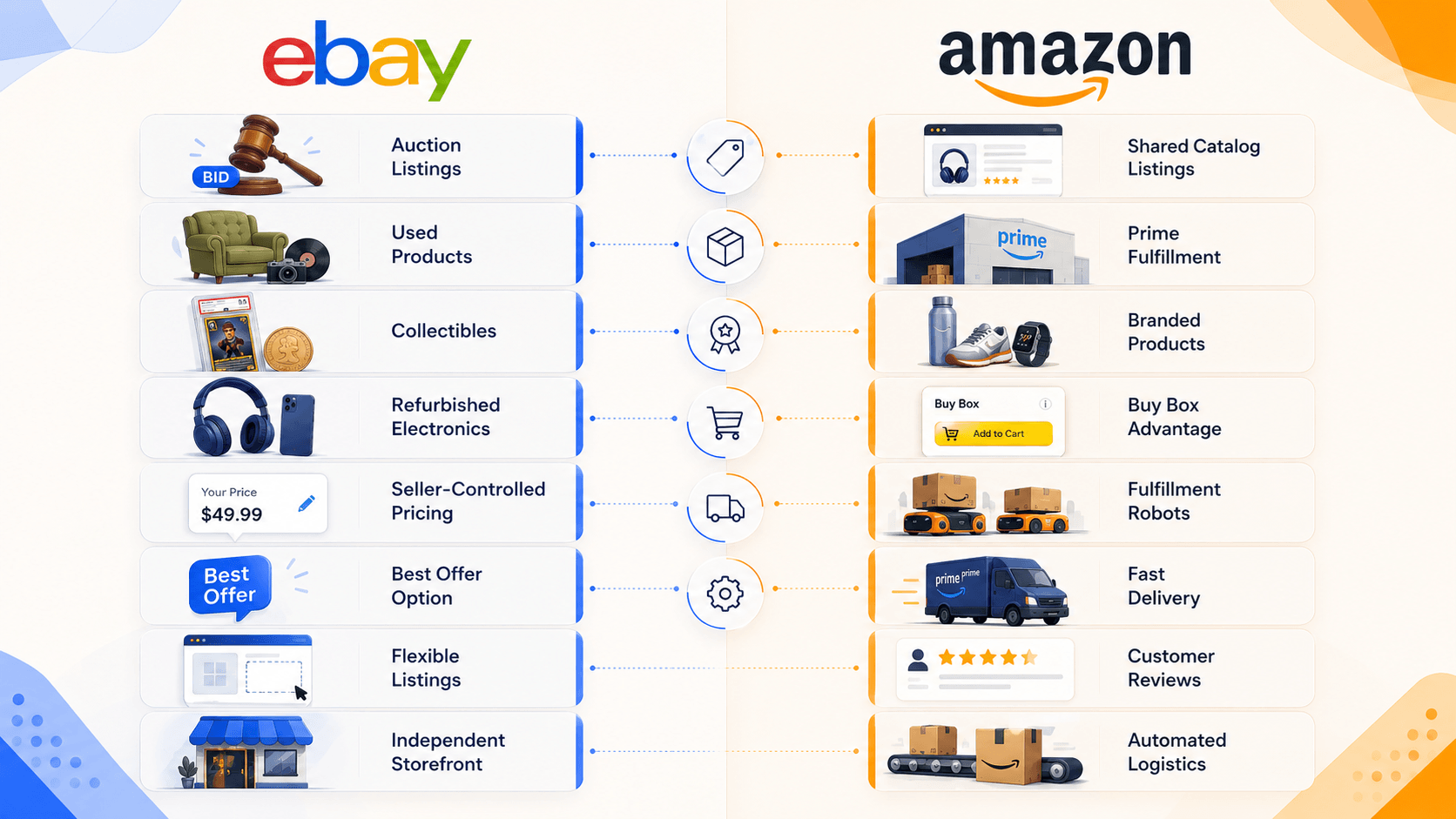
Let’s go through each factor one by one and see where eBay performs better, where Amazon has the advantage, and which marketplace is the better fit for different types of businesses.
1. eBay vs Amazon Selling Fees
When comparing Amazon vs eBay fees, selling costs are one of the biggest factors because they directly affect your profit margins. While both platforms charge sellers, they use different pricing models. eBay focuses on lower upfront costs and flexible selling. Whereas Amazon charges higher fees but offers additional services that can help businesses grow faster.
Every online seller should compare fees before choosing a marketplace.
eBay Seller Fees
eBay is a good option for sellers who want to start with a smaller budget or test new products before expanding. Most fees are charged only after an item sells, so you don’t need to invest heavily upfront. This makes eBay a practical choice for individuals, resellers, and small businesses looking for a cost-effective way to enter ecommerce.
eBay charges up to 250 free listings each month for most sellers. The eBay final value fees usually range between 2.5% and 15%, depending on the category. eBay optional store subscriptions offer additional tools and lower fees in some categories. Extra charges apply only if you choose features like Promoted Listings or listing upgrades.
Amazon Seller Fees
Amazon’s selling costs are higher, but they also include features that make it easier to manage a growing business. Sellers pay referral fees on each order and can choose between an Individual or Professional selling plan. Businesses using Fulfillment by Amazon (FBA) also pay storage and fulfillment fees, but in return they gain access to Prime shipping and Amazon’s trusted logistics network.
Amazon offers an Individual plan that charges $0.99 for each product you sell. Amazon’s Professional plan costs $39.99 per month and includes additional selling tools. Amazon applies referral fees to every order, and the amount depends on the product category. If you use Amazon FBA, you’ll also pay storage, fulfillment, and return processing fees.
Our Verdict:
If you’re comparing Amazon vs eBay selling fees, eBay is usually cheaper to start, while Amazon may provide better long-term value for growing businesses. If your goal is to scale faster and reach a much larger customer base, Amazon can provide better long-term value, even though the overall selling costs are higher.
2. eBay vs Amazon Buyer Audience & Purchase Intent
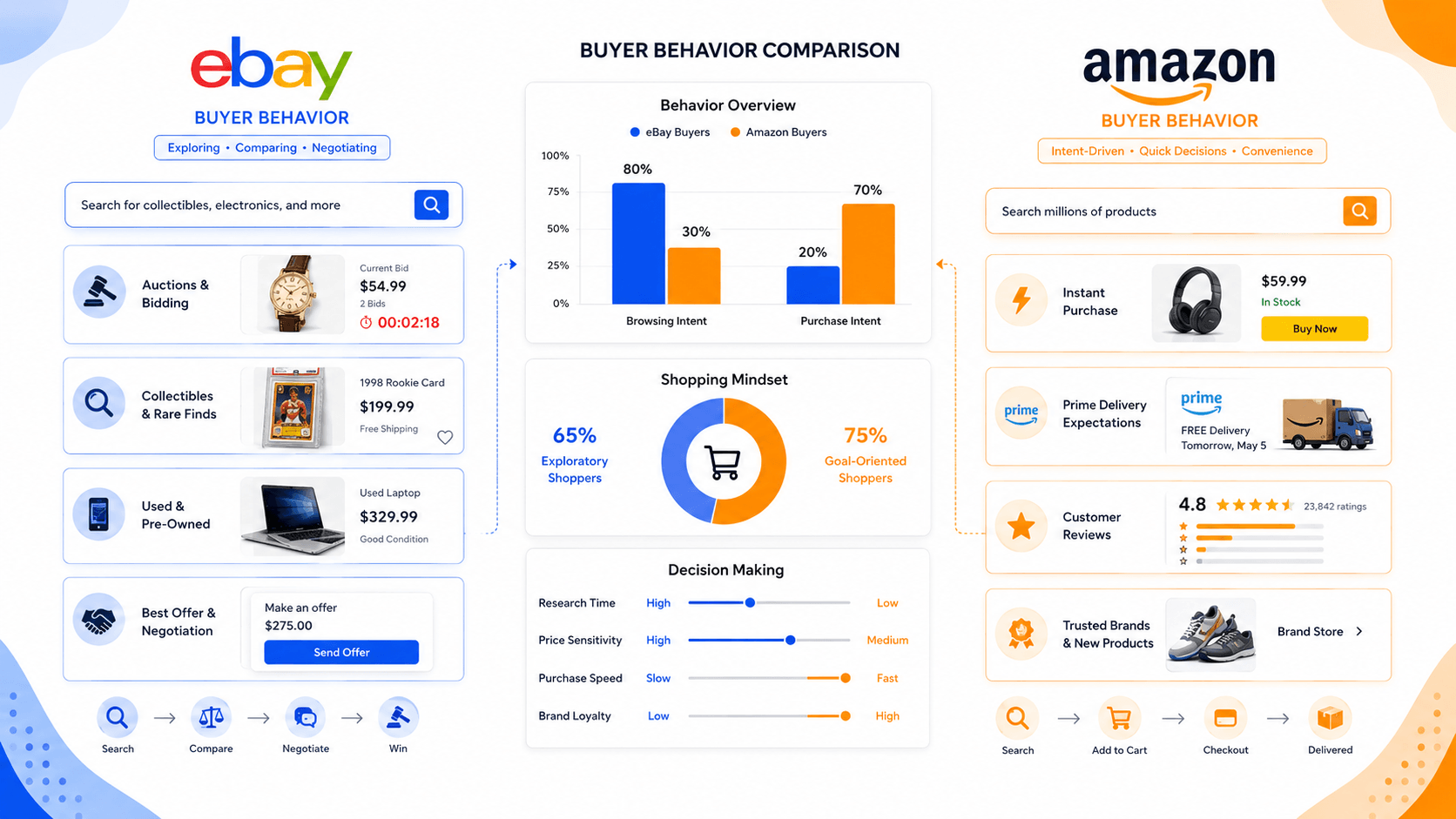
The number of buyers on a marketplace is important, but understanding how they shop is even more valuable. When comparing eBay vs Amazon, you’ll notice that both platforms attract millions of customers, but their buying habits are completely different.
eBay Buyers
eBay attracts buyers who enjoy comparing prices, bidding on auctions, and finding products that may not be available elsewhere. Many shoppers visit the platform looking for used, refurbished, vintage, or collectible items, making it an excellent marketplace for niche sellers.
There are around 134 million active eBay buyers worldwide. eBay supports both auction and fixed-price listings. eBay lets buyers negotiate prices through the Best Offer feature. It is popular among bargain hunters and hobby collectors. eBay attracts buyers searching for discontinued and rare products.
Amazon Buyers
Amazon shoppers usually know exactly what they want before they start browsing. They expect fast delivery, trusted reviews, and a simple checkout process. With more than 310 million customer accounts worldwide, Amazon offers sellers access to one of the largest online shopping audiences.
Over 310 million customer accounts globally. Amazon has more than 200 million Prime members. Buyers have high trust because of Prime delivery and customer reviews. Amazon reviews strongly influence purchasing decisions.
Our Verdict
If you sell products that people purchase regularly, Amazon gives you access to a much larger audience with stronger buying intent. If your business focuses on vintage items, refurbished products, collectibles, or niche categories, eBay connects you with buyers who are actively searching for those products.
3. eBay vs Amazon Product Categories
The products you sell play a major role in deciding whether eBay or Amazon is the right marketplace. While both platforms support thousands of categories, each has built a different reputation over the years. Some products consistently perform better on eBay, while others generate higher sales on Amazon.
Selling on eBay
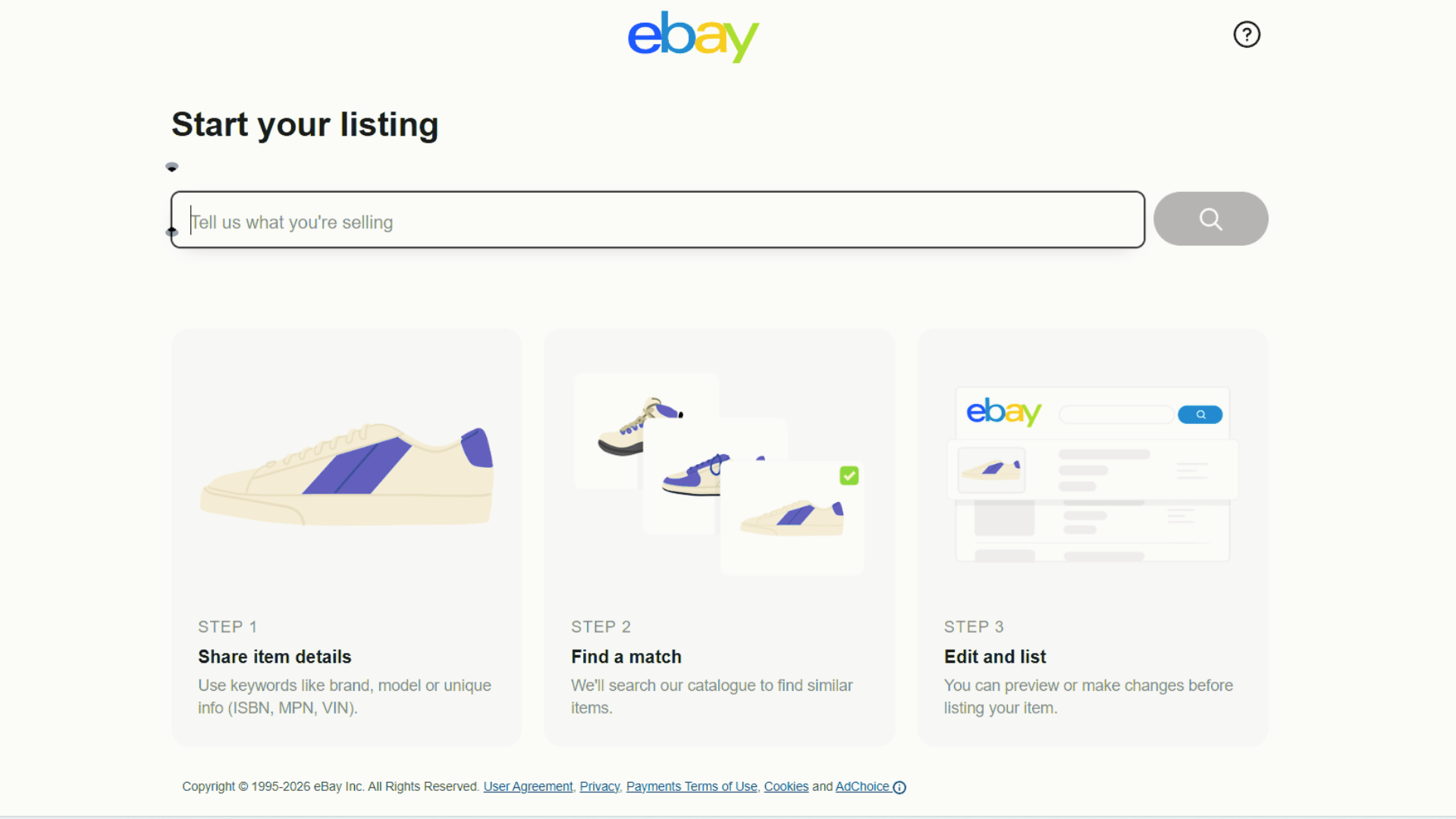
eBay is known for its diverse marketplace where sellers can list both new and used products. It has built a loyal customer base for niche categories that aren’t always easy to find elsewhere. eBay has strong demand for refurbished electronics. eBay performs well for automotive parts and accessories. It attracts buyers looking for vintage fashion.
Popular categories on eBay includes collectibles and antiques, used and refurbished electronics, automotive parts and accessories, vintage clothing, trading cards and memorabilia, musical instruments and luxury watches.
Selling on Amazon
Amazon is built around brand-new products and high-volume consumer demand. Categories with consistent daily purchases generally perform best because buyers trust Amazon’s fast delivery and return process. Amazon is one of the largest marketplaces for electronics and kitchen products. Amazon has strong demand for Beauty and Personal Care items.
Popular categories on Amazon include electronics, home and kitchen, beauty and Personal Care, health and wellness, toys and games, books, pet supplies, and grocery.
Our Verdict
If your business sells used, vintage, refurbished, or collectible products, eBay is usually the better marketplace. If you sell new branded products that customers buy regularly, Amazon offers greater visibility and a much larger customer base.
4. eBay vs Amazon Product Restrictions
Although both platforms have rules about what can be sold and cannot, Amazon has stricter selling requirements than eBay. Before choosing between eBay vs Amazon marketplace, it’s important to understand whether your products require approval or additional documentation.
Selling on eBay
eBay gives sellers more freedom to list products across different categories. Most products can be listed without going through lengthy approval processes. This makes it a popular choice for individuals, resellers, and small businesses.
eBay has fewer restricted product categories than Amazon. It allows most used and refurbished products. eBay sellers require fewer category approvals for new sellers. This makes it easier to test new product ideas.
Selling on Amazon
Amazon applies stricter policies to maintain product quality and protect customers. Many categories require sellers to obtain approval before listing products, especially if they involve well-known brands or regulated goods.
Some commonly restricted categories include:
Amazon requires approval for many Beauty products. It places restrictions on Grocery and Supplements. Amazon Marketplace also has stricter rules for Fine Jewelry. This platform limits access to some Luxury Brands. Amazon requires approval for certain Medical Devices and Electronics.
Our Verdict
If you want more flexibility and fewer approval requirements, eBay is the easier marketplace to start with. If you meet Amazon’s requirements and sell new branded products, the additional effort can be worthwhile because of the platform’s larger customer base and stronger buying intent.
5. eBay vs Amazon Payment Processing
Getting paid on time is important for every seller. Both eBay and Amazon handle payments directly through their platforms, but the payout process is different. Understanding how each marketplace processes payments can help you manage your cash flow more effectively.
eBay Managed Payments
eBay uses its own payment system called Managed Payments, allowing buyers to pay using credit cards, debit cards, PayPal, Apple Pay, Google Pay, and other popular payment methods. Once an order is completed, eBay deducts selling fees before transferring the remaining balance directly to the seller’s linked bank account.
Payouts are usually sent within 1–3 business days by eBay. It automatically deducts selling fees before payouts. eBay lets sellers track payments through Seller Hub. eBay doesn’t require a separate PayPal business account.
Amazon Payments
Amazon collects payments from buyers and releases payouts to sellers on a scheduled basis. Depending on your account and selling history, payments are generally transferred every 14 days, after deducting referral fees, FBA charges, refunds, and other applicable costs.
Amazon provides payment reports through Seller Central. It securely processes all customer payments. Amazon payments work seamlessly with FBA orders.
Our Verdict
If receiving payments quickly is important for your business, eBay offers faster payouts and greater flexibility. However, if you’re focused on building a larger ecommerce business, Amazon’s payment system is reliable and integrates smoothly with its entire selling ecosystem, making it easier to manage high sales volumes.
6. eBay vs Amazon Customer Support
Good customer support can save valuable time when dealing with account issues, payments, product listings, or order disputes. Both marketplaces provide seller support, but the level of assistance and response times can vary.
eBay Customer Support

eBay offers support through Seller Hub, help articles, community forums, and customer service representatives. Most common questions can be resolved through self-service resources, while live support is available for more complex issues.
It provides detailed Help Center articles. eBay customer support includes community discussion forums. It offers live chat and callback support and assists with listings, payments, and disputes.
Amazon Customer Support
Amazon provides dedicated support through Seller Central, with access to help documentation, case management, and customer support representatives. Professional sellers generally receive quicker assistance for account and operational issues.
Amazon provides 24/7 support through Seller Central. Amazon offers a case management system. It offers help for FBA, listings, payments, and account health. It has better support for high-volume sellers.
Our Verdict
Both platforms offer good seller support, but Amazon provides a more comprehensive support system, especially for businesses using FBA or managing large product catalogs. eBay offers dependable support, but much of it relies on self-service resources.
7. eBay vs Amazon: Fulfillment Methods
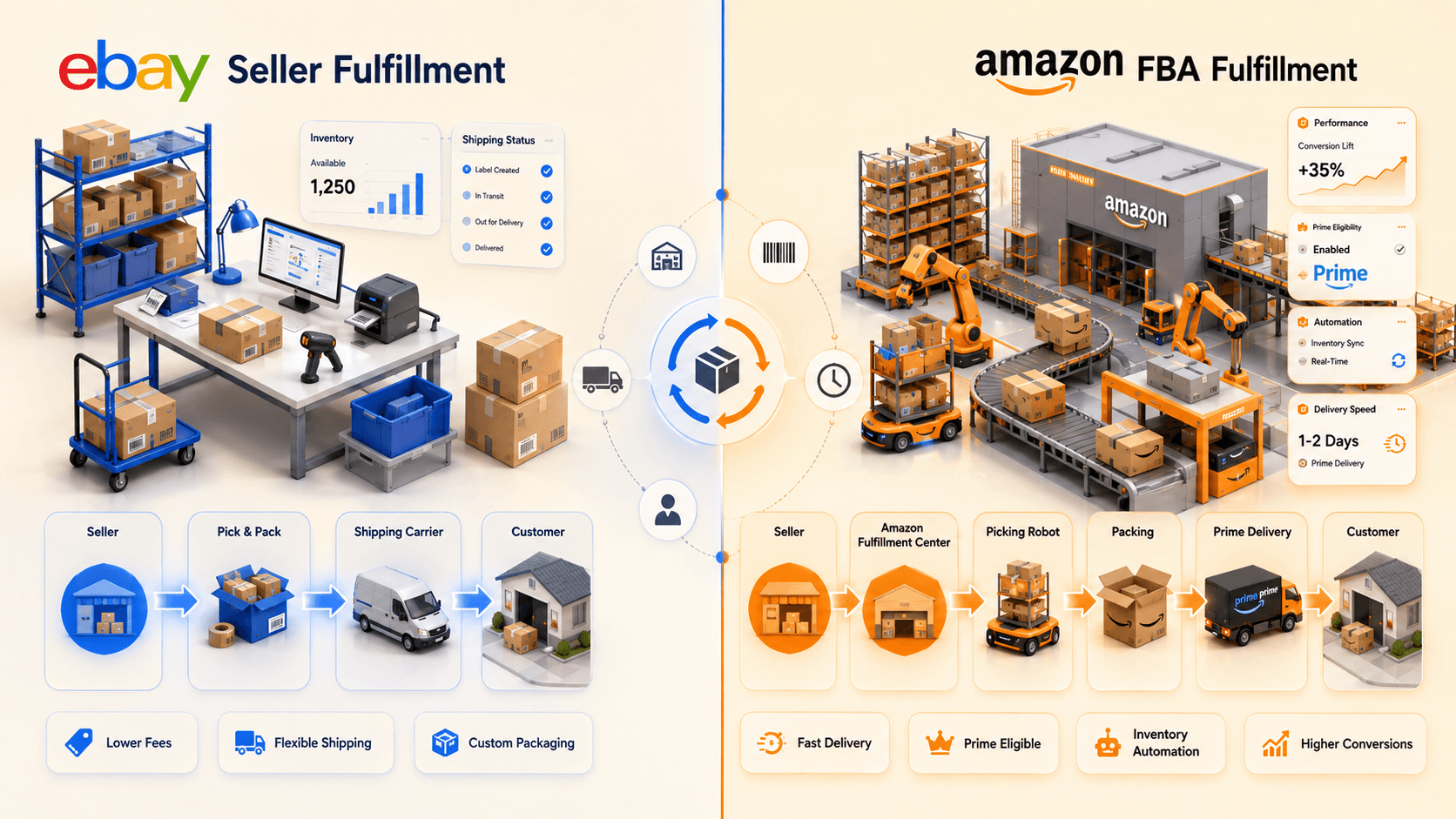
How you fulfill orders affects delivery speed, customer satisfaction, and the amount of time you spend managing your business. Both eBay and Amazon let you ship products to customers, but they take very different approaches. The fulfillment method you choose also impacts order management, shipping efficiency, and overall business operations.
eBay Fulfillment
eBay lets sellers manage their own fulfillment process, giving them the flexibility to choose shipping carriers, packaging, and delivery methods. This works well for businesses that want to control shipping costs or sell products that need special handling.
eBay supports third-party logistics (3PL) providers. It gives sellers complete control over shipping rates. It even lets businesses choose their preferred shipping carriers.
Amazon Fulfillment
Amazon offers Fulfillment by Amazon (FBA), where sellers send inventory to Amazon warehouses and the platform manages the rest. This saves time and helps businesses offer faster delivery without managing shipping themselves.
Amazon FBA stores inventory in Amazon warehouses. Amazon handles packing, shipping, and customer returns. Amazon Prime gives eligible products faster delivery. It provides nationwide fulfillment through its logistics network.
Our Verdict
If you want full control over shipping and fulfillment, eBay is the better option. If you’d rather automate fulfillment and offer Prime delivery, Amazon FBA makes managing orders much easier.
8. eBay vs Amazon: Returns & Refund Policies
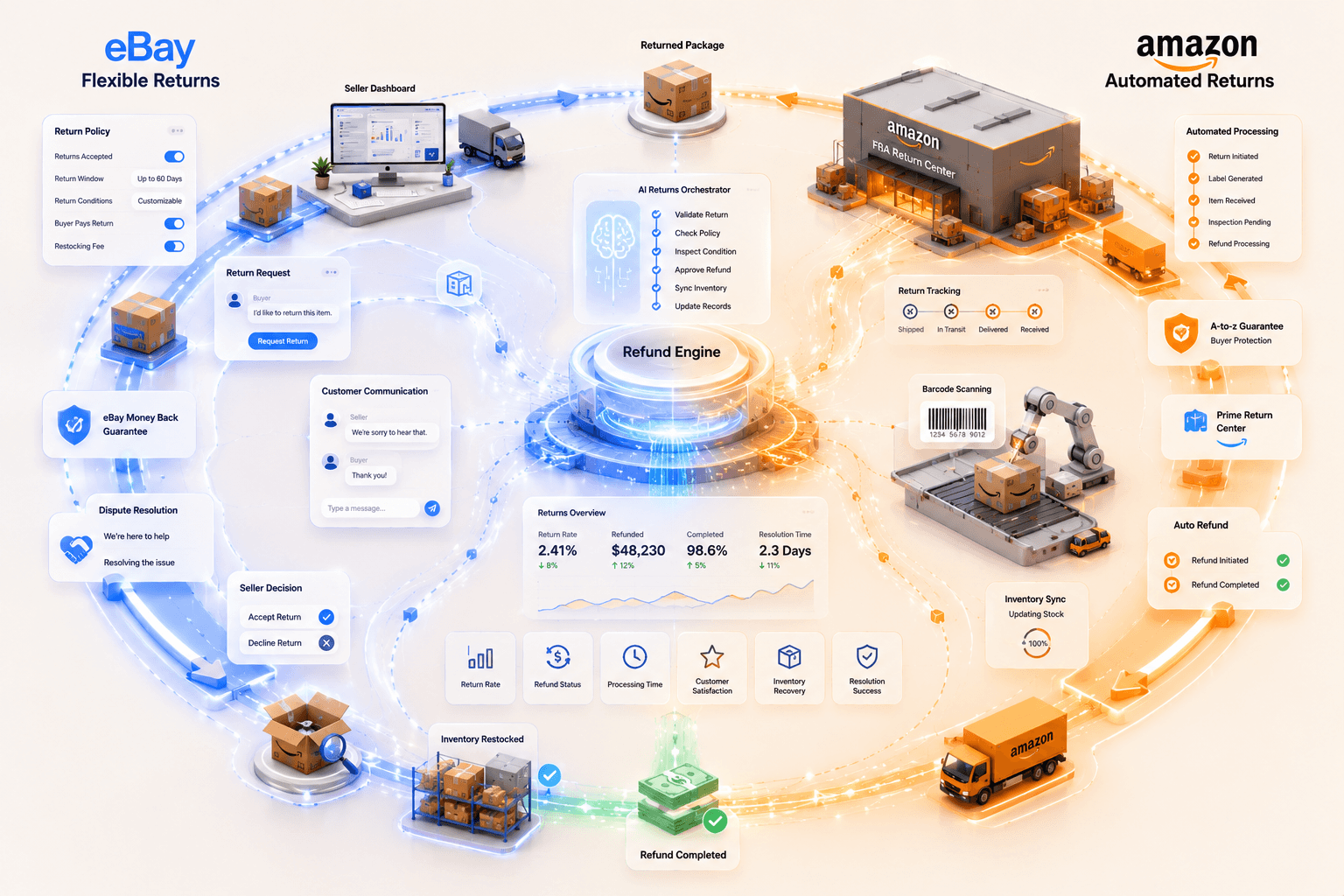
Returns are part of selling online, so having a clear return process is important for both sellers and customers. eBay and Amazon both support returns and refunds, but their policies give sellers different levels of flexibility.
eBay Returns & Refunds
eBay allows sellers to decide whether they accept returns and choose the return period for many products. This flexibility makes it easier to create return policies that suit different business models.
eBay lets sellers create their own return policies. It supports return windows up to 60 days. It offers a Money Back Guarantee for eligible purchases. eBay protects sellers through dispute resolution. It gives more flexibility for return conditions.
Amazon Returns & Refunds
Amazon follows a more consistent return policy to provide buyers with a reliable shopping experience. Sellers using FBA also benefit from Amazon handling much of the return process. Amazon manages returns automatically for FBA orders.
It offers easy returns on most eligible products. It protects buyers through the A-to-z Guarantee. Amazon processes refunds directly through the platform. Amazon requires sellers to follow marketplace return policies.
Our Verdict
If you want more control over your return policies, eBay gives you greater flexibility. If you prefer a standardized process with less manual work, Amazon simplifies returns through its marketplace and FBA services.
9. eBay vs Amazon: Ease of Use
Getting started on a new marketplace should be simple, especially for first-time sellers. While both eBay and Amazon provide the tools needed to run an online business, the overall experience is quite different. From creating product listings to inventory management, the platform you choose can save time or create extra work as your business grows.
Selling on eBay
eBay is generally easier to learn because eBay seller can create their own listings and have fewer approval requirements. The eBay seller dashboard is easy, making it a good choice for beginners and small businesses. Setting up an eBay store is quite easy for beginner sellers.
eBay makes it easy to create product listings. eBay requires fewer approvals for most categories. It offers a simple Seller Hub dashboard. eBay is beginner-friendly for first-time sellers.
Selling on Amazon
Amazon offers more features, but it also requires sellers to understand product catalogs, account health, and category requirements. It takes longer to learn, but the extra tools help businesses manage larger operations.
Amazon uses Seller Central to manage store operations. Amazon requires matching existing product listings. It tracks account health and seller performance. It provides detailed business reports and analytics.
Our Verdict
If you’re deciding between Amazon or eBay for beginners, eBay is usually the easier platform to start with because of its simple setup and flexible listing process. If you’re planning to build a larger business and don’t mind learning, Amazon offers more tools as your business grows.
10. eBay vs Amazon International Selling
Expanding into international markets can help you reach more customers and grow your business faster. Both eBay and Amazon allow sellers to sell globally, but the process is very different. Amazon provides a more structured system for international expansion. While eBay gives sellers greater flexibility over shipping and pricing.
Selling Internationally on eBay
eBay allows sellers to list products for buyers across multiple countries through its global marketplace. Sellers have full control over shipping methods, pricing, and international delivery options. This makes it a good choice for businesses that prefer managing their own logistics.
eBay connects sellers with buyers in over 190 markets. Sellers can choose their own international shipping partners. Sellers can set custom shipping rates and delivery times.
Selling Internationally on Amazon
Amazon simplifies global selling through regional marketplaces like Amazon US, UK, Canada, Germany, Australia, and Japan. Sellers can also use Amazon Global Selling and FBA to handle storage, shipping, and customer service in many countries.
Amazon FBA handles fulfillment in many countries. Amazon offers local customer support in supported regions. Amazon speeds up international delivery with FBA.
Our Verdict
If you want complete control over international shipping and pricing, eBay is the better choice. If your goal is to expand into multiple countries with less manual work, Amazon makes international selling much easier through its global marketplace and FBA network.
11. eBay vs Amazon Competition With Other Sellers
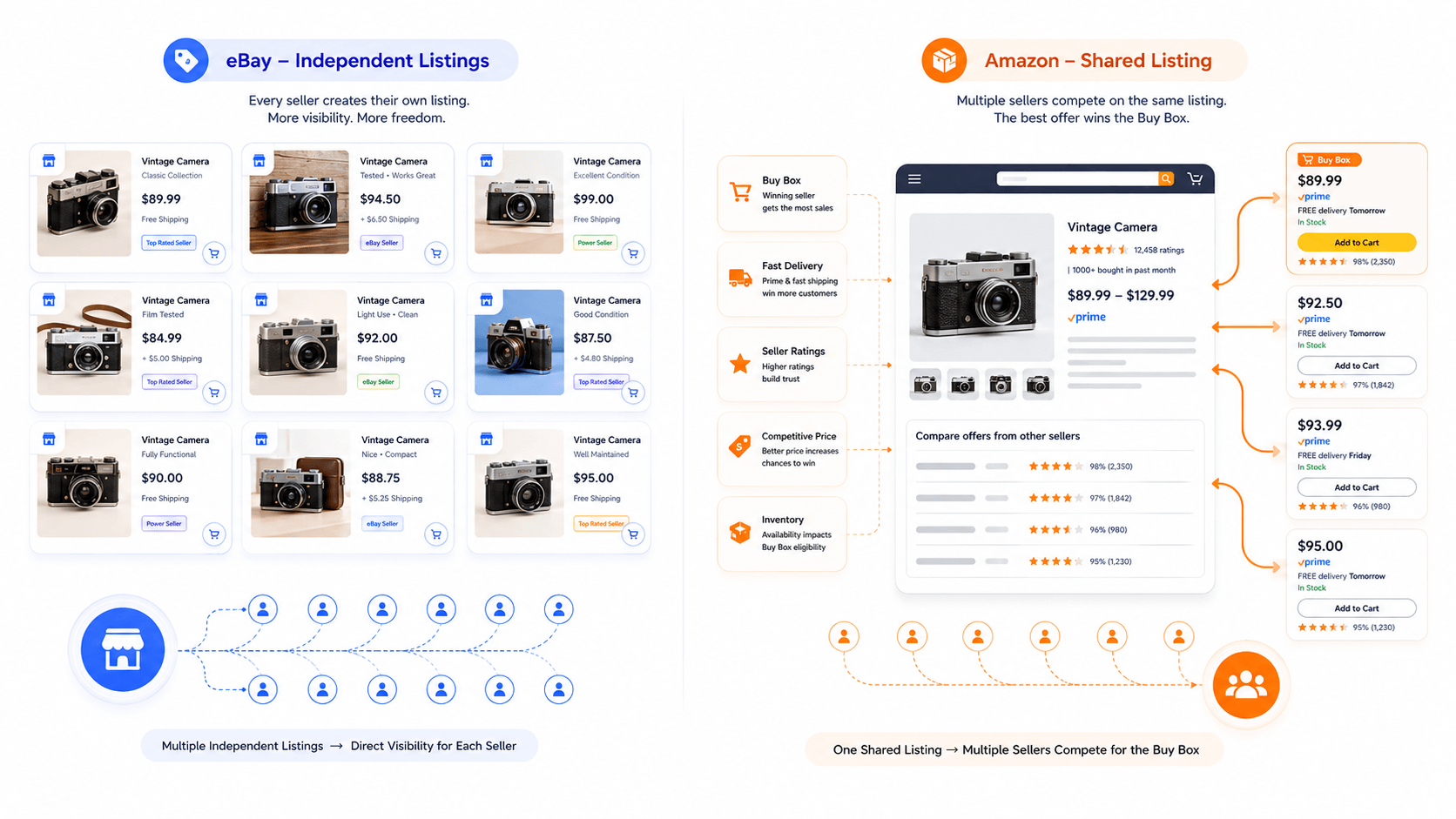
Competition affects how easily your products are discovered and how quickly you can generate sales. While both marketplaces are competitive, they compete in different ways. Understanding this difference can help you decide where your products have a better chance of standing out.
Selling on eBay
Competition on eBay is generally lower because sellers create their own listings instead of competing on a shared product page. This gives businesses more freedom to write unique titles, optimize descriptions, and build attractive listings that stand out in search results.
eBay allows sellers to create individual product listings. eBay supports both auction and fixed-price selling. It gives sellers greater pricing flexibility.
Selling on Amazon
Amazon is far more competitive, especially in popular product categories. Multiple sellers often share the same product listing, making price, seller ratings, delivery speed, and the Buy Box major factors in winning sales.
Amazon uses a shared product catalog for most listings. Amazon’s Buy Box drives a large share of sales. Amazon sellers face strong competition in popular categories. Customer reviews play a major role in buyers’ decisions.
Our Verdict
If you’re entering a competitive market for the first time, eBay gives you more opportunities to stand out through unique listings and flexible pricing. If you can compete on pricing and service, Amazon provides greater opportunities despite the higher competition.
12. eBay vs Amazon Branding & Customer Relationships
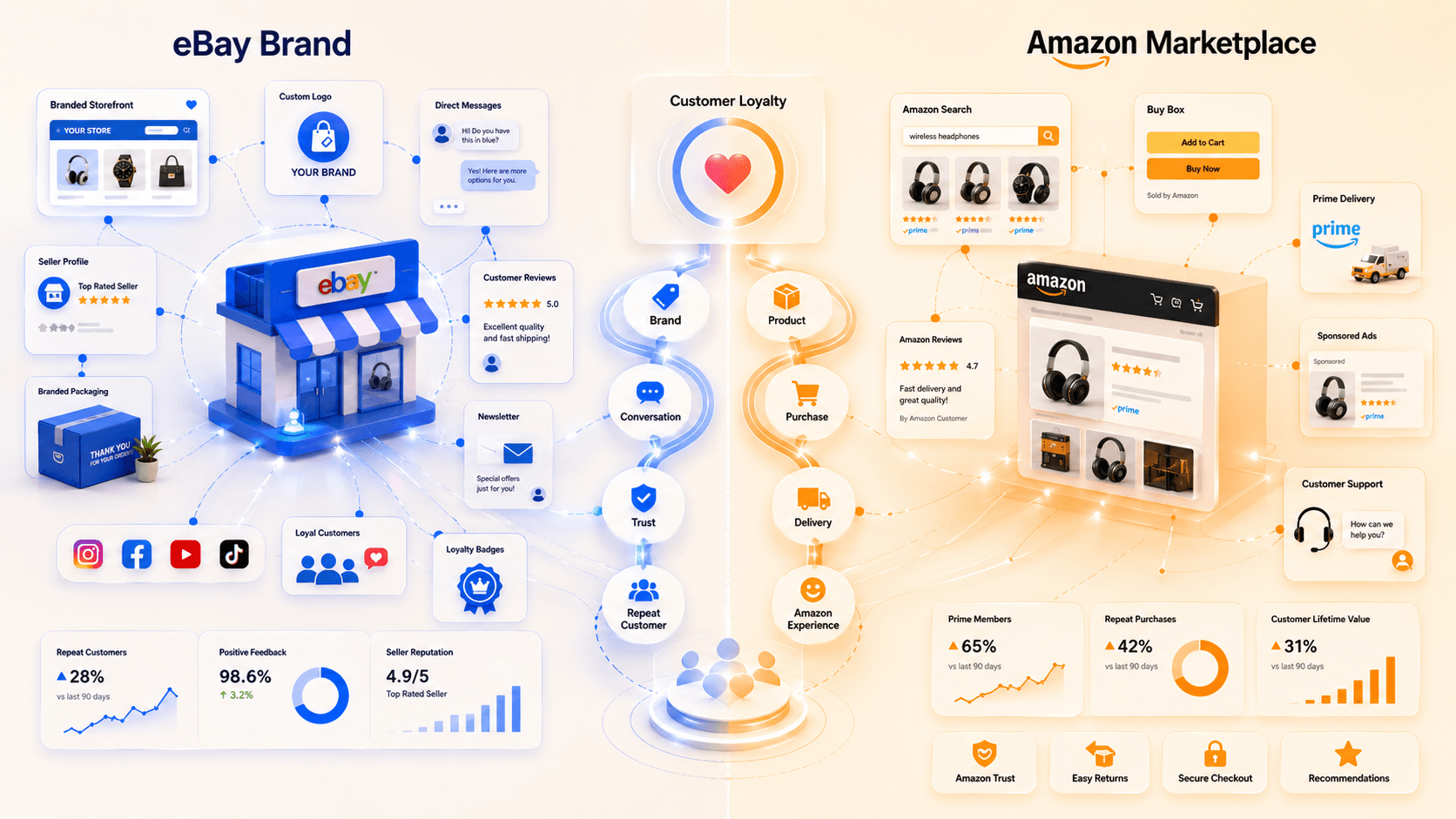
Building a successful business isn’t just about making sales; it’s also about creating a brand that customers remember. When comparing eBay vs Amazon, the biggest difference is how much control sellers have over branding and customer relationships.
Branding on eBay
eBay gives sellers more freedom to create a recognizable brand. You can customize your store, design listings, include branded packaging, and build stronger relationships with repeat customers. That control also includes the ability to block eBay buyers who repeatedly cause problems or violate your store policies.
eBay supports branded product descriptions and images. It even gives sellers more control over customer interactions. It’s easier to create a unique shopping experience on eBay marketplace.
- eBay allows customized shipping and return policies.
Branding on Amazon
Amazon customers usually trust the Amazon brand first, which means individual sellers receive less brand name recognition. Businesses enrolled in Amazon Brand Registry gain access to additional branding tools, but customer communication and marketing remain more restricted than on eBay.
Amazon offers Brand Registry for eligible businesses. It supports professional Brand Store pages. Amazon provides Sponsored Brands advertising. It limits direct communication with customers.
Our Verdict
If building your own brand and customer loyalty is your priority, eBay gives you greater control. If your goal is reaching a larger audience, then benefiting from Amazon’s trusted reputation is a good option for you.
eBay vs Amazon at a Glance
Choosing the right online selling platform between eBay and Amazon can make a significant difference in your business success. Go through the table below to look at the core differences between Amazon and eBay before diving into details.
| Feature | eBay | Amazon |
|---|---|---|
| Best For | Used, vintage, collectibles | New and branded products |
| Active Buyers | 134+ million | 310+ million |
| Selling Fees | Lower upfront costs | Higher overall fees |
| Fulfillment | Self-fulfilled or third-party | Fulfillment by Amazon (FBA) |
| Competition | Moderate | High |
| Brand Building | Better seller branding | Amazon brand comes first |
| Product Approval | Minimal restrictions | Many gated categories |
| International Selling | More manual | Easier through Amazon Global Selling |
| Customer Trust | High | Very High |
| Best Choice | Small businesses & niche sellers | Growing brands & high-volume sellers |
Why Choose One When You Can Sell on Both?
You don’t always have to choose between Amazon and eBay. Many successful businesses sell on both marketplaces because each platform attracts different types of buyers. Amazon helps businesses reach customers looking for branded products, fast delivery, and convenience, while eBay attracts shoppers searching for unique products, collectibles, refurbished items, and competitive pricing.
Selling on both marketplaces allows businesses to reach more customers, increase sales opportunities, and reduce the risk of depending on a single platform. Instead of limiting your business to one marketplace, you can benefit from the strengths of both.
QuickSync connects Amazon and eBay, automatically syncing products, inventory, and orders between both marketplaces. This allows merchants to manage both stores without manually updating listings or inventory after every sale.
Amazon vs eBay: Which Is Better for Different Types of Sellers?
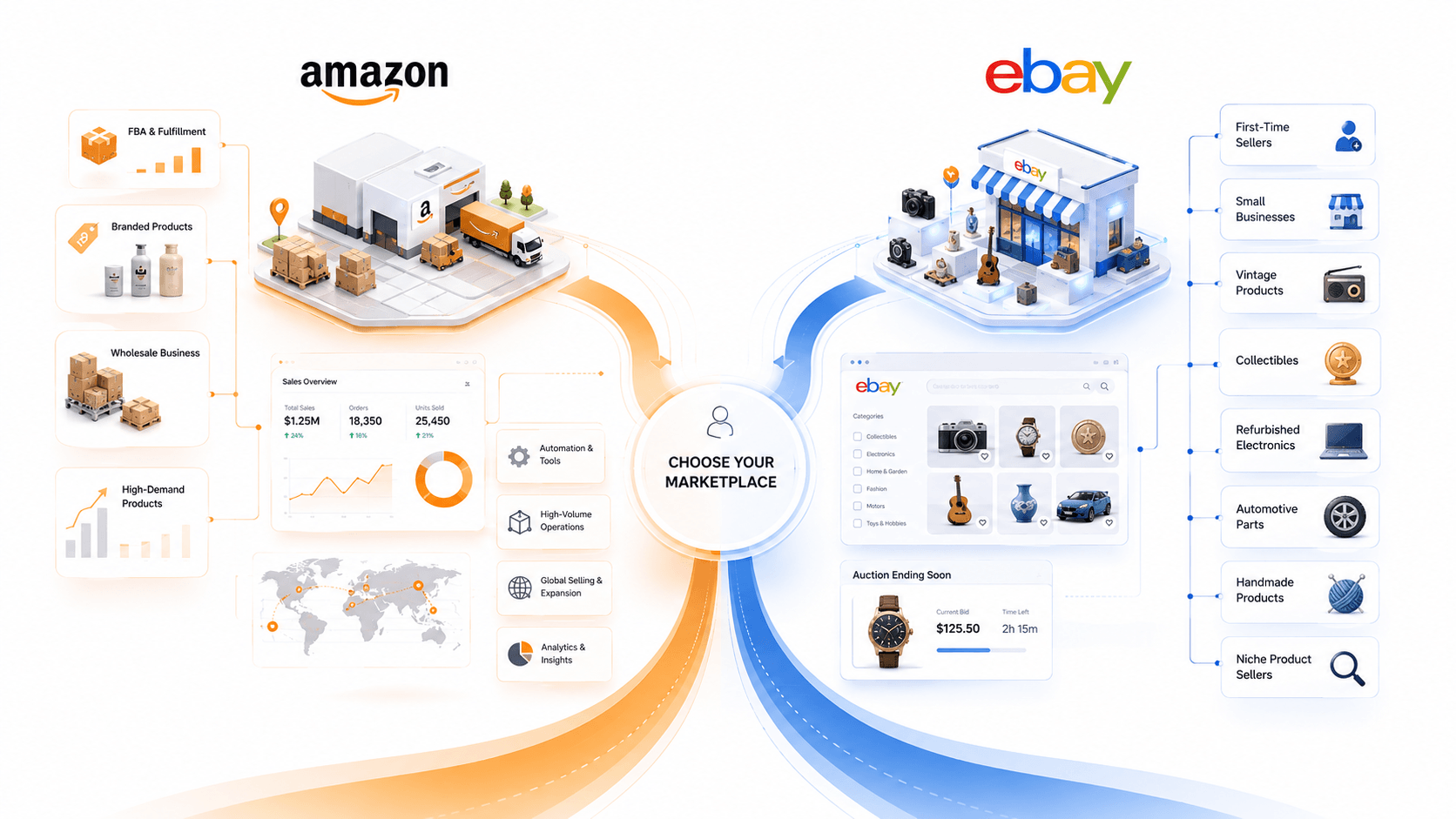
There isn’t one answer to which is better, eBay or Amazon, because every business has different goals. Both Amazon and eBay are excellent marketplaces, but the right choice depends on your products and the type of customer base you want. Before making a decision, consider where your target customers shop and how you want to grow your business.
Choose Amazon If You:
- Sell brand-new or branded products.
- Want access to millions of active buyers.
- Plan to use Fulfillment by Amazon (FBA).
- Need faster business growth.
- Sell products with consistent demand.
- Want advanced advertising tools.
- Plan to expand internationally.
- Prefer automated fulfillment and operations.
Choose eBay If You:
- Sell used, vintage, or refurbished products.
- Want lower upfront selling costs.
- Prefer flexible pricing and custom listings.
- Need fewer product approval requirements.
- Sell collectibles or niche products.
- Want greater control over shipping.
- Are starting with a smaller budget.
- Want to build your own store identity.
Can You Sell on Amazon and eBay at the Same Time?
Yes. In fact, many successful sellers don’t choose one marketplace; they sell on both. Selling on Amazon and eBay helps reach more customers, increase sales opportunities, and reduce the risk of depending on one platform.
Amazon attracts shoppers looking for fast delivery and branded products, while eBay brings in buyers searching for unique, refurbished, vintage, or discounted products. Selling on both marketplaces allows you to benefit from the strengths of each platform.
Reach More Customers
Amazon and eBay attract different audiences. Listing your products on both marketplaces increases your exposure and helps you connect with customers who may never shop on the other platform.
Increase Sales Opportunities
Every additional marketplace creates another opportunity to generate revenue. Selling on both platforms allows your products to appear in more searches and reach buyers with different shopping preferences.
Reduce Business Risk
Depending on a single marketplace can be risky; what if one account gets suspended? Changes in policies or seasonal demand can affect sales. Selling on multiple platforms creates a more stable business.
Build a Stronger Multichannel Business
Amazon provides the infrastructure for high-volume ecommerce, while eBay offers flexibility for niche and specialty products. Together, they create a balanced multichannel selling strategy that supports long-term business growth.
How to Sell on Amazon and eBay? Here’s Where QuickSync Fits
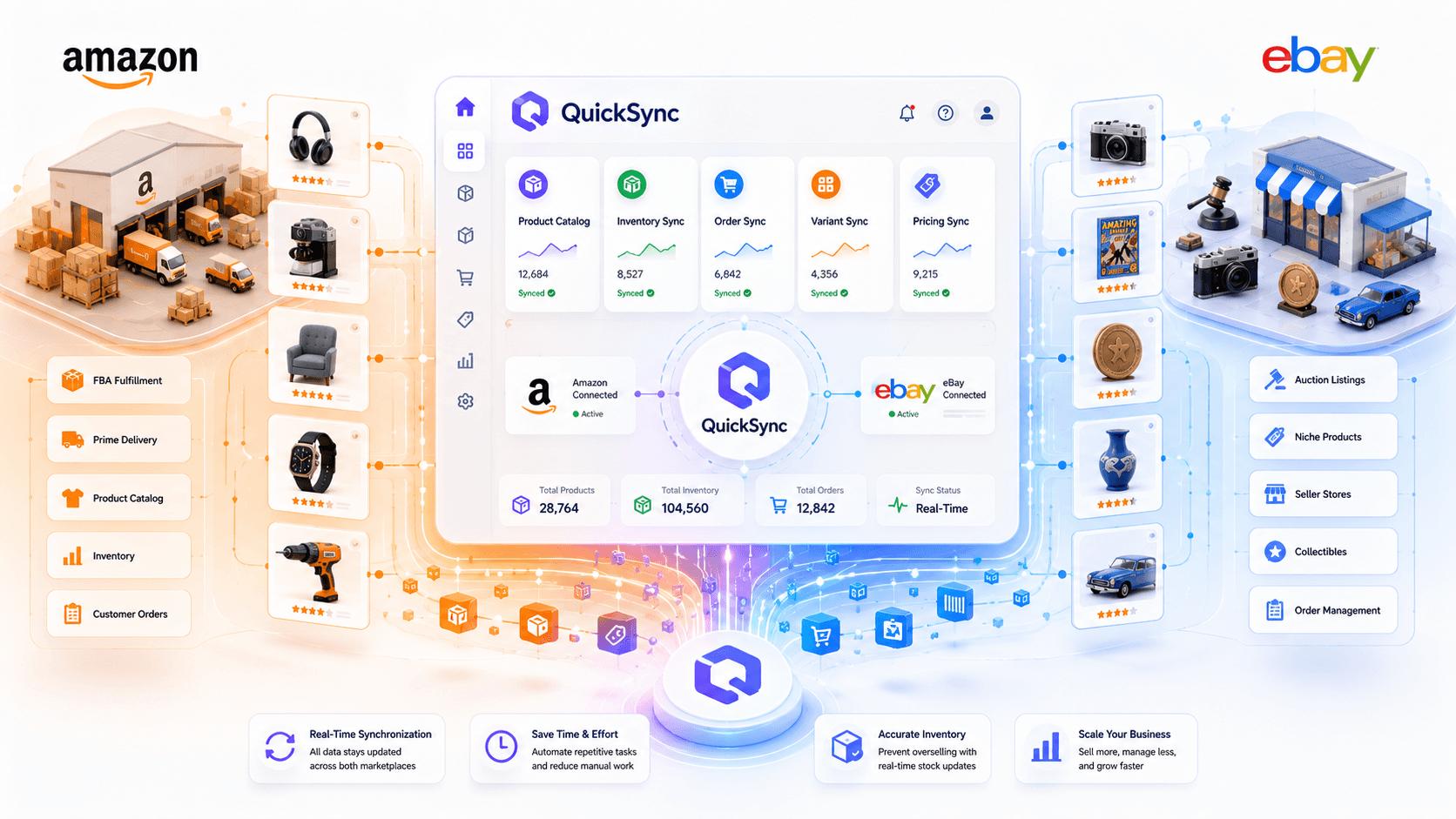
Many businesses don’t want to choose between Amazon and eBay. They want Amazon for its massive customer base, fast fulfillment, and ecommerce infrastructure, while using eBay to reach buyers looking for niche, vintage, refurbished, or collectible products.
That approach makes sense, but only if both marketplaces stay connected.
Managing two marketplaces manually quickly becomes difficult. Updating inventory after every sale, keeping product listings consistent, processing orders from separate dashboards, and maintaining accurate pricing across both platforms can consume hours every day. As your product catalog grows, these tasks become even more challenging.
This is where an integration solution like QuickSync helps. Instead of managing Amazon and eBay separately, QuickSync connects both marketplaces and automatically synchronizes your products, inventory, and orders in real time.
What QuickSync Actually Does
QuickSync acts as the connection between Amazon and eBay, allowing both marketplaces to work together instead of operating independently.
Product Catalog Sync
Managing product information across multiple marketplaces often leads to duplicate work. QuickSync product sync feature automatically syncs titles, descriptions, images, pricing, SKUs, and product details between Amazon and eBay. Instead of updating each marketplace individually, sellers can maintain one connected product catalog.
Real-Time Inventory Sync
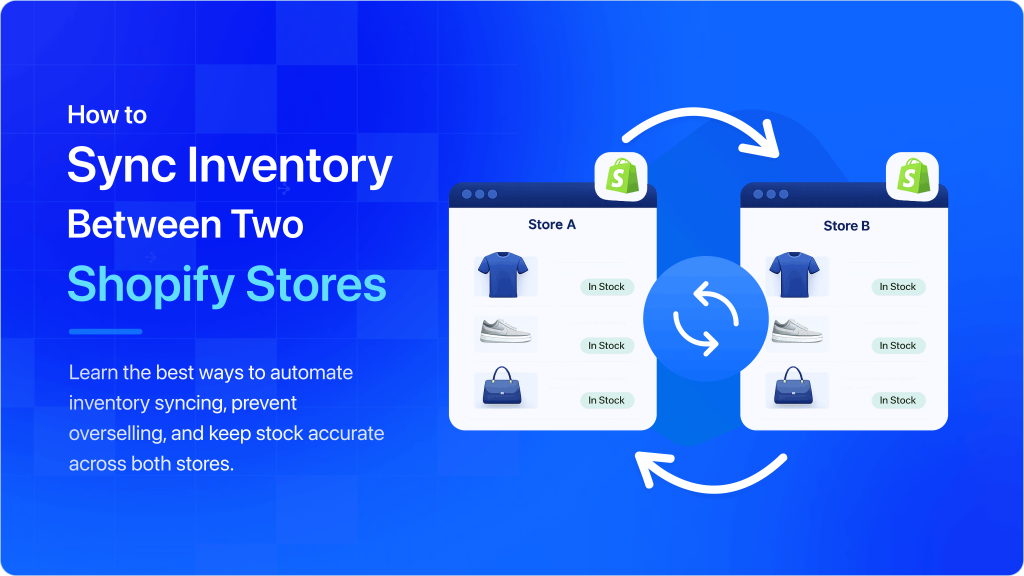
Inventory accuracy is one of the biggest challenges in multichannel selling. Whenever a product sells on Amazon, QuickSync automatically syncs inventory on eBay. Likewise, when a sale occurs on eBay, stock levels are updated on Amazon. This real-time inventory sync helps reduce overselling, stock mismatches, and cancelled orders.
Order Sync into One Place
QuickSync automatically imports orders from both Amazon and eBay into one centralized dashboard. Instead of switching between multiple seller accounts, order syncs into one dashboard. Merchants can process, fulfill, and manage orders from one place, improving efficiency and reducing manual work.
Product Variant Sync
Amazon and eBay organize product variations differently. QuickSync helps synchronize product variants, including sizes, colors, SKUs, barcodes, and option combinations, ensuring product information remains consistent across both marketplaces.
Pricing Sync
Keeping prices updated across multiple marketplaces can become difficult as products change. QuickSync automatically synchronizes pricing updates, allowing businesses to maintain consistent product pricing while reducing manual adjustments and pricing errors.
Why This Works
QuickSync doesn’t replace Amazon or eBay. Amazon continues to provide access to one of the world’s largest ecommerce marketplaces, while eBay continues to offer flexibility for niche products and independent sellers. QuickSync simply keeps both marketplaces connected.
This allows businesses to:
- Sell on Amazon and eBay without manually updating both marketplaces.
- Keep inventory synchronized automatically after every sale.
- Maintain consistent product information across multiple channels.
- Process orders from one centralized dashboard.
- Reduce overselling, cancelled orders, and inventory errors.
- Save hours of manual work every week.
- QuickSync also offers other multichannel integrations like Shopify eBay integration, Amazon WooCommerce integration, WooCommerce eBay integration, etc.
Conclusion
Many new sellers ask, “Is Amazon better than eBay?” The answer depends on your products, business model, and long-term goals. If you’re wondering whether you should sell on Amazon or eBay, start by identifying where your ideal customers are more likely to shop.
If you value lower selling costs, flexible listings, and a marketplace for vintage or niche products, eBay is a great place to start. If you’re looking for a larger customer base, faster fulfillment, and higher sales potential, Amazon is the stronger choice.
No matter which marketplace you choose, your business doesn’t have to stay on just one platform. As your sales grow, expanding to both Amazon and eBay can help you reach more customers and increase revenue.
QuickSync makes that expansion easier by automatically syncing your inventory, products, and orders across both marketplaces. No manual updates. One dashboard for managing operations. Double revenue.