Starting an ecommerce business is easier than ever. But if you want to grow an ecommerce business in 2026, the answer isn’t simply “get more traffic.”
Because more visitors mean very little if they don’t convert. More customers mean less if they never return. And increasing your ad spend won’t solve a business model that isn’t converting efficiently in the first place.
And the opportunity for ecommerce sellers is significant, undoubtedly. Global ecommerce sales are projected to reach $8.09 trillion by 2028, but competition for customers is growing alongside the market.
That makes efficient, sustainable growth more important than simply chasing bigger numbers. So, how do you actually grow an ecommerce business?
To help, we wrote this blog to guide you on growing your ecommerce business. In this guide, we’ll cover six proven growth strategies and explain how to identify where your store has the biggest opportunity to grow.
TL;DR: How to Grow an Ecommerce Business
Growing an ecommerce business doesn’t mean doing everything at once. Start with the basics, then work through the growth strategies that can have the biggest impact.
| → Get the basics right: Improve your product pages, fulfillment, inventory accuracy, and profit margins. → Bring in more traffic: Use SEO, content, email, social media campaigns, and paid advertising to reach more potential customers. → Convert more visitors: Make product pages clearer, improve the mobile experience, and recover abandoned carts. → Get customers to come back: Use post-purchase emails, loyalty programs, and personalized offers to increase repeat purchases. → Sell online on more channels: Expand to platforms such as Amazon, eBay, Etsy, or TikTok Shop while keeping inventory in sync. → Increase each customer’s value: Use bundles, upsells, cross-sells, and free-shipping thresholds to increase order value. → Track the numbers that matter: Monitor conversion rate, customer acquisition cost (CAC), average order value (AOV), customer lifetime value (CLV), repeat purchase rate, and inventory turnover. |
Note: Do not try to fix everything at once. Find your biggest growth constraint, fix it, and then move to the next.
Strategies in the Right Order to Grow Your Ecommerce Business
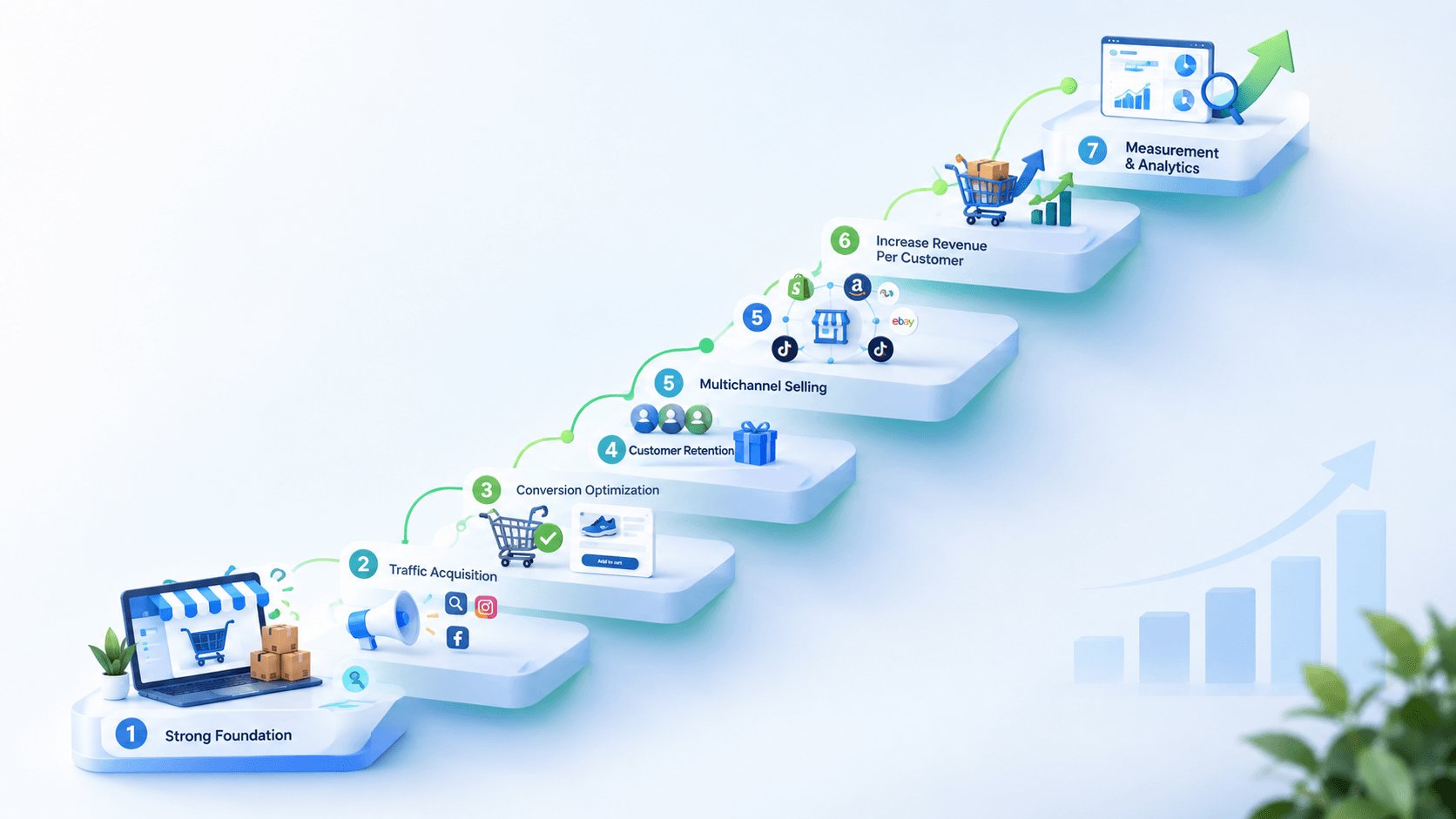
Most ecommerce growth guides give you a long list of tactics and leave you to figure out what to try first. But when you’re already running a business, you don’t have the time or budget to test everything at once.
That’s why we followed a clear sequence of strategies in this guide. Each growth strategy builds on the one before it, helping you fix the biggest problems first and get more from every strategy that follows.
Ensure to use the table below to see what each strategy solves, why it comes next, and when you can skip it based on where your ecommerce business stands today.
| Growth Strategy | What It Solves | Why It Comes Here | Skip It If… |
| 1. Get Foundations Right | Weak product pages, unreliable fulfillment, inaccurate inventory, unknown unit economics. | Your foundation needs to be solid before you scale. | Your store operations and unit economics are already healthy. |
| 2. Drive More Traffic | Not enough potential buyers are landing on your online store. | You cannot convert or retain visitors who never arrive. | You already have plenty of traffic but poor conversions. |
| 3. Convert More Visitors | Traffic arrives, but too few people buy. | More traffic to a low-converting store just means more people leaving without buying. | Your conversion rate is already above 3 percent. |
| 4. Keep Customers Coming Back | Customers buy once and disappear. | Retention is far cheaper than acquisition. Repeat buyers spend more and refer others. | You are still building your initial customer base. |
| 5. Head to multichannel selling | Revenue is capped by a single channel’s audience. | Multichannel selling brings new audiences who would never find you on your primary platform. | Your main channel and operations aren’t stable yet. |
| 6. Increase Revenue Per Customer | Each transaction earns less than it could. | Raising average order value grows revenue without requiring more traffic or channels. | Your product catalog does not naturally lend itself to bundling or upselling. |
| 7. Measure Your Growth | No clear picture of what is working or where to focus. | Measurement shows you what to improve next. | Never skip this one. Measure from day one. |
You can use the above table to find where you are right now. If your conversion rate is already above 3 percent, skip Section 3 and go straight to retention.
If you are still building your initial audience, skip the multichannel section for now. This guide is written in a way that you can read it from start to finish or jump directly to the ecommerce strategy that matters most for your business today.
01: Making Your Ecommerce Business Foundations Solid First
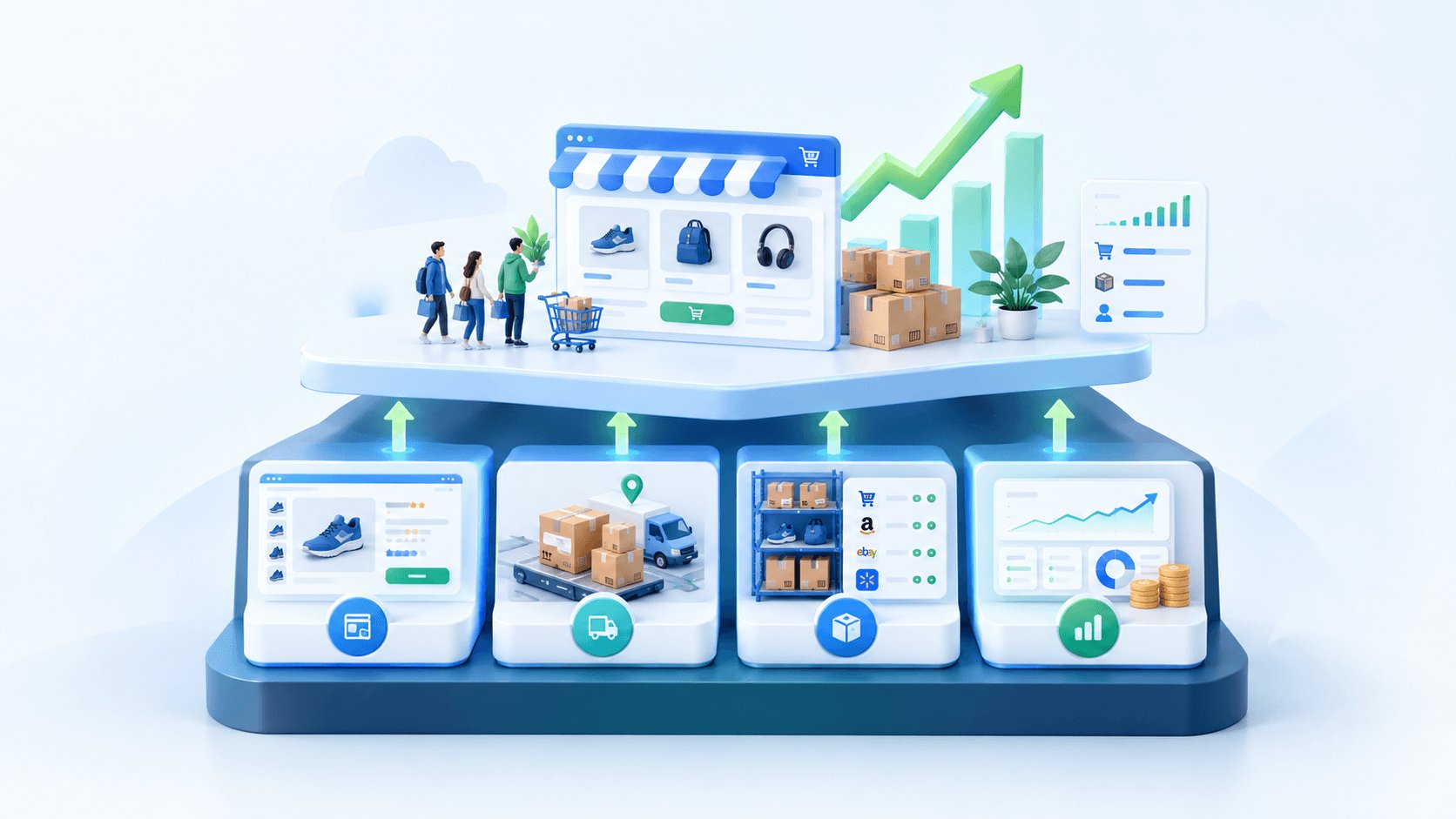
Before you try to grow your e commerce business, make sure it can handle growth. Most ecommerce growth advice skips straight to tactics. But growth strategies only work when the foundations supporting them are solid.
More traffic to a store with weak product pages means more people leaving without buying. More channels without accurate inventory means more challenges in multichannel selling, causing overselling. More marketing spend without knowing your numbers means faster losses.
Before you apply the 6 strategies mentioned in this guide, check if your ecommerce business has these four foundations.
Make Sure Your Product Pages Convert:
Your product pages do the heavy lifting when it comes to turning visitors into customers. If people are landing on your pages but not buying, sending even more traffic won’t solve the underlying problem.
Every product page should give shoppers the information they need to feel confident buying. That includes:
- High-quality photos showing the product from multiple angles.
- Clear, specific descriptions that answer common buyer questions.
- Pricing and shipping costs that are easy to find.
- A clear customer returns management policy.
- Customer reviews and other trust signals.
- A simple, easy-to-understand path to checkout.
These aren’t advanced conversion tactics. They’re the basics your online business needs before you start pouring more traffic into it.
Check if Your Fulfillment Is Reliable:
More orders sound great until you can’t ship them on time.
If you’re already struggling to fulfill your current order volume, scaling your sales will only put more pressure on the process. Late shipments, errors, and poor customer service can quickly turn growth into a bigger operational problem.
Before scaling, make sure your fulfillment process can handle a significant increase in orders without sacrificing accuracy or delivery times. Ideally, build enough capacity that a sudden increase in demand doesn’t immediately overwhelm your team. Heading into the holidays? Our Christmas ecommerce checklist covers how to get your store ready for peak order volume.
Keep Your Inventory Accurate:
Inventory mistakes become more expensive as you grow. If your stock counts are inaccurate, you risk selling products you don’t actually have. That can lead to overselling, canceled orders, disappointed customers, and problems with marketplace performance.
So ensure you use reliable inventory tracking and keep stock levels synchronized across every channel you sell on. If your inventory isn’t under control yet, fix that before adding more sales channels or driving significantly more demand.
Understand Your Unit Economics:
You can’t make good growth decisions if you don’t know what each sale is really worth.

Before increasing your marketing spend, understand how much it costs to acquire a customer, fulfill an order, and generate a profit. At a minimum, know your:
- Customer acquisition cost (CAC)
- Average order value (AOV)
- Profit per order
- Customer lifetime value (CLV)
These numbers tell you whether growth is actually making your business healthier or simply making your revenue numbers look bigger.
Once these four foundations are solid, your growth strategies have a much better chance of working. So always remember to build the foundation first, then scale what works.
Without them, even the best strategies may produce disappointing results.
02: Building a Strong Traffic Strategy for Your Ecommerce Business
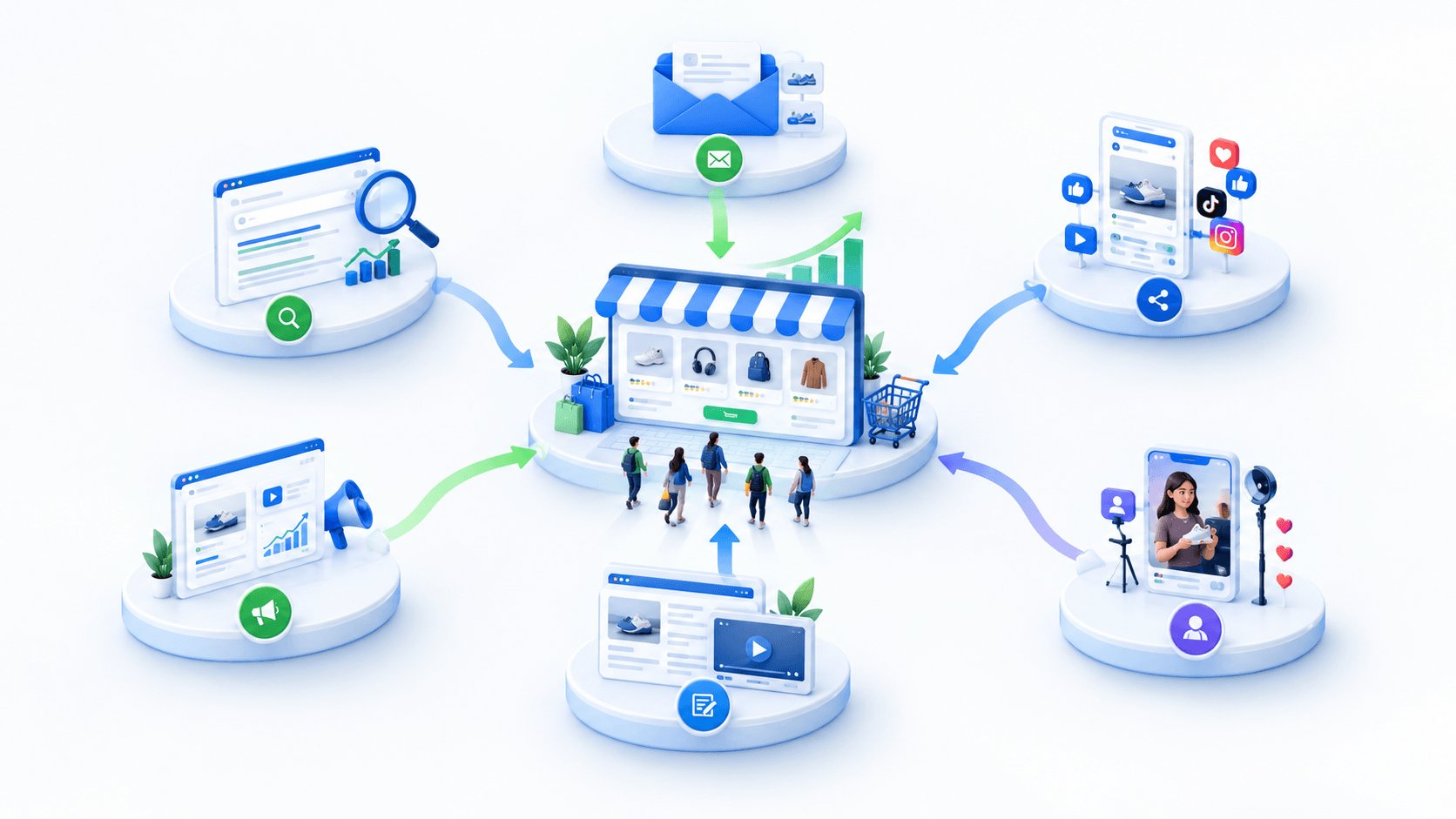
Once your store is ready to handle growth, the next step is getting more potential right customers through the door. But more traffic doesn’t automatically mean more sales. The goal is to attract the right visitors. People who are actually interested in what you sell and have a realistic chance of becoming customers.
Here are six channels to focus on to increase your business traffic.
Search Engine Optimization (SEO):
SEO can become a valuable source of ongoing organic traffic because you don’t pay for every individual visit from search.
Start with the pages closest to a purchase. Optimize your product titles, descriptions, headings, and other on-page elements around the terms your customers actually search for. When your ecommerce website is new or competing against larger brands, specific long-tail keywords can be easier to target than broad, highly competitive terms.
Then build supporting content around questions your potential customers ask before buying. Product pages can capture buying intent, while useful blog content can bring in people who are doing market research for their needs.
SEO takes time, but the content and search engine rankings you build can continue generating traffic long after you publish them.
Email Marketing:
Email marketing is one of the best marketing strategies and has a high ROI, averaging 42 dollars for every 1 dollar spent. Every person on your email list is someone you can reach directly without paying for their attention again.
Start by building your list through your website, purchases, and other customer interactions. Then automate the emails that matter most:
- Welcome emails for new subscribers.
- Abandoned-cart emails for shoppers who leave before purchasing.
- Post-purchase emails to thank customers, provide useful information, and introduce relevant products.
The biggest advantage of email is that you can continue communicating with an existing audience without having to pay to reach them again every time.
Social Media Marketing:
Social media can help you reach new audiences, showcase your products, and build familiarity with your brand.
The key is not to be everywhere. Choose the social media platforms where your target audience is actually active and where your products fit the type of content people consume there.
For visual products, platforms such as Instagram and TikTok can be useful for product demonstrations, tutorials, customer content, and behind-the-scenes posts. Other businesses may find Facebook Marketplace, Pinterest, LinkedIn, or another platform more relevant.
Start with one or two channels you can manage consistently rather than spreading yourself thin across five.
Paid Advertising:
Google Ads and Meta ads can drive targeted traffic quickly but require testing and optimization to be profitable. You can start with a manageable budget and test different audiences, offers, landing pages, and creative variations. Track the numbers that matter, especially customer acquisition cost and profit per order.
Don’t increase your budget simply because a campaign is generating sales. Scale campaigns when the data shows that the sales they generate are profitable and sustainable.
Content Marketing:
Useful content can attract potential customers before they’re ready to buy.
Create blog posts, guides, videos, comparisons, tutorials, and other content around the questions your audience is already asking. For example, instead of only writing about your product, answer the problems your product helps solve.
This brings potential customers into your brand earlier in the buying journey and gives you more opportunities to build trust before asking for the sale.
Influencer Partnerships:
You don’t always need a huge influencer to reach the right audience.
Smaller creators with a highly relevant and engaged audience can be a good fit for niche ecommerce brands. Look beyond follower count and evaluate audience relevance, engagement, content quality, and whether the creator’s audience actually matches your target customer.
You can also repurpose effective creator content as user-generated content across your own marketing channels, with the appropriate permissions.
Note: If all your traffic comes from one platform, an algorithm change, rising ad costs, or a change in customer behavior can have a major impact on your sales. So ensure to build a mix of channels such as organic search, email, social media, content, and paid advertising so your business can keep attracting customers even when one source slows down.
Now that you’ve got people coming to your ecommerce business, the next challenge is converting more of those visitors into customers.
03: Getting More Sales From the Traffic You Already Have
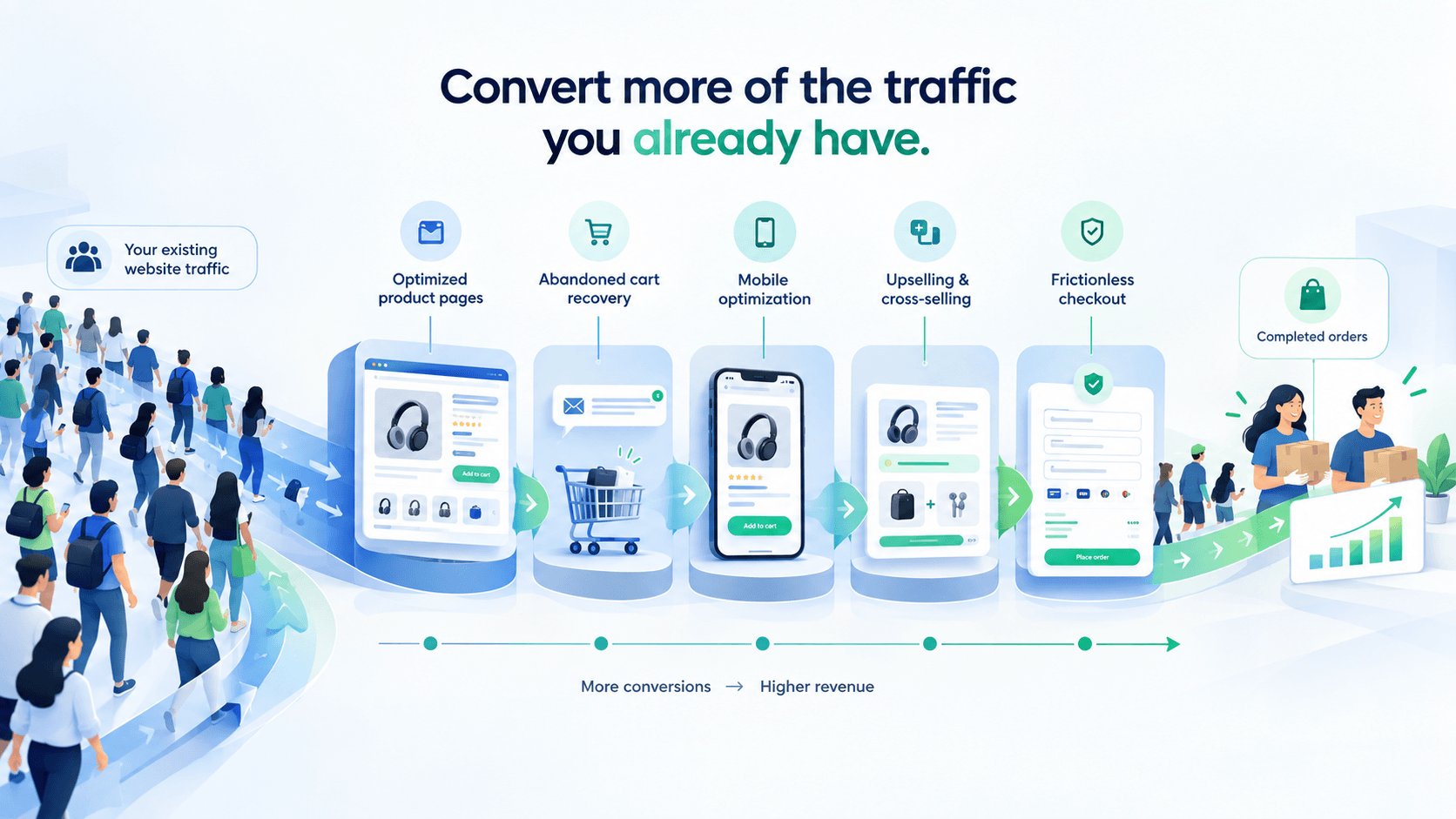
Most e commerce stores convert between 1% and 3% of their visitors into buyers. That means 97% to 99% of the people who visit your store leave without purchasing.
Even a small improvement in your conversion rate can have a meaningful effect on revenue without spending more money to attract additional traffic. Instead of always chasing more visitors, look for ways to get more value from the people who are already there.
Here are five areas to focus on.
Optimize Your Product Pages:
Your product page is where shoppers decide whether to buy.
Give them everything they need to make that decision without forcing them to search for answers elsewhere.
Include:
- High-quality photos from multiple angles.
- Images that show the product in real-life use.
- Clear, specific product descriptions.
- Pricing and shipping information that’s easy to find.
- Customer reviews and other trust signals.
- A clear call to action.
- Important information about returns, sizing, materials, or compatibility where relevant.
Every unanswered question creates another reason to hesitate. The goal is to remove that uncertainty before the shopper reaches checkout.
Fix Your Abandoned Cart Rate:
The average ecommerce cart abandonment rate is approximately 70 percent. Seven out of every ten shoppers who add a product to their cart leave without completing the purchase.
Some shoppers get distracted. Others have questions, unexpected costs, or simply aren’t ready to buy yet. An automated abandoned-cart sequence gives you a chance to bring some of those shoppers back.
A simple sequence can include:
- First reminder: Shortly after the cart is abandoned.
- Second reminder: Later, with helpful information or reassurance.
- Final reminder: A final nudge, potentially with a modest incentive if it makes financial sense.
Show the products they left behind and address common concerns such as shipping, returns, or payment options. Test different timing and messaging to find what works for your audience.
Make Mobile Shopping Easy:
Mobile optimization is critical for online store performance. More than half of all ecommerce traffic now comes from smartphones. A store that works perfectly on desktop but loads slowly or checks out awkwardly on mobile is losing the majority of its potential customers.
Website speed should be under three seconds to retain visitors. Every additional second of load time reduces conversions. Test your complete purchase customer journey on a smartphone monthly. Load speed, image display, navigation, and checkout flow all need to work smoothly on a small screen.
Upsell and Cross-Sell Before Checkout:
Once someone is ready to buy, you have an opportunity to increase the value of that order.
Recommend products that naturally complement what they’re already buying. You can also offer relevant bundles, upgrades, or quantity discounts.
For example, a customer buying a camera might also need a memory card or case. The key is relevance. Recommendations should make the purchase more useful, not simply add more products to the screen.
Reduce Checkout Friction:
The closer someone gets to purchasing, the less you should make them work for it.
Keep checkout simple by:
- Offering guest checkout.
- Limiting unnecessary form fields.
- Providing familiar payment options.
- Showing the full order total clearly.
- Displaying shipping costs and delivery estimates.
- Making errors easy to understand and correct.
- Giving customers confidence that their payment is secure.
Then test your checkout regularly. Even small improvements to confusing or unnecessary steps can recover sales that would otherwise be lost.
More traffic isn’t always the answer. Sometimes the fastest path to more revenue is simply converting more of the visitors you already have.
So you are getting traffic and converting more of it into sales. The next growth strategy is keeping those customers coming back, which costs far less than getting new ones.
04: Increasing Customer Retention and Repeat Purchases
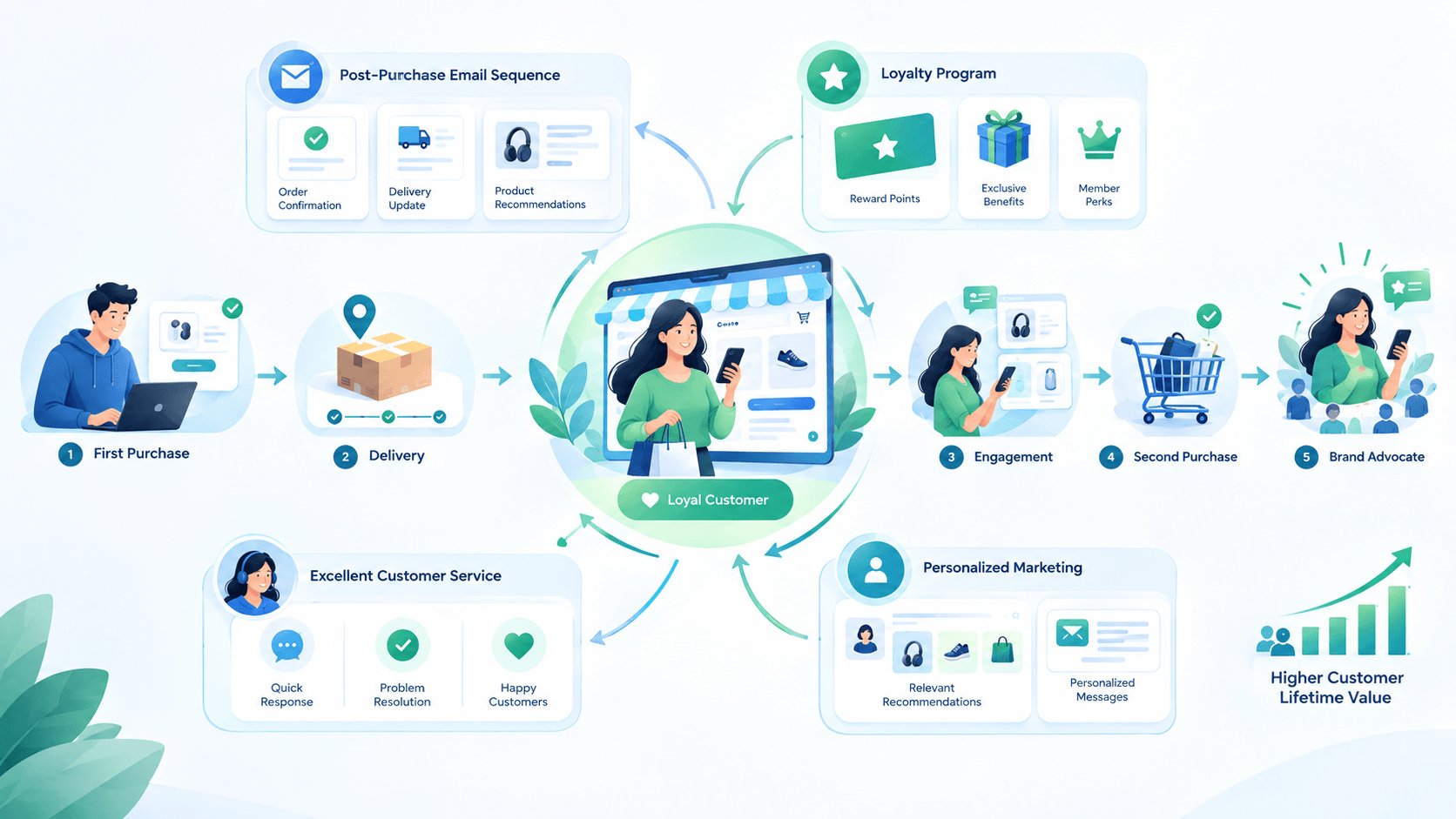
Getting a new customer can cost more than keeping an existing one. Repeat customers often spend more, buy more frequently, and are more likely to recommend your brand to others.
That is why customer retention should be an important part of your ecommerce growth strategy. Instead of constantly looking for new customers, find ways to give existing customers a reason to come back.
Here are four practical ways to increase repeat purchases and build stronger customer relationships.
Build a Post-Purchase Email Sequence:
Your relationship with a customer does not end after they place an order. What happens after the purchase can have a big impact on whether they buy from you again.
That’s why you should set up a series of helpful emails that keep customers engaged after their purchase. You can use these emails to:
- Thank customers for their purchase.
- Confirm their order and share delivery updates.
- Provide useful information about the product.
- Check in after the product has been delivered.
- Recommend products that complement their purchase.
For example, if someone buys a yoga mat, you could later recommend yoga blocks, straps, or other related products.
The first purchase allows you to build the relationship. A good post-purchase email strategy helps you to convert that first purchase into the next one by staying useful and relevant.
Implement a Loyalty Program:
A customer loyalty program can give customers an extra reason to shop with you again. You can reward customers for purchases, referrals, reviews, or other actions that help your business.
Keep the program simple. Customers should be able to understand how it works and what they can earn without having to read a long list of rules.
You could offer rewards such as
- Points that can be used on future purchases.
- Free shipping on future orders.
- Exclusive discounts.
- Early access to new products.
- Special rewards for referrals or reviews.
The goal is not just to offer discounts. It is to make customers feel appreciated and give them a reason to choose your store again.
Personalize Your Marketing:
Data-driven personalization improves customer engagement and sales by making every communication feel relevant rather than generic. Use purchase history and browsing behavior to recommend products that are genuinely relevant to each individual customer.
A customer who bought a yoga mat is more likely to respond to an email about yoga blocks than a general promotional blast. Utilizing customer data for personalization can enhance product recommendations and increase the open rates, click rates, and conversion rates across your email and social campaigns.
Deliver Excellent Customer Service:
Customer service can have a major impact on whether someone decides to buy from you again. Problems will happen. Orders may arrive late, products may be damaged, or customers may have questions. What matters is how quickly and fairly you handle those situations.
Respond to customers promptly, make it easy for them to get help, and offer a straightforward return or refund process. A customer who has a problem but receives helpful and respectful support may still become a repeat customer.
Customer feedback can also help you improve your business. Pay attention to common questions, complaints, and requests because they can show you where your products, website, or services need improvement.
Strong customer service does more than solve problems. It can build trust, encourage repeat purchases, and lead to word-of-mouth recommendations.
| “The best ecommerce brands I have seen so far share one habit. They obsess over what happens after the first sale, not just before it. Getting a customer is expensive. Keeping them costs a fraction of that. The post-purchase experience is where most small business owners are leaving the most money on the table.” – Jelena L. | Product Sync & Order Management Expert |
If you are successfully bringing customers back and increasing repeat purchases, the next step is to reach new customers in more places.
05: Selling on Multiple Channels to Grow Your Ecommerce Business
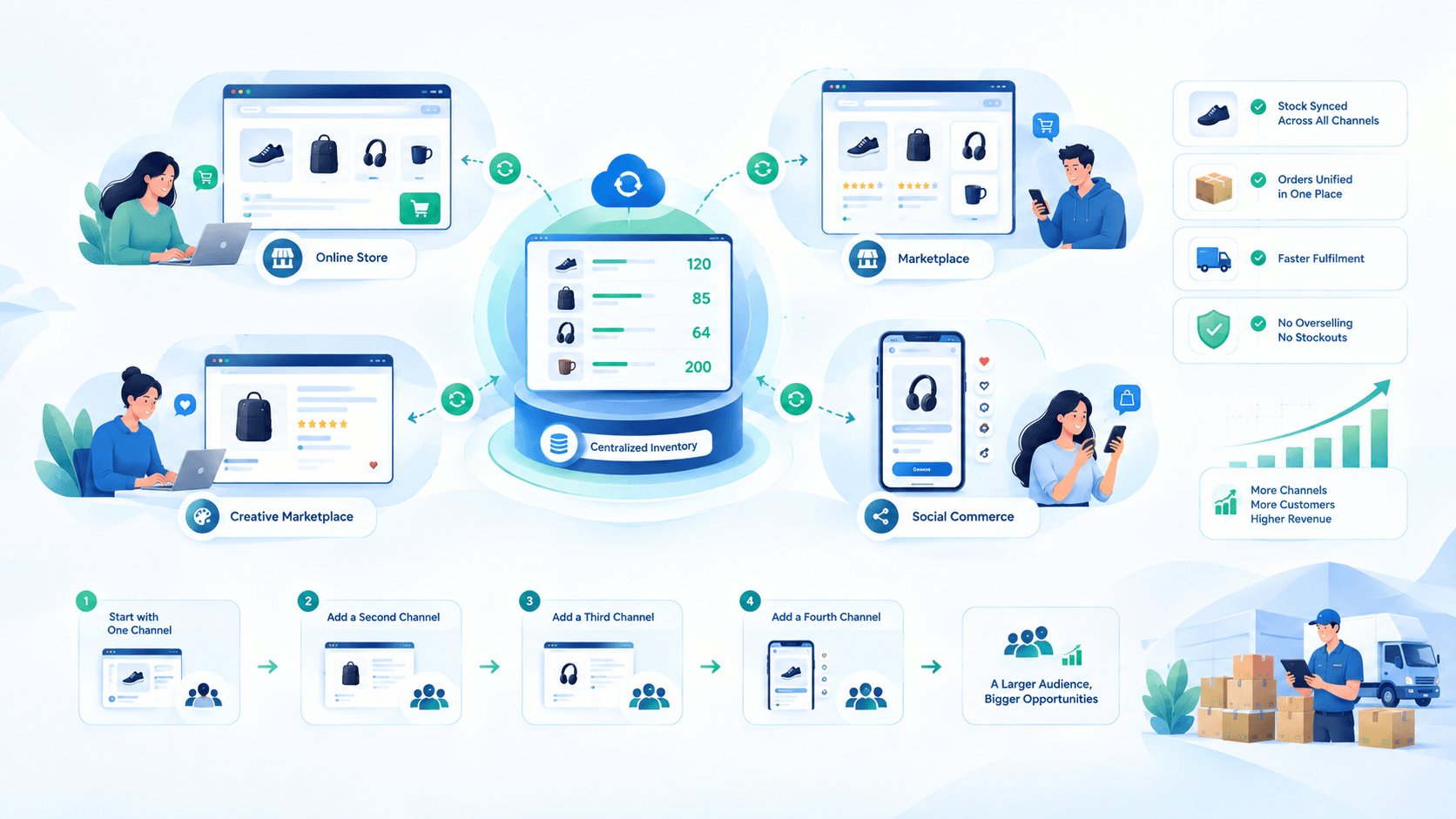
Many ecommerce sellers start by selling through one channel. That is a good way to start your ecommerce business, but relying on a single channel can limit how many customers you can reach.
Adding more sales channels gives your products more opportunities to be discovered by new buyers. Someone who does not find your product through your online store may discover it on Amazon, Etsy, eBay, or TikTok Shop.
The key is to expand carefully and choose channels that fit your products and target customers.
Why Multichannel Selling Strategy Works:
In a recent study, it was found that retailers selling on two or more marketplaces generate 190% more revenue than single-channel sellers. Each additional channel adds a new audience with different buying habits.
For example:
- Amazon attracts shoppers who are often searching for specific products and are ready to buy.
- Etsy is popular with shoppers looking for handmade, vintage, personalized, and unique products.
- eBay can be useful for used, collectible, rare, and hard-to-find products.
- TikTok Shop helps shoppers discover products through videos, creators, and social content.
By selling on more than one channel, you can reach different groups of customers instead of depending on a single source of sales.
Amazon also provides a large opportunity for independent sellers. In 2025, more than 75,000 independent sellers surpassed $1 million in annual sales on Amazon.
These numbers show the potential of selling across multiple channels. However, adding more channels does not automatically guarantee growth. You still need to choose the best multichannel listing software, manage your product listings, and keep your operations under control.
Which Sales Channels Should You Consider?
The right channels depend on what you sell and where your customers shop. For many US ecommerce sellers, these platforms are worth considering:
- Amazon: A large marketplace with strong search traffic and high purchase intent. It can work well for products that people actively search for and that have broad demand.
- Etsy: A strong option for handmade, vintage, personalized, and creative products. It is particularly useful for sellers whose products have a unique or artisan appeal.
- eBay: A good fit for collectibles, used products, rare items, and hard-to-find products. Its flexible selling options can also work well for certain product categories.
- TikTok Shop: A discovery-focused channel where customers find products through videos and creators. It can be a good fit for visually appealing products and brands that can consistently create engaging content.
You do not need to sell on every platform. Start with the channels where your target customers are most likely to shop. Our beginner guides cover selling on Amazon, Etsy, eBay and TikTok Shop.
Add One Channel at a Time:
The most common multichannel expansion mistake is adding too many channels simultaneously. Each marketplace has its own listing requirements, its own performance standards, and its own buyer expectations.
That’s why spreading across five channels before any of them are working well creates operational problems with no clear priority order for fixing it. Add one channel at a time. Learn it, optimize it, and stabilize it before adding the next.
Keep Your Inventory in Sync Across Every Channel:
Selling on multiple channels creates another major challenge: inventory management. Each platform can have its own inventory count. For example, your Shopify store may show that you have 10 units available. Amazon may also show 10 units, while Etsy shows another 10.
But if a customer buys one unit on Amazon, the other channels do not know about that sale. As sales increase, these inventory differences can lead to overselling. That is why real-time inventory sync becomes important as you expand. Ecommerce inventory management reduces costs by avoiding overselling, and effective inventory management can increase sales conversions by 20 percent.
With the right inventory sync software, a sale on one channel automatically updates your available stock across your other connected channels. This helps you maintain one accurate inventory count without manually updating every platform after each sale.
So far, your channels are expanding, and your inventory is under control. The next strategy is to increase how much each customer spends when they buy, which grows your revenue without requiring more traffic or more channels.
06: Growing Your Ecommerce Revenue by Increasing Order Value
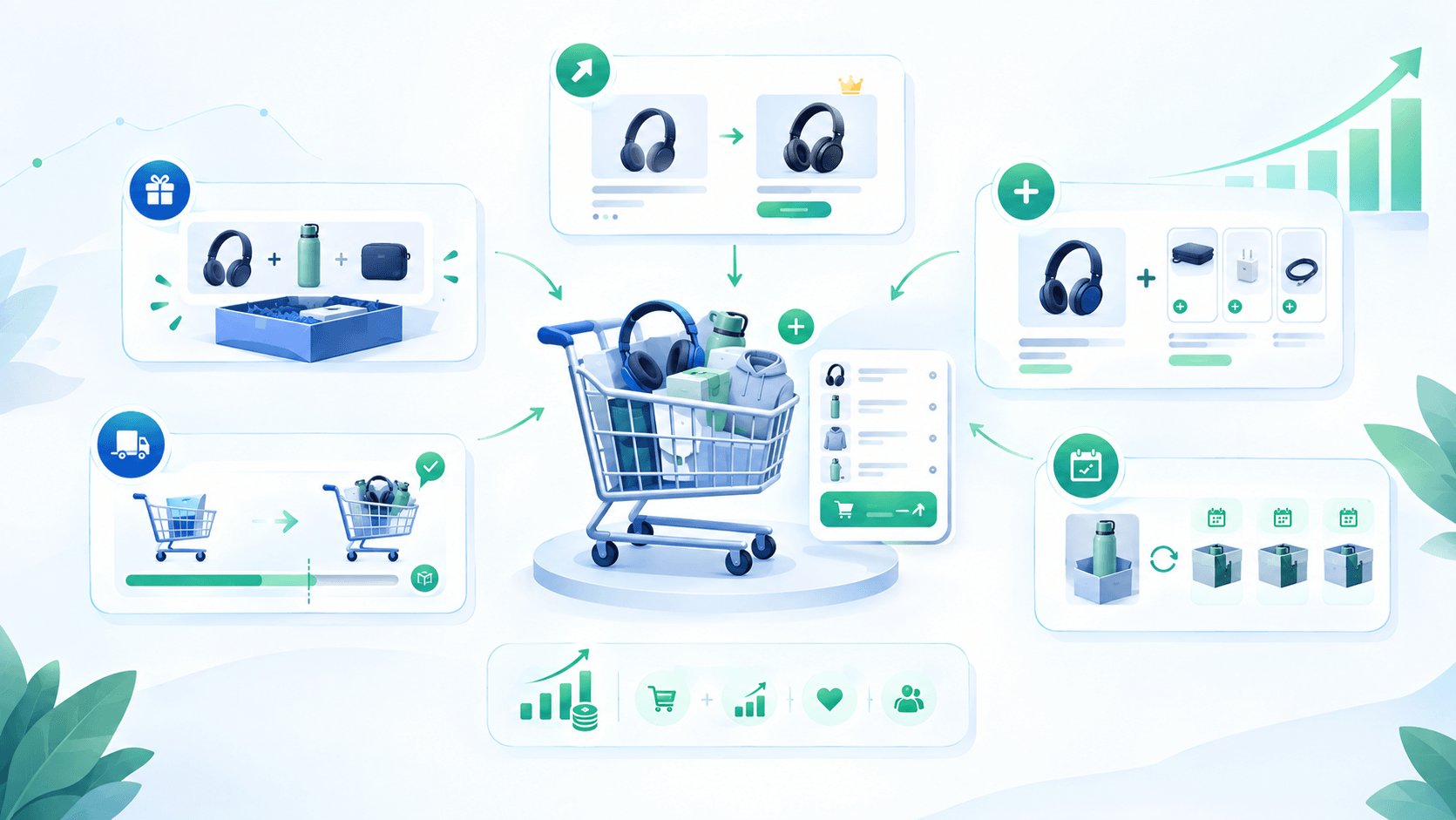
Getting more customers is not the only way to grow your ecommerce revenue. You can also increase how much each customer spends when they place an order.
This is where your average order value (AOV) becomes important. A few simple changes can encourage customers to add more relevant products to their cart without requiring you to attract more visitors.
Here are five ways to increase the value of each order.
Create Product Bundles:
Product bundles make it easy for customers to buy several products that work well together.
For example, you could bundle a camera with a memory card and carrying case, or combine a skincare cleanser, serum, and moisturizer into one package.
Offer the bundle at a slightly lower price than buying each product separately. Customers get better value, while you increase the amount they spend in a single order.
Start by looking at which products your customers commonly buy together. These are usually the best products to turn into bundles.
Upsell at the Right Moment:
An upsell encourages a customer to choose a better or more valuable version of the product they are already considering.
For example, if a customer is looking at a basic product, you could show them a premium version with additional features.
The important thing is to keep the recommendation relevant. The upgrade should solve the same need but offer something extra that the customer may find useful.
Show the upsell on the product page or near the point where the customer is making their purchase decision. Avoid showing too many options, as this can make the buying process more confusing.
Recommend Complementary Products:
Show products that work well with what the customer is buying on the product page and in the cart before checkout. A customer buying a camera bag is a natural candidate for a lens cleaning kit recommendation. A customer buying a face serum is a natural candidate for a complementary moisturizer. The more relevant the cross-sell, the higher the conversion rate.
Set a Free Shipping Threshold:
Setting a free shipping threshold slightly above your current average order value encourages buyers to add one more item to qualify. If your average order value is 35 dollars, a free shipping threshold of 50 dollars gives buyers a clear and specific reason to keep adding to their cart. This is one of the simplest and most consistently effective average order value tactics available.
Offer Subscriptions for Repeat-Purchase Products:
If you sell products that customers need to purchase again and again, consider offering a subscription option. This can work well for products such as skincare, supplements, pet supplies, coffee, household essentials, and other regularly used items.
You can offer a small discount or another benefit in exchange for recurring orders. Customers get the convenience of automatic deliveries, while your business gets more predictable repeat sales.
Subscriptions are not right for every ecommerce business, so focus on products that customers naturally need to repurchase.
Note: Increasing your revenue per customer does not always require more traffic. Simple strategies such as bundles, upsells, cross-sells, free shipping thresholds, and subscriptions can help you generate more revenue from the customers you already have.
Now that you are bringing in customers, converting them, retaining them, expanding your sales channels, and increasing order value, the last and final step is to measure whether these strategies are actually working.
Track What Matters to Grow Your E commerce Business
Growing an ecommerce business without tracking your numbers is like driving without a dashboard. You may be moving forward, but you cannot tell what is working, what needs improvement, or how quickly your business is growing.
Tracking the right metrics helps you understand where your business is performing well and where you should focus your efforts next.
Here are the key ecommerce metrics you should monitor:
| Metric | What It Measures | What to Do With It |
| Conversion rate | The percentage of visitors who make a purchase. | Below 1% means fix product pages first. 1 to 3% is average. Above 3% is strong. |
| Customer acquisition cost | How much you spend to get a new customer. | Must stay below profit per order. Rising CAC signals marketing inefficiency. |
| Average order value | How much customers spend on each order on average. | Use upselling and bundles to push this up without needing more traffic. |
| Customer lifetime value | Total revenue per customer over time | Rising CLV means retention is working. Use it to justify higher CAC. |
| Repeat purchase rate | The percentage of customers who come back and buy again. | Low rate signals a product quality or post-purchase customer experience problem. |
| Inventory turnover | How quickly you sell and replace your inventory. | Low turnover means cash is tied up in slow-moving products. Act early. |
Use Google Analytics alongside your ecommerce platform’s built-in reporting to track these metrics from day one. Google Analytics shows you how customers find and move through your store. Your platform shows you what they buy and how much they spend. Together they give you the complete picture of your growth.
The Bottom Lines
Summing it up, the answer to how to grow an ecommerce business is not to chase every new strategy, platform, or online marketing trend. Real growth comes from knowing what your business needs most right now and focusing your efforts there.
If you need more customers, improve your traffic strategy. If visitors are not buying, improve your product pages and checkout experience. If customers are not returning, focus on retention. If your current channel is limiting your reach, expand to new sales channels. And if customers are already buying, find ways to increase the value of each order.
Most importantly, keep measuring your results. The numbers will show you where your biggest opportunities are and whether your changes are actually making a difference.