Every November, sellers ask the same question: should the big offer go out on Black Friday or Cyber Monday? Most Cyber Monday vs Black Friday guides answer it for shoppers and tell them which day has the cheapest TVs. If you’re the one selling, you need a different answer.
Black Friday and Cyber Monday are different for sellers. Black Friday attracts more in-store shoppers, with big discounts on toys, clothing, and home products. Cyber Monday focuses more on online shopping, with better deals on electronics and computers.
This guide compares Black Friday vs. Cyber Monday from the seller’s side. You’ll see how big each day is, which categories peak when, and how to plan one sale that works across both.
What is the difference between Black Friday and Cyber Monday?

Black Friday is the day after Thanksgiving, and it has long marked the start of holiday shopping in stores. Cyber Monday is the Monday after Thanksgiving. The National Retail Federation’s online arm, Shop.org, coined the name in a November 2005 press release to give online stores their own sale day.
Today the line between them is mostly gone. Both days are online events, and many shops run one sale across both. The differences that are left are about timing, size, and what shoppers buy.
| Black Friday | Cyber Monday | |
|---|---|---|
| 2026 date | Friday, November 27 | Monday, November 30 |
| Started as | An in-store shopping day | An online shopping day, named in 2005 |
| 2025 US online sales | $11.8 billion | $14.25 billion |
| 2026 forecast | $12.9 billion | $15.1 billion |
| Deepest discounts (Adobe 2026) | TVs, toys, apparel, appliances, furniture | Electronics and computers |
| Shoppers | In stores and online | Mostly online |
The 2025 figures come from Adobe’s Cyber Monday 2025 report. The 2026 figures and category days come from Adobe’s 2026 holiday forecast, both checked in November 2026.
When are Black Friday and Cyber Monday in 2026?
Black Friday 2026 is on Friday, November 27. Cyber Monday 2026 is on Monday, November 30. The four days from Black Friday to Cyber Monday are called BFCM. Add Thanksgiving, and you get Cyber Week, a five-day stretch.
| Day | 2026 date | What happens |
|---|---|---|
| Thanksgiving | Thursday, November 26 | Many online sales start |
| Black Friday | Friday, November 27 | The main in-store and online sale day |
| Small Business Saturday | Saturday, November 28 | Shoppers focus on independent shops |
| Sunday | Sunday, November 29 | Sales carry on into Monday |
| Cyber Monday | Monday, November 30 | The biggest online sales day of the weekend |
Some marketplaces start earlier. TikTok Shop’s 2026 Black Friday campaign, for example, runs from November 11 to 30.
Already know your dates and want the plan? Jump to the planning steps.
Which is bigger: Black Friday or Cyber Monday?
Cyber Monday is bigger online. Adobe called Cyber Monday 2025 “the biggest online shopping day of all time”, and it expects Cyber Monday to stay ahead in 2026.
| US online sales | 2025 actual | 2026 forecast |
|---|---|---|
| Thanksgiving | $6.4 billion | $6.9 billion |
| Black Friday | $11.8 billion | $12.9 billion |
| Cyber Monday | $14.25 billion | $15.1 billion |
| Cyber Week (5 days) | $44.2 billion | $47.5 billion |
Black Friday is growing faster, though. Adobe forecasts Black Friday up 9.2% in 2026 and Cyber Monday up 6.2%. The gap between the two days is getting smaller.
A few more numbers from Adobe that matter for sellers:
- Cyber Week is 17.3% of the season. Adobe expects those five days to bring in $47.5 billion of the $275.1 billion it forecasts for November and December.
- Most orders come from phones. On Cyber Monday 2025, 57.5% of online sales came from mobile devices. On Thanksgiving it was 61.6%.
- Evenings are the peak. Between 8 p.m. and 10 p.m. on Cyber Monday 2025, US shoppers spent $16 million a minute.
That last point matters if you sell on several channels. The most orders arrive in the same two hours, often while you’re not watching.
Which day has the best deals by category?
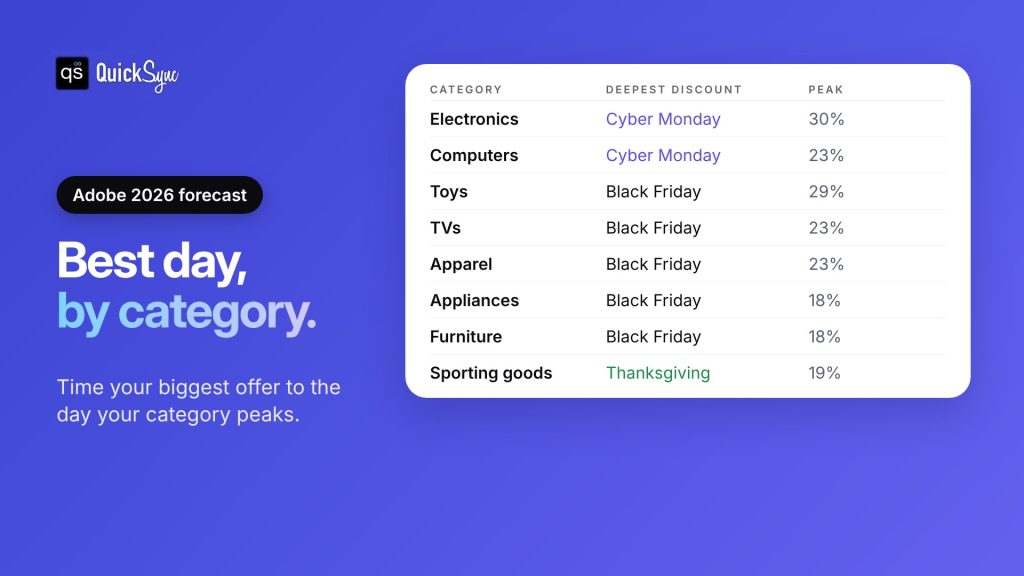
Adobe’s 2026 forecast names the day each category is expected to hit its deepest discount. Use it to time your biggest offer.
| Category | Deepest discount expected on | Peak discount (Adobe 2026) |
|---|---|---|
| Electronics | Cyber Monday | 30% |
| Computers | Cyber Monday | 23% |
| Toys | Black Friday | 29% |
| TVs | Black Friday | 23% |
| Apparel | Black Friday | 23% |
| Appliances | Black Friday | 18% |
| Furniture | Black Friday | 18% |
| Sporting goods | Thanksgiving | 19% |
If you sell clothing, toys, or home goods, big retailers will cut those prices hardest on Black Friday. For electronics and computer gear, the deepest cuts come on Cyber Monday. Across all categories, Adobe expects discounts of up to 30% during Cyber Week, compared with up to 14% in early November.
Black Friday or Cyber Monday: which is better for your shop?
For most online sellers, the answer is both. Shoppers don’t stop after Friday, and the biggest online day comes three days later. Three questions help you decide where to put your biggest offer.
1. What do you sell? Use the category table above. Match your strongest offer to the day your category peaks.
2. Where do you sell? If you have a shop or market stall as well as an online store, Black Friday and Small Business Saturday bring the in-person crowd. If you sell only online, Cyber Monday is your biggest day.
3. How much stock do you have? If stock is tight, a big Black Friday offer can sell you out before Cyber Monday. Hold back some units or plan a smaller second offer.
Most sellers end up with one of these setups:
| Setup | How it works | Good for |
|---|---|---|
| One Cyber Week sale | The same offer from Thanksgiving to Cyber Monday | Small shops that want one plan and less work |
| Two offers | One offer on Black Friday, a new one on Cyber Monday | Shops with email lists that want a reason to message twice |
| Early start | Sale opens in mid-November and runs to Cyber Monday | Sellers on marketplaces that start early, like TikTok Shop |
What changes when you sell on more than one channel?
Black Friday and Cyber Monday put your stock under the most pressure of the year. Say you sell the same products on Shopify, Etsy, eBay, Amazon, or TikTok Shop. Every order has to lower the count on every other channel. When that doesn’t happen fast enough, you sell stock you no longer have.
Here’s how that looks on Cyber Monday evening:
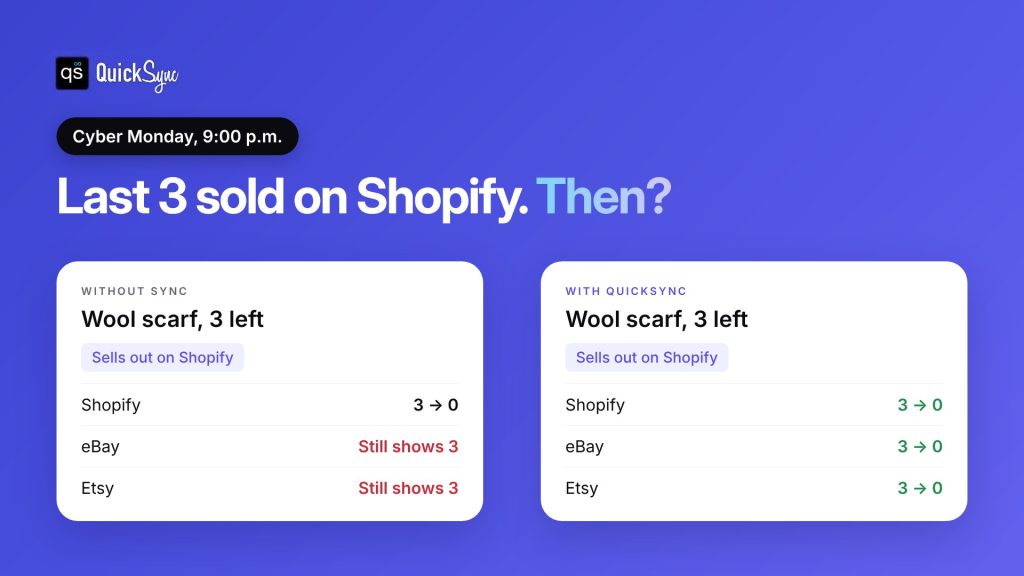
This is how most oversells happen on a busy weekend. If counts are updated by hand, or only every so often, the same units can sell several times before anyone notices. The buyer then gets a cancellation instead of an order, and marketplaces like eBay and Amazon track seller cancellations in your account metrics.
The fix is one stock count shared by every channel. QuickSync is a multichannel selling tool that does this, and more:
- Inventory sync. A sale on any channel lowers the count everywhere else, so the last unit sells once.
- Product and listing sync. On Pro, titles, photos, options, and prices stay in step with your main store, so a sale price you set once carries to every channel.
- Order sync. On Pro, orders from every channel land in one place, which makes a busy weekend easier to pack and ship.
- Price rules. On Ultra, set a different price on one channel, for example, to cover marketplace fees.
- Channels. Shopify, Etsy, eBay, Amazon, TikTok Shop, WooCommerce, Squarespace, Square and Clover.
Check our guide on Shopify BFCM 2026 for stores that also sell on Etsy, eBay or Amazon to make sure you earn maximum profits without backend operational problems.
Plans start at $19 a month for two shops, with unlimited orders on every plan. See the QuickSync pricing page.
How to plan your Black Friday and Cyber Monday sales
A week or two is enough to plan a good BFCM sale if you keep it simple. Here’s the order to work in.
- Pick your dates. Decide whether you run one Cyber Week sale or two offers. Write down the start and end time for each channel.
- Pick your offer. Match it to your category’s peak day from the table above. A clear offer like “20% off everything” is easier to run across channels than different deals on each one.
- Check your stock. Count your best sellers now, not on Friday. Fix any counts that don’t match between channels.
- Set up stock sync. Connect your channels so they share one count. Test it with one product and one sale before November 26.
- Set your sale prices. Change prices in one place and let them carry to every channel, or schedule them in each marketplace’s own sale tool.
- Plan for Cyber Monday evening. Make sure low-stock items can’t sell twice while you’re away from your desk.
For a dated checklist that covers shipping, returns, and what to do after the weekend, see our BFCM checklist for multichannel sellers. Etsy sellers can also read our Etsy Black Friday and Cyber Monday tips.
Final thoughts
Black Friday and Cyber Monday are no longer two separate events for online sellers. They’re the two biggest days in one long weekend. Cyber Monday brings more online sales. Black Friday brings the in-store crowd and the best prices in categories like toys, apparel, and home goods.
The simplest plan is one clear offer from Thanksgiving to Cyber Monday, timed to your category’s peak day. Then make sure your stock can keep up. If you sell on more than one channel, every order across those four days has to reach every other channel. That’s what decides whether the weekend ends with happy customers or a pile of cancelled orders.
Set up sync this week, test it on a few products, and go into Black Friday with one stock count everywhere.