On this page
- Crucial Factors We Considered to Evaluate Shopify vs Squarespace
- What Is Shopify?
- What Is Squarespace?
- Brief Comparison of Shopify and Squarespace: At a Glance
- Shopify vs Squarespace: A Detailed Comparison Based on Each Factor
- 1. Ease of Use and Setup
- 2. Design and Customization
- 3. eCommerce Capabilities
- 4. Shopify vs Squarespace Cost
- 5. Inventory Management
- 6. Payment Processing
- 7. SEO Capabilities
- 8. App and Integration Ecosystem
- 9. Scalability and Performance
- 10. Customer Support
- Pros and Cons of Shopify Store and Squarespace Site
- So Who Actually Wins in This Squarespace Shopify Comparison
- Not Sure What to Choose? Key Points to Help You Decide
- What If You Didn’t Have to Choose Between Shopify and Squarespace?
- QuickSync: A Unified System for Shopify Squarespace Integration
- The Bottom Line: What Next?
- FAQs
The Shopify vs Squarespace decision usually starts with one simple question: “Which platform is better?” The real question is far more important. Better for what?
Shopify and Squarespace are both polished, user-friendly platforms with strong reputations and built-in eCommerce tools. But beneath the surface, they are designed with entirely different priorities in mind. Shopify focuses relentlessly on selling online at scale. Squarespace focuses relentlessly on creating visually impressive websites.
That difference shapes everything from the dashboard experience to the features you rely on as your business grows. A small creative brand with a curated product line may value Squarespace’s elegant design system far more than advanced commerce tools. A growing retailer handling large inventories, multiple sales channels, and complex operations will likely need the infrastructure Shopify was built around.
In this Squarespace vs Shopify comparison, we broke down the differences that actually matter. We covered features, real costs, design, eCommerce depth, scalability, as well as Shopify Squarespace integration if the decision turns out to use both platforms together.
Crucial Factors We Considered to Evaluate Shopify vs Squarespace
Before we start comparing both platforms deeply, let’s look at every factor below that was evaluated consistently across both platforms. Here is what we covered and why each one matters.
- Ease of use and setup: How quickly you can go from zero to a live store, and how much technical knowledge you are required to have.
- Design and customization: How much control you have over the look of your store and how good the results can be without a developer.
- eCommerce capabilities: The depth and quality of selling features, including inventory, checkout, payment options, and product management.
- Pricing Plans: The real monthly cost of each platform, including fees that do not appear in the headline pricing.
- Inventory management: How each platform handles stock tracking, variants, and multi-location inventory.
- Payment processing: Supported payment methods, transaction fees, and flexibility to use different processors.
- SEO capabilities: How well each platform supports search engine visibility and organic traffic growth.
- App and integration ecosystem: How well each platform connects with external tools and services.
- Scalability and performance: How each platform handles growth in products, traffic, and order volume.
- Customer support: What help is available when something goes wrong, and how reliable it is.
What Is Shopify?

Shopify is a fully hosted eCommerce platform founded in 2006. It started as a solution for a snowboard store whose founders could not find an eCommerce platform that was simple enough to use. So they created Shopify then, and today, it powers over 4.6 million businesses across 175 countries and processes hundreds of billions of dollars in annual sales.
Shopify’s core proposition is that selling online should be as powerful as it is simple. You get a complete commerce infrastructure, from inventory management to payment processing to shipping integrations, without managing a single server or installing a single plugin just to get started.
Shopify: Our Expert Review of Shopify
- eCommerce depth: Shopify helps businesses sell online with built-in tools for inventory sync, orders, payments, and discounts, without needing technical expertise.
- Multichannel selling: Sell on TikTok Shop, Instagram, Facebook, Amazon, eBay, and in-store from one Shopify backend without additional platforms.
- Scalability: Shopify grows from your first sale to millions of orders without requiring a platform change. Shopify Plus handles enterprise-level volume.
- App ecosystem: Over 8,000 integrations cover accounting, marketing, fulfillment, analytics, loyalty, and more.
- Payment processing: Shopify Payments eliminates transaction fees and integrates checkout seamlessly. All major payment methods are supported.
- 24/7 support: Official phone, email, and live chat support for all plan levels.
What Is Squarespace?
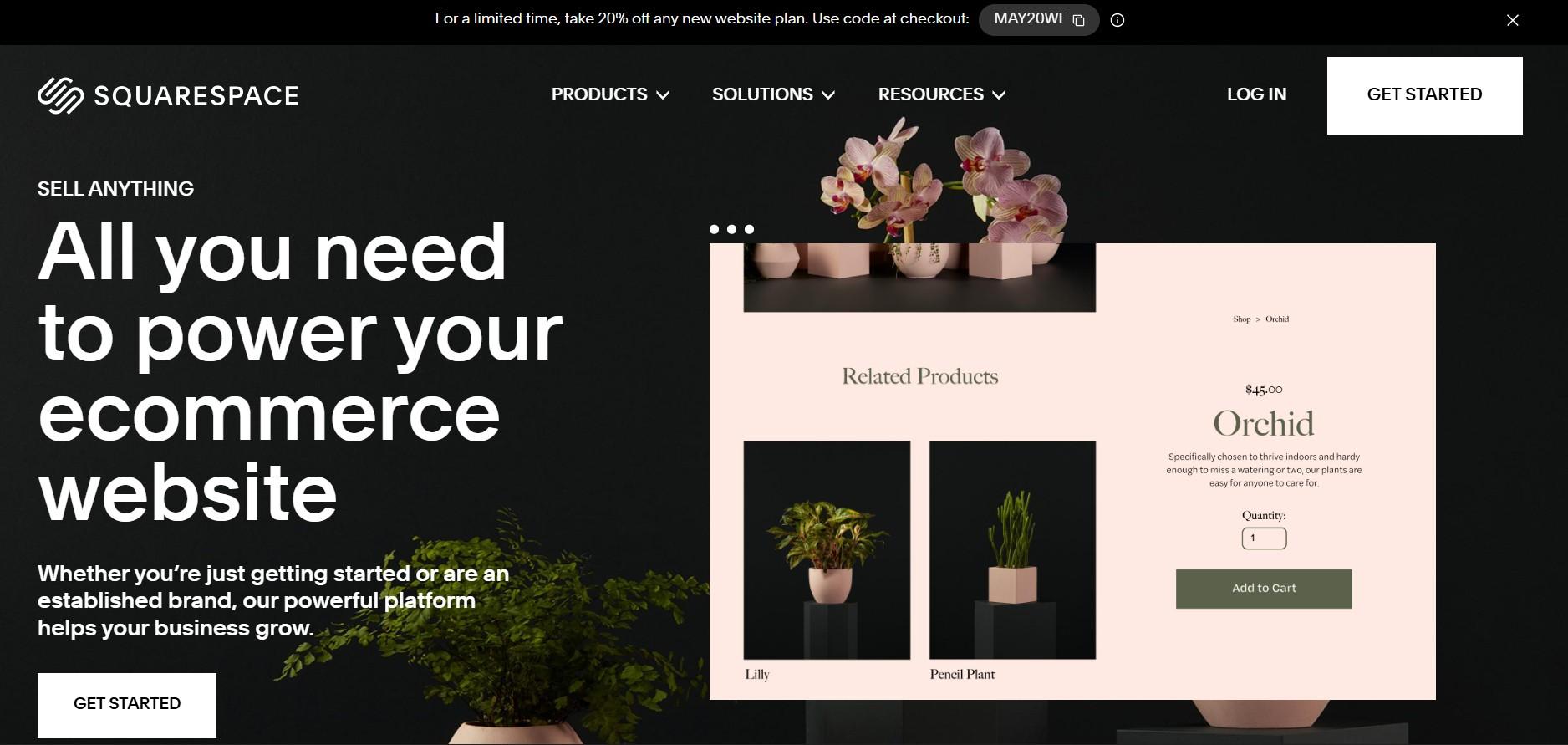
Squarespace is a fully hosted website builder founded in 2003. It built its reputation on producing websites that look like they were designed by professionals, even when built by people with no design background. Today, it powers millions of websites across creative industries, service businesses, portfolios, and online stores.
Squarespace’s core proposition is that your website should represent your brand at the highest possible visual standard without requiring a designer or a developer. Commerce was added to Squarespace in 2013 and has grown into a genuine selling platform for businesses with straightforward product catalogs. It handles payments, inventory, and order management competently. It does not approach Shopify’s depth for serious multichannel or high-volume selling.
Squarespace: Our Expert Assessment
- Design quality: Squarespace produces the most visually refined websites available without a custom developer. Its templates are genuine works of design.
- Ease of use: Squarespace’s drag-and-drop editor is intuitive even for complete beginners. The learning curve is genuinely low.
- SEO: Clean URL structures, built-in metadata control, and strong page speed make Squarespace a solid SEO platform.
- No transaction fees: Squarespace charges no additional transaction fees on any plan, which is a genuine financial advantage for some merchants.
- Easy Content Management: Squarespace’s content tools are excellent, competitive with WordPress for non-technical users.
- All-in-one simplicity: Squarespace handles your website, blog, portfolio, and store from one dashboard without plugins or apps for basic functionality.
Brief Comparison of Shopify and Squarespace: At a Glance
Now that we understand what each platform is built for, let’s compare Shopify and Squarespace side by side. This section breaks down how Shopify and Squarespace perform across the most important areas of running an online business. The goal is not just to list features, but to show you where each platform truly stands out in real-world use.
| Feature | Shopify | Squarespace |
| eCommerce Depth | Industry-leading. Built for selling at scale and handling complex stores. | Good for simple stores, but limited for high-volume or complex selling. |
| Design Templates | Solid selection with professional themes. | Best-in-class templates with a strong focus on design quality. |
| Inventory Management | Advanced multi-location inventory tracking. | Basic inventory management for single-location stores. |
| Payment Processing | Shopify Payments built-in, with optional third-party gateways. | No transaction fees, supports Stripe and PayPal. |
| App Marketplace | Huge ecosystem with 8,000+ apps. | Limited integrations compared to Shopify. |
| SEO Tools | Strong SEO features built in. | Strong SEO with clean URLs and easy controls. |
| Multi-Channel Selling | Sell across TikTok, Instagram, Amazon, eBay, and more. | Limited multichannel selling support. |
| POS Support | Built-in Shopify POS for in-store sales. | No native POS system. |
| Abandoned Cart Recovery | Included on most paid plans. | Available only on Commerce plans. |
| Digital Products | Fully supported. | Fully supported. |
| Growth | Built to scale from small stores to enterprise-level businesses. | Best suited for small to mid-sized stores. |
Shopify vs Squarespace: A Detailed Comparison Based on Each Factor
So we’ve seen the big differences between Shopify and Squarespace. Now let’s go deeper into each of the factors.
Starting now, we’ll compare all factors based on real-world cases that matter when you’re running a business online. This will help you see which platform is easier, more practical, and a better fit for your goals. First up is ease of use, because that’s usually where most merchants start.
1. Ease of Use and Setup
Both platforms are designed with beginners in mind, and both deliver on that promise quite well. However, the real difference shows up in what each platform is trying to make simple for you, and that changes the overall experience.
Shopify Ease of Use:
Shopify is built specifically for people who want to sell online. From the very beginning, it guides you step by step through adding products, setting up payments, and getting your store ready to launch.
As a result, most users can have a fully working store live within just a few hours. Once inside the dashboard, everything feels clean and structured around one goal, which is running an online business. Because of this focused workflow, even teams with no technical background can quickly understand and manage it without much training.
Squarespace Ease of Use:
On the other hand, Squarespace makes a different move. It is designed for users who want to build a visually appealing website first, with selling as an added feature.
Its editor makes the process feel very natural, thanks to drag-and-drop sections, real-time previews, and simple template customization. So instead of dealing with complex store settings, you can focus more on how your website looks and feels.
For this reason, it often feels easier for users who just want to launch a beautiful website quickly without thinking about technical eCommerce setup, like inventory rules or product variations.
Our verdict-
In the end, both platforms are easy to use, but in different ways. Shopify feels simpler when your main goal is selling products, while Squarespace feels simpler when your main goal is building a visually strong website. So the better choice really depends on what you are trying to create and how you want to build your online presence.
2. Design and Customization
Now that we’ve covered ease of use, the next important factor is design. This is where Shopify and Squarespace really start to differ.
Design matters because it is the first thing customers notice, and it directly affects trust and buying decisions. A good design helps your brand look professional, while a weak one can turn visitors away quickly.
Shopify Design and Customization:
Shopify offers a wide selection of themes through its official theme store, including both free and paid options. Premium themes typically range from $100 to $400 and are designed with eCommerce performance in mind.
These themes focus heavily on product presentation, smooth navigation, and optimized checkout experiences. You can customize your store using Shopify’s visual editor, and for bigger changes, developers can work with the Liquid templating system.
For most businesses, this setup is more than enough to create a professional online store. However, if you are aiming for a highly unique or design-heavy brand identity, there can be some limitations in how far you can push customization without technical help.
Squarespace Design and Customization:
And when it comes to Squarespace, it is widely known for its exceptional design quality. Its templates are built by professional designers and are consistently recognized for their clean, modern, and visually striking layouts.
Everything from typography and spacing to image placement and animations is carefully crafted to create a polished, premium look without requiring design experience. This makes it especially appealing for brands that care deeply about visual storytelling and aesthetics.
Because of this strong design focus, Squarespace often feels more refined out of the box, especially for users who want their website to immediately look high-end without extra customization work.
Our verdict-
When it comes to design and visual appeal, Squarespace clearly takes the lead. Its templates and overall design system offer a level of polish that is hard to match. For brands where appearance plays a major role in customer perception, this advantage can be a deciding factor.
3. eCommerce Capabilities
The next and most important factor in this comparison is the e-commerce capability. This is where the difference between Shopify and Squarespace becomes most obvious and often the deciding factor for many businesses.
Shopify eCommerce:
Shopify is built for serious selling. It offers advanced product management, unlimited variants, multi-location inventory, automated order handling, and powerful discount tools.
It also includes abandoned cart recovery, digital product support, subscriptions via apps, and a highly optimized checkout. On top of that, it supports multichannel selling across platforms like Instagram, TikTok, Amazon, and eBay, with everything managed from one dashboard.
Squarespace eCommerce:
Squarespace is better suited for simple online stores. It allows you to list products, accept payments, manage basic inventory, and sell digital goods with ease.
However, it has limitations in scaling, such as no native multichannel selling, fewer product options, and simpler inventory tools. These are usually fine for small business owners, but can become restrictive as the business grows.
Our verdict-
When it comes to eCommerce power and scalability, Shopify clearly leads. It is built for businesses that want to grow and sell across multiple channels. Squarespace works well for simple stores, but Shopify is the stronger choice for serious and scalable online selling.
4. Shopify vs Squarespace Cost
The next important factor is cost and pricing plans. This is where many users start comparing plans, but the real picture is not just about monthly pricing. In the case of Shopify and Squarespace, the actual cost depends on fees, features, and how you plan to sell.
Below, we have prepared a comparison table of the pricing structure of both Shopify and Squarespace.
| Pricing Plans | Shopify | Squarespace |
| Starting Price | $39/month (Basic) | $28/month (Basic Commerce) |
| Mid Tier Plan | $105/month (Shopify) | $52/month (Advanced Commerce) |
| Top Tier Plan | $399/month (Advanced) | $52/month (highest Commerce plan) |
| Hosting & Security | Included | Included |
| Transaction Fees | No fees with Shopify Payments, otherwise extra charges apply | No additional transaction fees |
| Payment Processing | Shopify Payments, Stripe, PayPal, and more | Stripe and PayPal |
| Extra Costs | Possible app costs and third-party fees | Fewer add-ons, more features locked in higher plans |
| Best For | Growing and high-volume businesses | Small to mid-sized stores |
| Cost Structure | Flexible but can increase with scale | Predictable and simple pricing |
Our verdict-
Squarespace is more budget-friendly for small or simple stores, especially with no transaction fees. Shopify costs more upfront but offers stronger selling tools and better long-term value for growing businesses. For high-volume sellers, Shopify often becomes more cost-efficient, while Squarespace works well for smaller operations with simpler needs.
5. Inventory Management
After pricing, the next key factor is how well each platform handles daily operations. Inventory management is especially important because it keeps your stock accurate and your orders running smoothly. It helps prevent overselling, stock issues, and fulfillment mistakes that can hurt customer experience as your business grows.
Shopify Inventory Management:
Shopify offers a highly advanced inventory system designed for growing businesses. Each product variant can have its own SKU, barcode, price, and stock level, making it easy to manage inventory even in complex catalogs.
One of its biggest strengths is multi-location inventory tracking. You can manage stock across warehouses, retail stores, and fulfillment centers all from one dashboard. Features like stock transfers, low inventory alerts, and demand tracking are built in, so you do not need extra apps to manage operations.
On top of that, every sale across a connected channel automatically updates Shopify inventory : instantly on channels that tell us about the sale, Squarespace included, and within a couple of minutes on eBay and Etsy, where we go and look for new orders.
Squarespace Inventory Management:
Squarespace provides a simpler inventory system that works well for small stores. You can track stock for product variants, set quantity limits, receive low stock alerts, and hide items when they run out.
For a small business with a single location and a straightforward product catalog, this setup is usually enough. However, as soon as your business grows or you start selling across multiple channels or locations, the system starts to feel limited.
Our verdict-
Shopify clearly leads in inventory management. With multi-location tracking, advanced product control, and real-time syncing across channels, Shopify is built for operational scale. Squarespace works well for simple setups, but Shopify is far more powerful for businesses managing serious inventory.
6. Payment Processing
Payment processing plays a big role in your profit margins because even small fees can add up with every sale. It also affects how flexible and smooth the checkout experience is for your customers across different regions and payment methods.
Shopify Payment Processing:
Shopify offers its own built-in system called Shopify Payments, which supports major credit and debit cards, Apple Pay, Google Pay, Shop Pay, and buy now pay later options.
The biggest advantage is that there are no extra transaction fees when you use Shopify Payments. However, if you choose a third-party payment provider, additional charges may apply, which encourages most Shopify users to stay within Shopify’s system for better cost efficiency and integration.
Squarespace Payment Processing:
Squarespace supports Stripe and PayPal as its main payment options and does not charge any extra transaction fees on top of standard processor rates.
This makes pricing simple and transparent, especially for small businesses. However, the downside is that payment options are more limited compared to Shopify, with fewer payment gateways available depending on your region.
Our verdict-
It is a close comparison with different strengths. Shopify offers broader payment flexibility and a highly optimized checkout experience, while Squarespace stands out for its no extra transaction fee structure. The better choice depends on whether you value flexibility or simplicity in payments.
7. SEO Capabilities
Even the best online store will struggle without traffic, and that is where SEO becomes essential. Strong search engine optimization helps your store attract consistent, free traffic over time, making it a key driver for long-term growth on both Shopify and Squarespace.
Shopify SEO:
Shopify offers strong built-in SEO tools that allow you to optimize meta titles, descriptions, URLs, image alt text, and canonical tags. It also automatically generates sitemaps and benefits from fast loading speeds due to its managed infrastructure.
However, it does have some limitations in advanced technical SEO. For example, URL structure flexibility and deeper control over certain SEO elements can feel restrictive for experienced SEO professionals.
Squarespace SEO:
Squarespace also provides solid SEO features out of the box. It includes clean URL structures, automatic sitemaps, SSL security, and reliable page speed performance.
Its SEO settings are simple and easy to use, making it a good option for beginners who want to optimize their site without dealing with technical complexity. You can easily manage metadata and basic optimization without any extra tools.
Our verdict-
This is a close tie. Both Squarespace and Shopify provide strong SEO foundations that are more than enough for most business owners. While neither offers the deep technical control of platforms like WordPress, both are well-optimized for helping non-technical users rank and grow organic traffic effectively.
8. App and Integration Ecosystem
After SEO and growth capabilities, the next major factor is how well each platform connects with other tools. In real-world business operations, no platform works alone. The apps and integrations you use directly impact how efficiently your store runs behind the scenes on both Shopify and Squarespace.
Shopify Integrations:
Shopify has one of the largest app ecosystems in eCommerce, with over 8,000 integrations available. These cover almost every business need, including accounting tools like QuickBooks, email marketing platforms like Klaviyo and Mailchimp, analytics tools like Google Analytics, ad platforms like Meta Ads, and shipping or fulfillment services.
It also supports strong multichannel integrations with platforms like TikTok Shop, Instagram, Facebook, Amazon, and eBay, allowing you to manage everything from a single dashboard. Its API is also widely used, making it highly flexible for custom solutions.
Squarespace Integrations:
Squarespace offers a more limited but well-curated set of integrations. It supports essential tools like Google Analytics, Mailchimp, and basic shipping and marketing extensions.
Instead of focusing on a large app marketplace, Squarespace is designed to be more self-contained, with most core features already built in. This works well for simple websites or small stores that do not rely heavily on external tools. However, for businesses that need advanced workflows or multiple third-party systems, the options can feel limited.
Our verdict-
Shopify clearly leads in this area. With more integrations and strong multichannel support, it offers far more flexibility for growing and complex businesses. Squarespace works well for simpler setups, but Shopify is the stronger choice when your operations depend on multiple tools working together.
9. Scalability and Performance
After looking at integrations and how each platform connects with other tools, the next important question is how well they perform as your business grows. A platform might work perfectly at the beginning, but if it cannot handle growth, it can quickly become a limitation. This is where the difference between Squarespace and Shopify becomes very clear.
Shopify Scalability:
Shopify is built to scale from day one. It automatically handles traffic spikes, large product catalogs, and high order volumes without requiring any technical setup from the user.
As your business grows, Shopify continues to perform smoothly without slowing down or requiring migration. For larger businesses, Shopify Plus provides enterprise-level infrastructure, advanced automation tools, and customized checkout experiences designed for high-volume selling.
Squarespace Scalability:
Squarespace performs very well for small to mid-sized websites and stores. Its managed infrastructure ensures stable performance for portfolios, service-based websites, and simple eCommerce setups.
However, limitations become more noticeable as the business expands. Stores with larger inventories, multiple locations, or complex multichannel selling needs may eventually outgrow what Squarespace is designed to handle.
Our verdict-
Shopify clearly leads when it comes to eCommerce business scalability. It is built for long-term growth and high-volume selling, while Squarespace works best for smaller businesses that stay within a simpler operational structure.
10. Customer Support
After scalability, the final factor in this comparison is customer support. This often gets overlooked, but when something breaks or a store issue appears, the quality and speed of support can directly impact your sales and downtime. This is where the difference between Shopify and Squarespace becomes very important.
Shopify Support:
Shopify provides 24/7 customer support across phone, email, and live chat for all plan levels. This means help is always available, no matter the time or issue.
In addition to direct support, Shopify also offers a detailed help center with guides, tutorials, and webinars to help users solve common problems on their own. For more advanced needs, the Shopify Experts marketplace connects businesses with verified developers and specialists for custom solutions.
Overall, support is fast and widely accessible, especially for urgent issues that need immediate attention.
Squarespace Support:
Squarespace also offers 24/7 email and live chat support, along with a strong help center that includes video tutorials and community forums.
Phone support is available, but only on higher-tier plans, which means not every user gets direct call access. The platform also provides additional resources through Squarespace Circle, which supports designers and developers with tools and community guidance.
While the overall support experience is reliable and helpful, access to faster phone support depends on your subscription level.
Our verdict-
Shopify has a slight advantage in customer support due to 24/7 phone access on all plans. For businesses where quick resolution is critical, this level of availability can make a meaningful difference during urgent situations.
Pros and Cons of Shopify Store and Squarespace Site
After breaking down Shopify and Squarespace across each important factor, it becomes much easier to see where each platform truly shines and where it has limitations. To make this even clearer, let’s summarize everything in a simple pros and cons comparison of Shopify and Squarespace, followed by a look at customer support, which is often a deciding factor when issues arise.
| Category | Shopify | Squarespace |
| Pros | Industry-leading eCommerce built for scaling businesses.Multichannel selling (TikTok, Instagram, Amazon, eBay, in-store).Advanced multi-location inventory management.Massive app ecosystem (8,000+ integrations).Scales to enterprise level with Shopify Plus.24/7 support across all plans. | Best-in-class website design and templates.No transaction fees on any plan.Strong built-in content tools (blog, video, newsletter).All-in-one platform (website + store + content).Beginner-friendly drag-and-drop editor. |
| Cons | Higher monthly cost, especially at scale.Design flexibility is good, but not best-in-class.Extra fees apply if not using Shopify Payments.Basic content features. | Limited eCommerce depth for scaling businesses.No native multichannel selling.No built-in POS system.Smaller app and integration ecosystem.Advanced commerce features locked behind higher plans. |
In short, Shopify is built for growth and selling power, while Squarespace focuses on design and simplicity. Choose based on what matters more for your business.
So Who Actually Wins in This Squarespace Shopify Comparison
After comparing these two platforms across 10 key factors and pros and cons, here is a clear, at-a-glance summary of the complete Shopify vs Squarespace comparison.
| Factor | Shopify | Squarespace | Winner |
| Monthly Fees | $39 to $399/month | $28 to $52/month (Commerce) | Squarespace |
| Transaction Fees | 0% with Shopify Payments | 0% on all plans | Tie |
| eCommerce Depth | Industry-leading | Good for simple stores | Shopify |
| Design Quality | Strong, theme-based | Best-in-class templates | Squarespace |
| Inventory Management | Multi-location, advanced | Single location, basic | Shopify |
| App Marketplace | 8,000+ apps | Limited integrations | Shopify |
| SEO Tools | Strong but less flexible | Strong and beginner-friendly | Tie |
| Multi-Channel Selling | Built-in across platforms | Not available natively | Shopify |
| POS Support | Shopify POS built-in | No native POS | Shopify |
| Scalability | Enterprise-ready | Best for small to mid-size | Shopify |
| Ease of Setup | Beginner-friendly | Extremely beginner-friendly | Squarespace |
| Abandoned Cart Recovery | Included on all paid plans | Advanced Commerce only | Shopify |
| Customer Support | 24/7 on all plans | 24/7 chat & email | Tie |
Shopify wins on eCommerce depth, inventory management, multichannel selling, app ecosystem, and scalability. These are decisive advantages for businesses where selling is the primary purpose of the platform. Squarespace wins on design quality, blogging, and cost at the entry level. These advantages matter most for creative businesses, service providers, and brands where visual presentation drives customer experience.
Not Sure What to Choose? Key Points to Help You Decide
Choose Shopify if:
- Selling is the primary purpose of your website, and you want the most powerful selling infrastructure available.
- You need to sell across multiple channels, including social media, marketplaces, and in-store.
- You manage significant inventory across multiple locations or product variants.
- You are building a business that will scale, and you do not want to migrate platforms as you grow.
- You need a wide range of app integrations to connect your commerce operation with other business tools.
- You want 24/7 official support on every plan without exception.
Choose Squarespace if:
- Your website is as important as your store, and you need a professional-quality design without a developer.
- You run a creative business, service business, or portfolio brand where visual presentation drives customer trust.
- Your product catalog is small and straightforward, with no need for multichannel selling or complex inventory.
- You use content marketing as a primary acquisition channel and need excellent content and newsletter tools.
- You prefer Stripe or PayPal and want to avoid platform transaction fees entirely.
- You want an all-in-one platform that handles your website, blog, and store without plugins for core functionality.
What If You Didn’t Have to Choose Between Shopify and Squarespace?
This is a question most comparison guides rarely address, even though it matters a lot for many online sellers. Instead of choosing one platform, many brands benefit from using both Shopify and Squarespace together. The reason is simple. Each platform serves a different purpose.
- Shopify takes the commerce side, including inventory, orders, payments, and scaling sales
- Squarespace focuses on the brand side, including design, storytelling, and visual presentation
However, once both platforms are in use, consistency becomes the real challenge. Product details, pricing, and inventory must stay aligned across both systems at all times.
Without proper synchronization, manual updates can become time-consuming and error-prone. That is why keeping both platforms automatically in sync is what makes this dual setup practical in real-world operations.
QuickSync: A Unified System for Shopify Squarespace Integration
When Shopify and Squarespace are used together, the real challenge is not choosing tools but keeping them aligned. QuickSync is built to solve exactly that by turning both platforms into a single, connected system.
Instead of manual updates and constant cross-checking, QuickSync’s Squarespace Shopify integration keeps Shopify and Squarespace continuously in sync. Shopify changes reach Squarespace within seconds; a stock edit made inside Squarespace is picked up on a two-minute check.
Key capabilities include:
- Product sync that syncs data from Shopify to Squarespace, including titles, variants, images, etc.
- Real-time inventory updates whenever a sale happens on Shopify.
- Automatic alignment of sale pricing and promotional rules across both platforms.
- SEO metadata sync to maintain consistency without duplication.
- Order and tracking data flow between Shopify and Squarespace for unified operations.
With this setup, Shopify remains the commerce engine while Squarespace stays the brand layer, and QuickSync ensures both operate as one system.
With QuickSync, you can also integrate Squarespace with other platforms, such as WooCommerce, Clover POS, QuickBooks, etc. QuickSync supports Squarespace QuickBooks integration. You can also connect Shopify to WooCommerce and manage operations from one unified dashboard.
The Bottom Line: What Next?
In short, Shopify and Squarespace are built for different business goals. Shopify is best for serious selling and scalable eCommerce operations. Squarespace is best for design-focused websites and brand storytelling.
But choosing between Shopify vs Squarespace depends on what matters more for your business.
If you need both, QuickSync.pro allows Shopify and Squarespace to work together as one system. Shopify handles sales, Squarespace handles presentation, and QuickSync keeps everything synchronized automatically.
Start your free 14-day trial at QuickSync Inventory Sync Software today. No credit card required.