Shopify says $39 a month. Then your first payout lands, and it’s smaller than your sales report.
How much does Shopify cost? The pricing page says $39 a month. Your payouts will tell a different story.
Every online sale on Shopify Basic costs 2.9% plus 30 cents. Using another payment provider adds up to 2% more. And if you also sell on Etsy, eBay or TikTok Shop, each one takes its own cut, often several times what Shopify charges.
Below are all the 2026 Shopify fees in one place, with real numbers on a $50 sale. All rates are US rates, checked against Shopify’s pricing page on 28 October 2026.
Shopify pricing and fees at a glance
Shopify charges a monthly plan fee plus a fee on every card payment. In the US, Shopify plans cost $39, $105 or $399 a month, or $29, $89 and $359 a month billed yearly. Shopify Payments then takes 2.5% to 2.9% plus 30 cents per online card sale, depending on your plan.
| Plan | Billed monthly | Billed yearly | Online card rate | In-person card rate | Third-party provider fee |
|---|---|---|---|---|---|
| Basic | $39/mo | $29/mo | 2.9% + 30¢ | 2.6% + 10¢ | 2% |
| Grow | $105/mo | $89/mo | 2.7% + 30¢ | 2.5% + 10¢ | 1% |
| Advanced | $399/mo | $359/mo | 2.5% + 30¢ | 2.4% + 10¢ | 0.6% |
| Plus | from $2,300/mo | n/a | 2.25% + 30¢ | 2.3% + 10¢ | 0.2% |
A few things the table doesn’t show:
- New stores get 3 days free, then $1 a month for the first 3 months. After that, the normal price applies.
- There’s no setup fee on any plan.
- The $5 Starter plan no longer appears on the US pricing page. Older guides also list Grow at $79 and Advanced at $299 billed yearly. The current yearly prices are $89 and $359.
How much does Shopify take per sale?
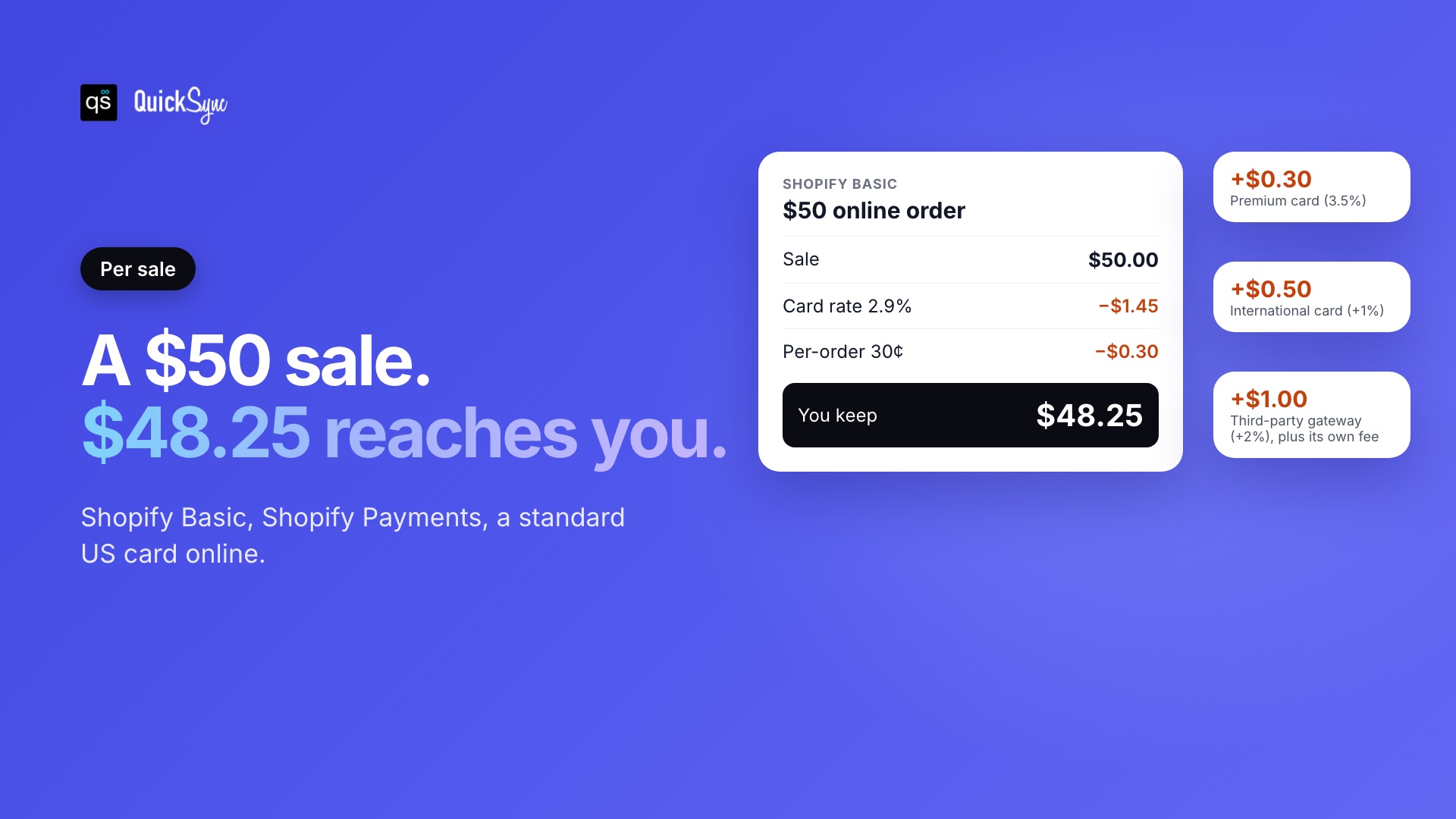
Shopify fees per sale depend on your plan. On the Basic plan, Shopify takes 2.9% plus 30 cents from each online card sale. That’s $1.75 on a $50 order, so $48.25 reaches you. On a $20 order it’s 88 cents. In person, Basic charges 2.6% plus 10 cents, or $1.40 on $50. Higher plans charge a little less.
Here’s the online card fee on three common order sizes:
| Plan | $20 sale | $50 sale | $100 sale |
|---|---|---|---|
| Basic | $0.88 | $1.75 | $3.20 |
| Grow | $0.84 | $1.65 | $3.00 |
| Advanced | $0.80 | $1.55 | $2.80 |
| Plus | $0.75 | $1.43 | $2.55 |
That’s the best case: a standard US card, paid online through Shopify Payments. Three things push it up.
- Premium cards cost more. Shopify charges 3.5% plus 30 cents on premium cards on Basic. On a $50 order that’s $2.05, not $1.75.
- International cards add 1%. A $50 order from a buyer abroad costs $2.25 on Basic.
- Keyed-in card payments cost more in person. Typing a card number into Shopify POS costs 3.5% plus 10 cents instead of 2.6% plus 10 cents.
You’ll see these mixed together on your payout, which is why the effective rate is usually a bit higher than the headline 2.9%.
The fees that aren’t on the plan card
The monthly price and card rate are the two numbers everyone compares. These are the ones that catch people out later.
Third-party payment providers. If you take card payments through a provider other than Shopify Payments, Shopify adds its own transaction fee. That’s on top of what your provider charges. These are the Shopify transaction fees people usually mean: 2% on Basic, 1% on Grow, 0.6% on Advanced and 0.2% on Plus. On a $50 Basic order, that’s an extra $1.00 before your provider takes anything. Mixing providers costs extra too. If you keep Shopify Payments on for Shop Pay alongside another card provider, Shopify’s help center says those Shopify Payments transactions carry a 1.25% premium.
POS Pro. Selling in person with a phone or card reader is included on every plan. POS Pro, which adds staff roles, in-store inventory management and in-store pickup, costs $89 a month per location.
Apps. Most stores add apps for reviews, email, shipping and syncing. Each one is a separate monthly bill, and they add up faster than the plan price.
Marketplace orders. Shopify’s Marketplace Connect app links your store to marketplaces such as Amazon, eBay, Walmart and Target Plus, and syncs their orders into Shopify. Your first 50 synced marketplace orders each month are free. After that, Shopify charges 1%, up to $99 a month. We come back to this below, because it’s where selling on several channels starts to cost real money.
Which Shopify plan is cheapest for you?
Shopify Basic is the cheapest plan until you sell about $30,000 a month online. Grow costs $60 more a month billed yearly and saves 0.2% on each online sale, so it only pays for itself above that level. Advanced only beats Grow on fees once you pass about $135,000 a month.
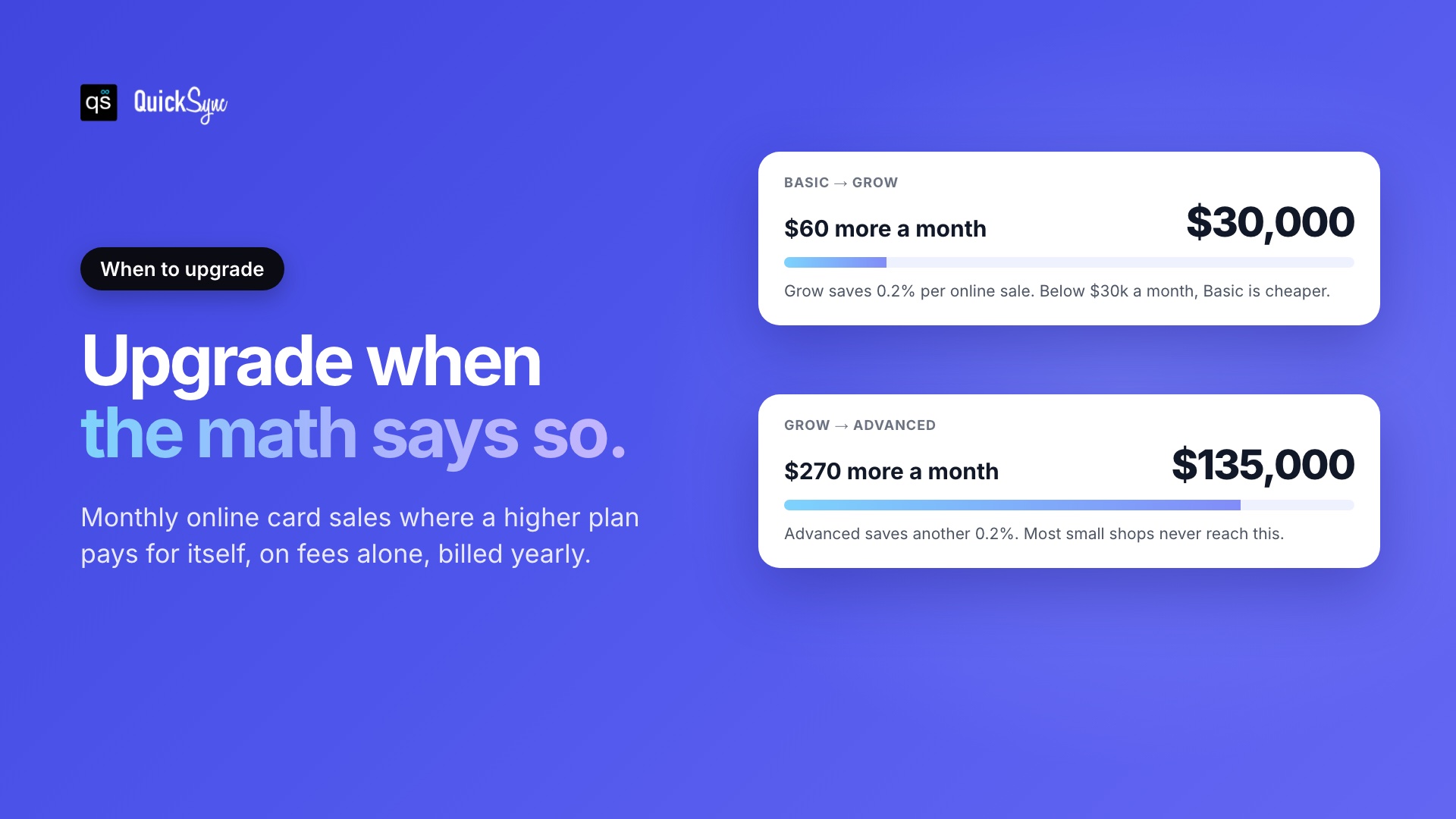
Here’s the math. Grow’s card rate is 2.7%, Basic’s is 2.9%. That 0.2% difference is $2 for every $1,000 you sell. Grow costs $60 a month more on yearly billing, so you need $30,000 in online card sales before the savings cover it. On monthly billing, the gap is $66 and the break-even is $33,000.
The same logic applies one step up. Advanced costs $270 a month more than Grow on yearly billing and saves another 0.2%, so it pays off at $135,000 a month. On monthly billing it’s $147,000.
Fees aren’t the only reason to upgrade. Grow adds up to 5 staff accounts and Advanced up to 15, and you might need those well before you hit the break-even. But if you’re upgrading only to save on card fees, run your own numbers first.
One saving that works on any plan: bill yearly. It costs $120 less a year on Basic, $192 on Grow and $480 on Advanced.
The true cost of selling on multiple channels
Selling on Shopify, Etsy, eBay and TikTok Shop means paying four sets of fees, not one. Each channel takes its own cut of every sale. Then you pay to keep listings, orders and stock counts in step between them, either with a connector app or with your own time.
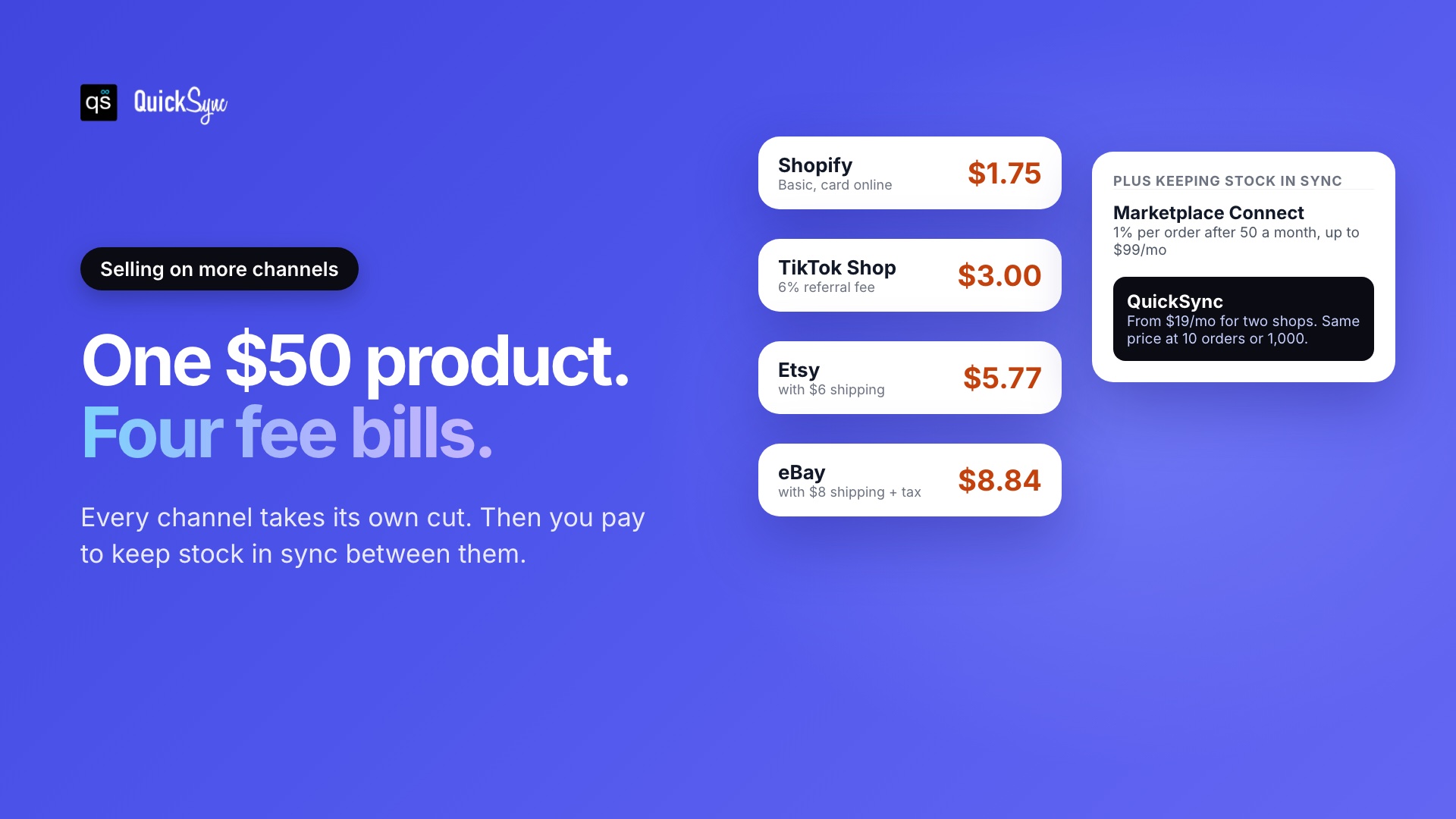
Here’s what each channel takes from a $50 sale, using the worked examples from our fee guides:
| Channel | Fee on a $50 sale | What’s in it |
|---|---|---|
| Shopify (Basic) | $1.75 | 2.9% + 30¢ card fee |
| TikTok Shop | $3.00 | 6% referral fee, before any creator commission (TikTok Shop fees) |
| Etsy | $5.77 | Listing, 6.5% transaction and payment processing fees, with $6 shipping charged (Etsy fees) |
| eBay | $8.84 | 13.6% of the total including $8 shipping and sales tax, plus 40¢ (eBay seller fees) |
The channel rates come from Etsy’s fees policy, eBay’s selling fees page and TikTok Shop’s referral fee page, worked through in each guide.
The examples use different shipping amounts, so they aren’t a perfect match. Charged on the same totals, Shopify Basic’s card fee would be $1.92 on the Etsy order and $2.10 on the eBay one. It’s still the smallest line on the bill. The bigger costs of selling on several channels come from two places.
Keeping the channels connected
Every channel has its own stock count. When something sells on eBay, Shopify doesn’t know unless something tells it. You can update counts by hand, or use a connector.
Shopify’s own option is Marketplace Connect, which covers Amazon, eBay, Walmart and Target Plus. Its pricing is per order: the first 50 synced marketplace orders a month are free, then 1% up to $99 a month. Sell 100 marketplace orders a month at $50, and the 50 over the free limit add about $25 (1% of $2,500). Sell 300, and you hit the $99 cap. It also can’t make new Etsy connections, as we covered in our guide to Shopify Etsy integration apps.
The alternative is a flat-priced sync tool. QuickSync’s pricing starts at $19 a month for two shops and is based on how many items you list, not how many orders you get. A busy month costs the same as a quiet one. See how it works for Shopify and eBay or Shopify and Etsy.
Selling stock you don’t have
The cost nobody puts in a fee table is overselling. If a sale on Etsy doesn’t reach Shopify and eBay fast enough, the same last unit sells twice. You refund one buyer, the cancellation goes on your seller record, and the fees you paid on that sale don’t come back.
That’s why stock sync isn’t optional once you’re on two or more channels. With real-time inventory syncing, a sale on any channel lowers the count everywhere else, usually within a couple of minutes. Our guide on how to prevent overselling covers the other fixes.
How to lower your Shopify fees
Shopify’s card rates are set by your plan, but you can stop paying for things you don’t need. Here are the six changes that make the biggest difference.
- Bill yearly. It’s the same plan for less: $120 a year saved on Basic, $480 on Advanced.
- Use Shopify Payments as your only provider. It removes the 2% third-party fee on Basic, and the 1.25% premium that applies when you mix providers.
- Pick your plan by break-even, not by feature list. Stay on Basic until you’re near $30,000 a month online, unless you need the staff accounts.
- Watch per-order fees as you add channels. A connector that charges per order costs more every time you grow. Flat pricing doesn’t.
- Stop paying for oversells. One cancelled order can cost more than a month of sync software.
- Audit your apps every quarter. Cancel the ones you installed for a test and forgot about.
The fee you’re probably overpaying isn’t Shopify’s
Shopify fees in 2026 are easy to work out once they’re in one place: $29 to $39 a month on Basic, 2.9% plus 30 cents per online sale, and a few extras for premium cards, other payment providers and POS Pro. For most small shops, Basic billed yearly is the cheapest plan until online sales near $30,000 a month.
But if you sell on more than one channel, Shopify’s fee is the smallest number on your bill. The bigger costs are the other channels’ fees, the per-order price of keeping them connected, and the orders you refund because a stock count was wrong.
That last one is the cost you can remove. QuickSync connects Shopify to Etsy, eBay, Amazon, TikTok Shop and your POS, and keeps one stock count across all of them. It’s priced by catalogue, not orders, starting at $19 a month for two shops. Start 14-day trial: no card, and every trial includes a free 30-minute session where the team connects your first two shops with you.
Shopify’s fees are fixed. What you lose to oversells isn’t.