
Etsy gives you buyers on day one. Shopify gives you a shop that is fully yours. Most sellers think they have to pick one.
The trade-off is real, and the numbers show it. Etsy reported about 87 million active buyers in its second-quarter 2026 letter to shareholders. Any of them can find your listing through Etsy search. A new Shopify store starts with none. In return, Etsy keeps about $10 of every $100 sale, while Shopify takes $3.20 plus a monthly plan.
You don’t have to choose one forever. This guide compares Shopify vs Etsy on fees, traffic, control, and effort, so you can see which one fits your shop today. It also covers when running both makes sense, and how to do it without selling the same item twice.
The short answer
- Choose Etsy if you’re starting out, sell handmade, vintage or craft supplies, and need buyers more than you need control.
- Choose Shopify if you already have a following, want your own brand and customer list, and can bring traffic yourself.
- Run both once you’re growing. Etsy finds new buyers, and Shopify keeps the ones who come back.
Shopify vs Etsy at a glance
Before going into each difference, here is how Etsy vs Shopify compares side by side.
| Etsy | Shopify | |
|---|---|---|
| What it is | A marketplace for handmade, vintage, and craft items | A platform for building your own online store |
| Who brings buyers | Etsy, through its search and ads | You, through social media, email and ads |
| Fee on a $100 sale | $9.95, plus 15% if an Offsite Ad made the sale | $3.20 with Shopify Payments and a US card |
| Monthly cost | None required | $39 on Basic, or $29 billed yearly |
| Cost to open | A one-time $15 fee for some new shops | Free trial, often followed by $1 a month for the first three months |
| What you can sell | Items made, designed, handpicked or sourced by you | Almost anything legal |
| Your customers | Belong to Etsy’s marketplace | Yours, including their email addresses |
| Best for | New shops and makers who need buyers | Brands with an audience to bring |
The table makes Shopify look cheaper, and per sale it is. But fees are only half the story, so let’s start there and then look at what each fee actually buys you.
Shopify vs Etsy fees on a $100 sale
Etsy charges three fees on every sale. There is 20 cents to list, a 6.5% transaction fee, and 3% plus 25 cents for payment processing, according to Etsy’s fees policy. On a $100 sale with free shipping, that comes to $9.95.
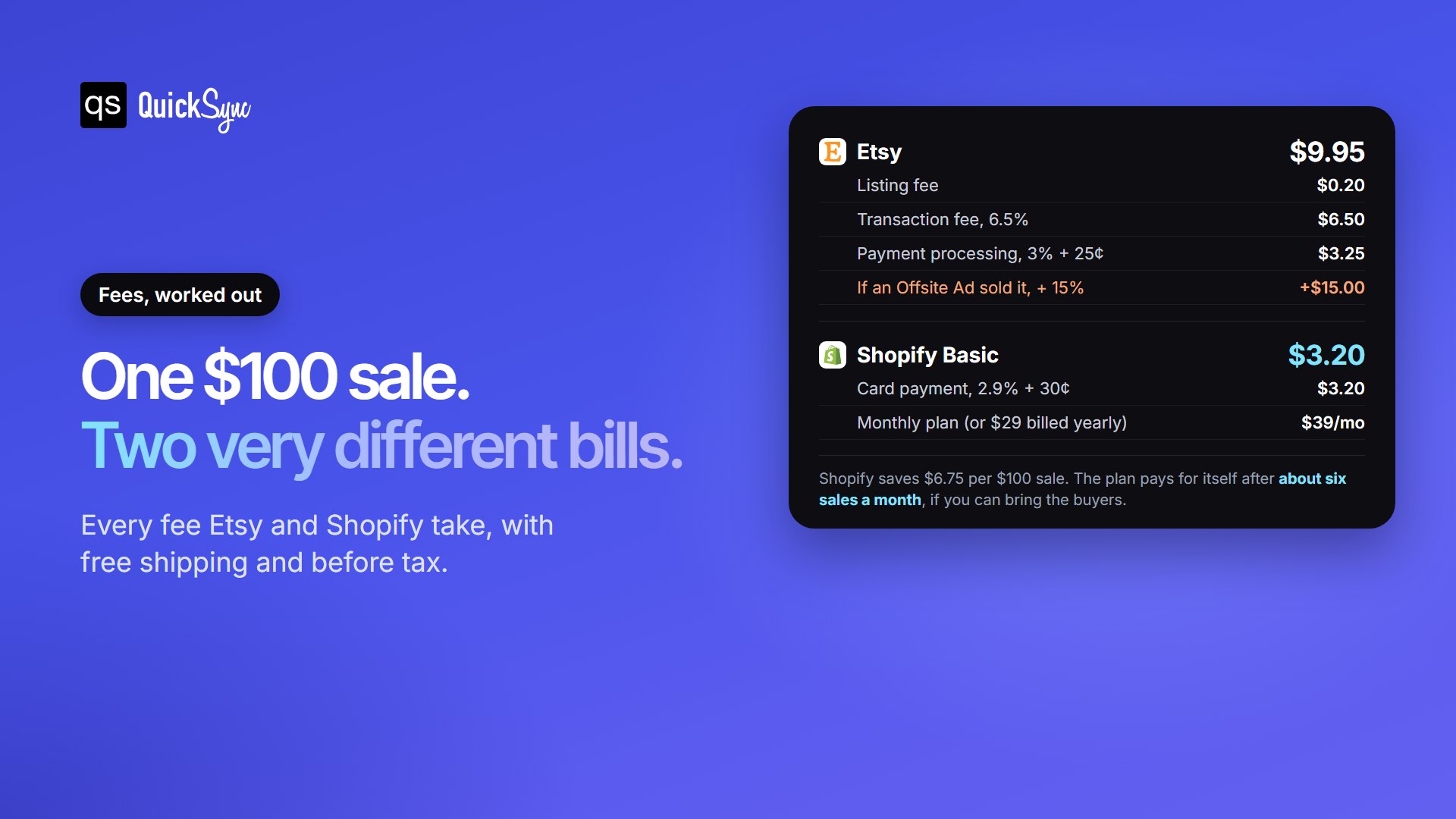
Etsy’s Offsite Ads can add a lot more. When a buyer arrives through an ad Etsy ran for you, Etsy takes another 15% of the order. Once your shop has made $10,000 in a year, the rate drops to 12%. On our $100 sale, that is $15 more. That hurts on thin margins. Craftybase, which makes inventory software for makers, warns that you need a margin of at least 20 to 25% after Etsy’s standard fees. Below that, an Offsite Ads sale can leave you losing money or barely breaking even. Our guide to Etsy fees walks through every charge.
Shopify works the other way round. You pay a monthly plan, and then a smaller fee on each sale. According to Shopify’s pricing page, the Basic plan costs $39 a month, or $29 a month billed yearly. Online payments with a standard US card through Shopify Payments cost 2.9% plus 30 cents. On a $100 sale, that is $3.20. If you use a different payment provider instead, Shopify adds a 2% fee on top.
Put the two together and Shopify saves you $6.75 on every $100 sale. The $39 plan pays for itself after about six of those sales a month. Before that point, Etsy is usually cheaper overall. After it, Shopify wins on fees, but only if you can bring the buyers.
Traffic: who brings the buyers
That “if” is the biggest difference between the two. Etsy is a marketplace. People go there to shop, search for something like “personalised leather wallet”, and find your listing. A good part of your Etsy fee pays for that traffic.
Shopify is a store builder. It gives you the shop, but nobody walks past it. Every visitor has to come from somewhere you create, such as Instagram, TikTok, an email list, Google or paid ads. That takes time, and ads cost money that never shows up on Shopify’s fee page.
This is why the fee comparison can mislead new sellers. A shop with no audience pays less to Shopify per sale but often makes far fewer sales. Etsy’s higher fee is the price of buyers who were already looking.
Control: your brand, your customers, your rules
Once you do have buyers, control starts to matter more than traffic. On Etsy, your shop lives inside Etsy’s rules. Everything you list must be made, designed, handpicked or sourced by you under Etsy’s Creativity Standards. Etsy also controls how search ranks your listings, and it can suspend a shop it thinks has broken a policy. Our guide on how to avoid getting banned on Etsy covers the most common reasons.
Customer relationships are limited too. Etsy’s off-platform policy bans moving an Etsy sale elsewhere, so you can’t send an Etsy buyer to your own website to pay.
Shopify gives you that control back. You choose the design, use your own domain and keep every customer’s email address. When they buy again, they buy from you, not from a marketplace that also shows them your competitors.
Setup and day-to-day work
Control comes with more work. An Etsy shop can be live in an afternoon. You add photos, a description and a price, and Etsy handles the checkout, the design and the payments. Some new shops pay a one-time $15 setup fee before opening. Our guide on how to create an Etsy account walks through each step.
A Shopify store takes longer. You pick a theme, connect a domain, set up payments, shipping and tax, and write your own policy pages. Many stores also add apps for reviews or email, and many of those charge their own monthly fee. None of it is hard, but it adds up to days, not hours.
Shopify or Etsy: which should you choose?
Putting fees, traffic and control together, the answer depends mostly on where your shop is today.
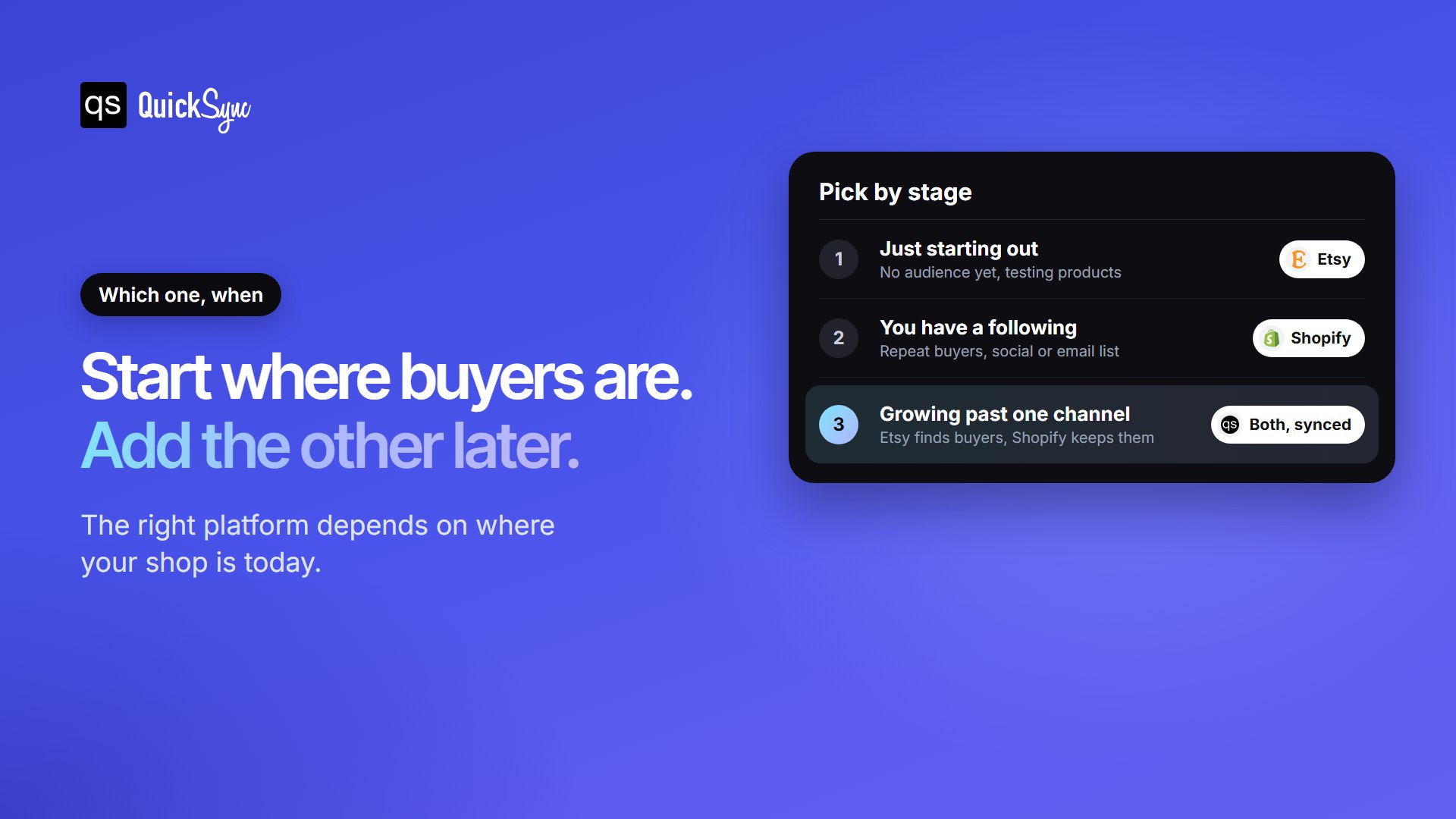
- Just starting out: start on Etsy. You get buyers before you have an audience, and you learn what sells without paying a monthly plan.
- You already have a following: start on Shopify. If people already know you from social media or markets, you can send them straight to a shop you own.
- You’re growing on Etsy: add Shopify. Keep Etsy for new buyers, and give your repeat customers a place to buy directly.
That last stage is where many sellers end up, so it is worth knowing how running both works in practice.
Final Take: Can you sell on both Shopify and Etsy?
Yes, and nothing in Etsy’s rules stops you listing the same items on your own store. The hard part is keeping Etsy and Shopify in step. Handmade stock is usually small. If a piece sells on Etsy and is still live on Shopify, a second buyer can pay for something you no longer have.
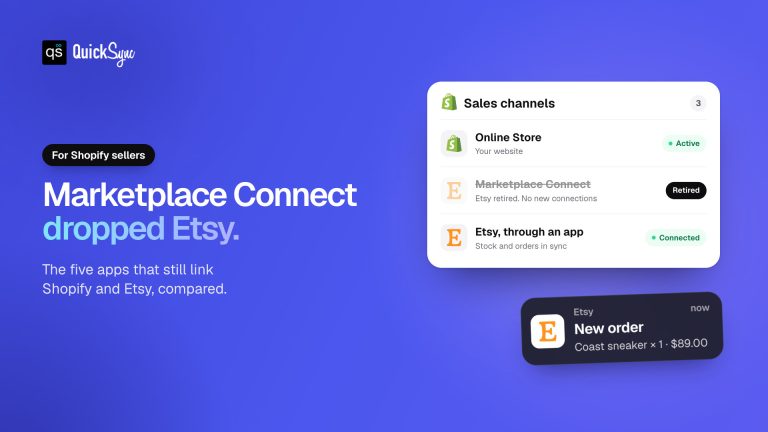
There is no longer a free built-in fix. Shopify’s own Marketplace Connect app used to link the two, but its help center now says new Etsy connections can’t be made. Many older guides still recommend it, so check the date on anything you read. Today, you need a third-party app. We compare the main options in our guide to Shopify Etsy integration apps.
Whichever app you use, two Etsy limits matter before you connect anything. Etsy allows only two option types per listing, so a product sold by size, colour and material on Shopify has to fold down to two. And each variation needs its own SKU, because two listings sharing one code means two stock counts that can drift apart.
Timing matters too. Etsy doesn’t send an alert when something sells, so any sync tool has to check. QuickSync looks for new Etsy orders every five minutes and for stock changes every two, then updates Shopify within seconds. For your fastest sellers, keeping one spare unit back covers that short window. The Shopify Etsy integration page shows exactly what syncs in each direction.