

The best Vendoo alternative depends on what you sell. If you resell one-off items on Poshmark, Mercari, or Depop, try List Perfectly, Crosslist, PrimeLister, Nifty, or Flyp. If you sell multiple units or variants on eBay, Etsy, and Shopify, you need inventory sync instead of crosslisting, and that’s what QuickSync does.
Vendoo is one of the most popular crosslisting apps for resellers. It says more than 81,000 resellers use it to post items to eBay, Poshmark, Mercari, Etsy, Depop, Shopify, and others, then delist them when they sell.
For a closet of one-of-a-kind pieces, that works well. Problems start when your business changes. Maybe you now restock the same product, sell in sizes and colors, or run a Shopify store as your main channel. At that point, you’re paying for a tool built around single items while you manage quantities by hand.
This guide compares six Vendoo alternatives, with pricing and marketplace support checked on each tool’s own site in November 2026. It also covers the question most comparison posts skip: whether you need a crosslister at all.
Why do sellers look for a Vendoo alternative?
Most sellers who leave Vendoo aren’t unhappy with crosslisting. They switch because the price rises as they grow, Shopify costs extra, some channels aren’t covered, or they now sell multiple units of the same product. Here’s each reason in more detail.
The price climbs as you grow. Vendoo’s pricing page lists Starter at $14.99 a month, Growth at $29.99, and Pro at $59.99. Bulk actions, AI listing tools, and auto offers sit in the higher tiers.
| Vendoo plan | Monthly | Billed yearly | What it adds |
|---|---|---|---|
| Starter | $14.99 | $12.49/mo | Unlimited items, sale detection and auto-delisting |
| Growth | $29.99 | $24.99/mo | AI listing tools, bulk actions on up to 240 listings |
| Pro | $59.99 | $49.99/mo | Auto offers, marketplace sharing, listing videos |
Shopify costs extra. Vendoo’s homepage says connecting Shopify adds a $9.99 monthly charge, billed through Shopify. If Shopify is your main store, that’s a second bill for your most important channel.
Some channels aren’t covered. Vendoo doesn’t list TikTok Shop, Amazon, Square, or Clover. If you also sell in person or on TikTok Shop, those sales won’t reach your other listings.
You sell quantities, not one-offs. Crosslisters are built mainly for one-off items. Their core job is to spot a sale and remove the item everywhere else. Vendoo does offer multi-quantity listings, but a listing with 20 units across five variants needs its stock count kept right on every channel, after every sale.
That last point decides which kind of tool you need. So let’s look at it properly.
Crosslister or inventory sync: which do you need?
A crosslister copies a listing to several marketplaces and delists it everywhere once it sells. An inventory sync tool keeps one stock count across your channels and updates every listing’s quantity after each sale. Resellers of one-off items need a crosslister. Sellers with repeat stock or variants need inventory sync.
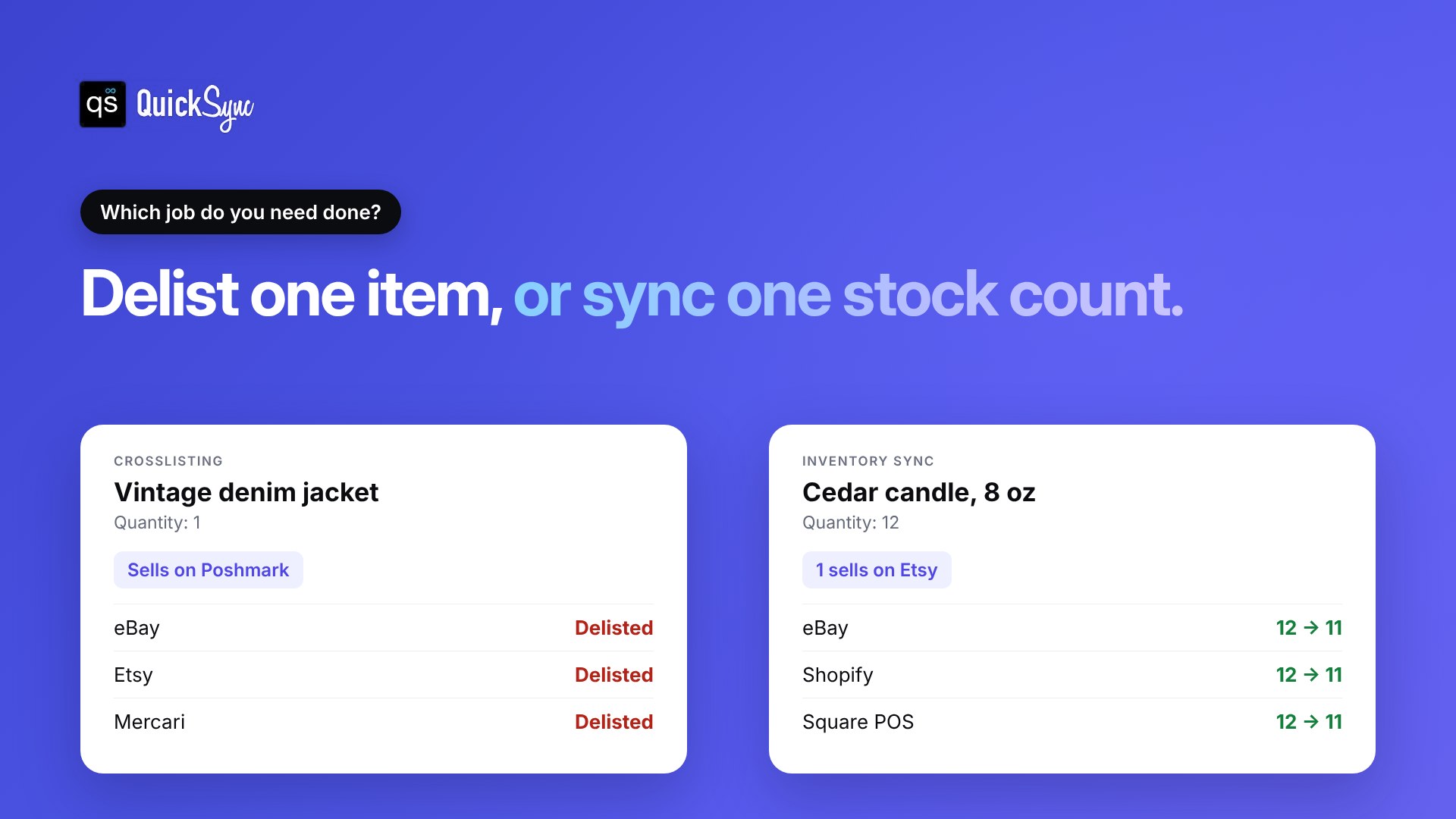
Here’s what this looks like in practice.
A reseller finds a vintage denim jacket. There’s exactly one. They list it on eBay, Poshmark, and Etsy. It sells on Poshmark, so the cross-lister pulls it from eBay and Etsy. Job done.
Now take a candle maker with 12 jars of one scent on Etsy, eBay, and Shopify. A jar sells on Etsy. Nothing should be delisted, because 11 jars are still for sale. What needs to happen is a quantity change from 12 to 11 on every channel. On the next sale, 11 to 10. When the last jar sells, every channel shows zero.
That’s a different job. If your tool can’t do it, you end up fixing quantities yourself, and one missed update is enough to sell a jar you don’t have.
On eBay, that mistake has a cost. eBay’s seller standards policy counts an order you cancel because it’s out of stock as a transaction defect. If your defect rate goes above 2% and involves more than four buyers, your account drops to Below Standard. Our guide on how to prevent overselling covers the other ways this goes wrong.
Before you compare tools, decide which camp you’re in. Most of the confusion in this category comes from comparing the two as if they did the same job.
The best Vendoo alternatives at a glance
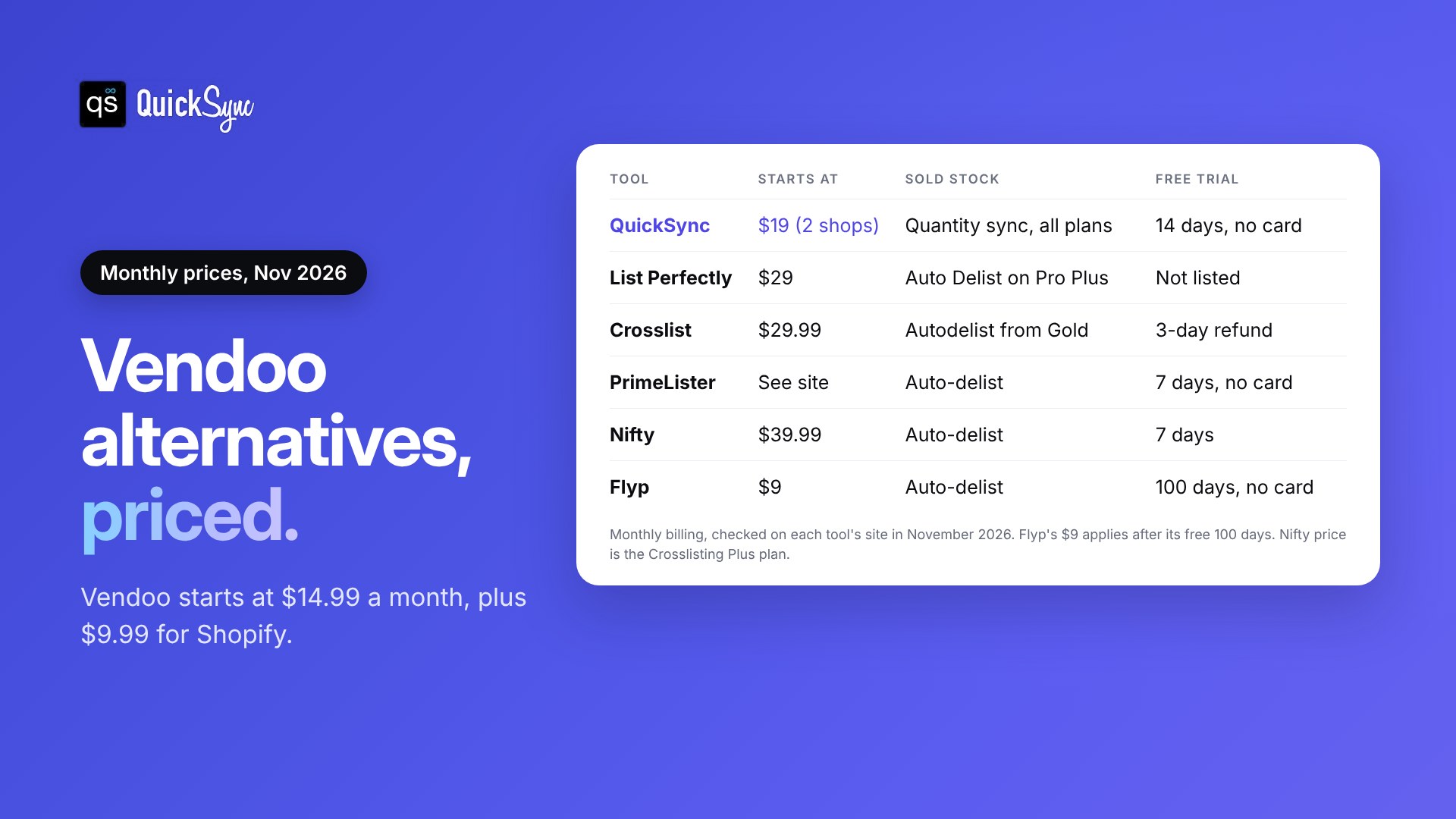
| Tool | Best for | Starting price | eBay, Etsy, Shopify | Free trial |
|---|---|---|---|---|
| QuickSync | Multi-quantity stock, variants and POS | $19/mo for 2 shops ($38 for 3) | All three, plus TikTok Shop, Amazon, Square, Clover | 14 days, no card |
| List Perfectly | Fashion resellers who want lots of marketplaces | $29/mo | eBay and Etsy (no Shopify listed) | Not listed |
| Crosslist | Low-cost crosslisting at higher volumes | $29.99/mo | All three, plus WooCommerce | 3-day money-back |
| PrimeLister | Crosslisting plus Poshmark automation | See pricing page | All three | 7 days, no card |
| Nifty | Resellers who want automation bots | $39.99/mo | eBay and Etsy (no Shopify listed) | 7 days |
| Flyp | Budget crosslisting | $9/mo after 100 free days | eBay and Etsy (no Shopify listed) | 100 days, no card |
Prices are monthly billing, checked on each tool’s site in November 2026. Most offer a discount if you pay yearly.
6 Vendoo alternatives worth trying
Each tool below is listed with what it’s best for, what it costs, and where it falls short. The first one is ours, so we’ve been specific about when it isn’t the right pick.
1. QuickSync: best for multi-quantity inventory across eBay, Etsy and Shopify
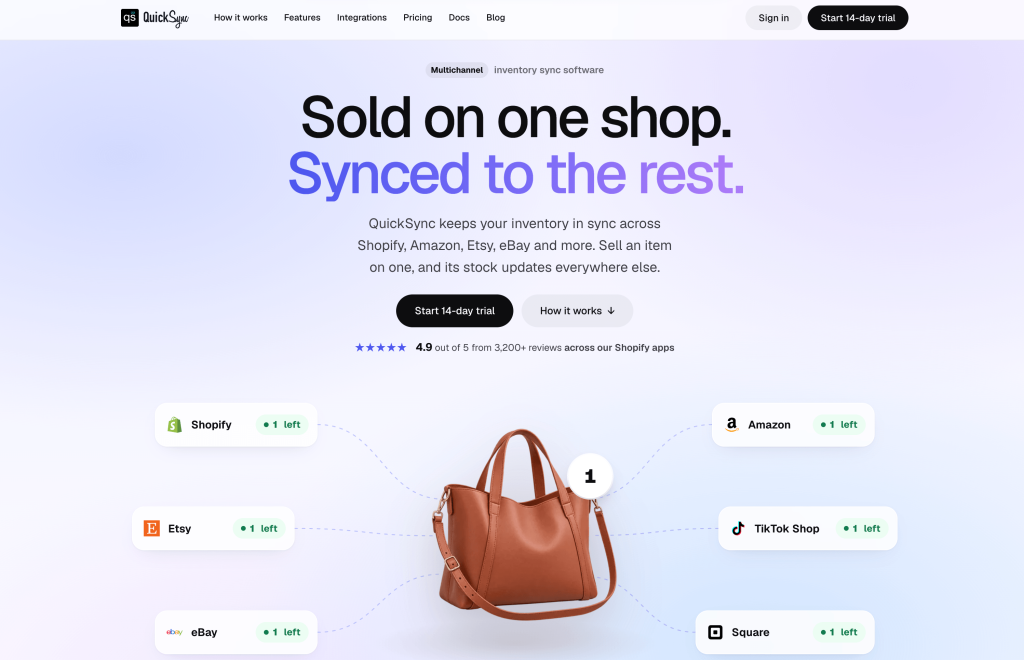
QuickSync isn’t a crosslister. It’s an inventory sync tool. You connect your shops, and QuickSync keeps one shared stock count across them. When an item sells on Etsy, the quantity drops on eBay, Shopify, and every other connected channel.
It connects 13 platforms: Shopify, Amazon, Etsy, eBay, TikTok Shop, WooCommerce, Square, Clover, Squarespace, Lightspeed, Wix, QuickBooks and Xero. Stock syncs both ways on eBay, Etsy, Shopify, TikTok Shop, and the POS systems. On Amazon, it’s two-way for orders you ship yourself and one-way for FBA, according to our integrations page.
Pricing: Lite is $19 a month for two shops and 1,000 items, with stock sync. Pro is $29 for 2,500 items and adds product sync and order sync. Ultra is $69 for 10,000 items and adds price rules, so you can charge more on channels with higher fees. Ultra+ is $99 for 20,000 items. Each plan includes two shops, and each extra shop adds the plan price again, so eBay, Etsy, and Shopify on Lite comes to $38 a month. Orders are unlimited on every plan. Full details are on the QuickSync pricing page.
Watch out for: QuickSync doesn’t connect to Poshmark, Mercari, Depop, or Grailed. If those are your main channels, pick one of the crosslisters below.
2. List Perfectly: best for fashion resellers on many marketplaces
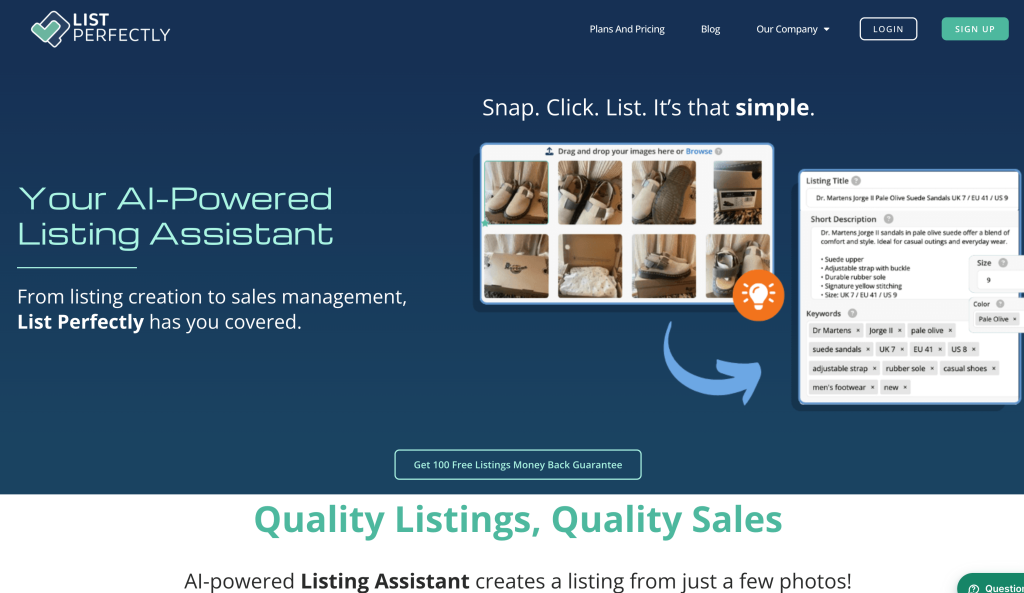
List Perfectly is a crosslister aimed at resellers, with a strong lean toward fashion marketplaces. Its pricing page lists Depop, eBay, Etsy, Facebook, Grailed, Mercari, Poshmark, Vestiaire Collective, and a lighter Vinted connection.
Pricing: Simple is $29 a month, Business $49, Pro $69, and Pro Plus from $99.
Watch out for: Auto Delist is only included on Pro Plus. Shopify isn’t on its marketplace list, so it’s a poor fit if Shopify is your main store.
3. Crosslist: best for low-cost crosslisting at volume
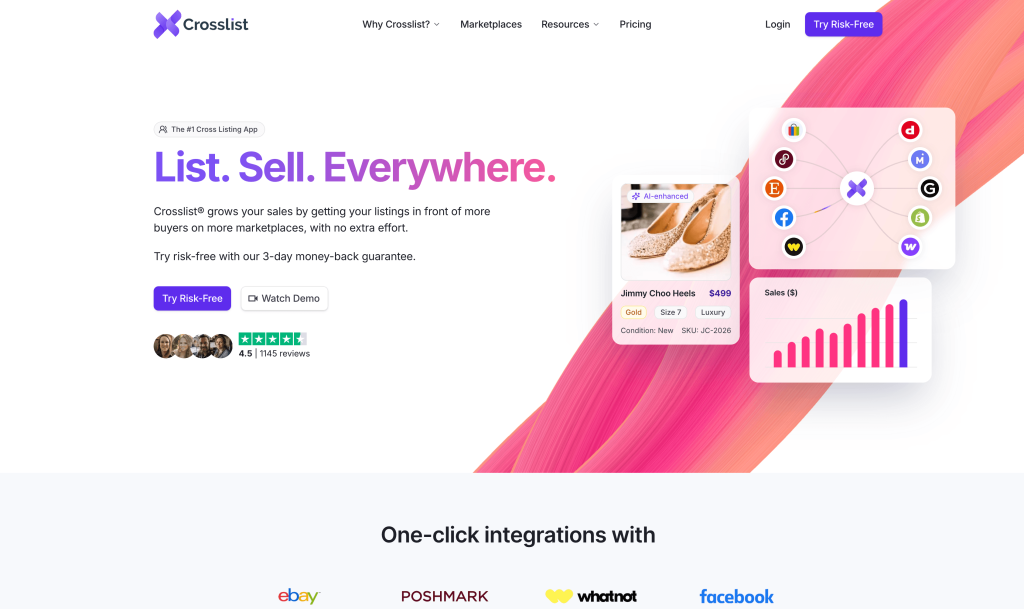
Crosslist keeps its plans close together on price, so moving up a tier doesn’t cost much. Its homepage lists eBay, Poshmark, Mercari, Depop, Etsy, Facebook Marketplace, Grailed, Whatnot, Shopify, WooCommerce, and OfferUp. It’s available in the US, UK, Canada, and Australia.
Pricing: According to Crosslist’s pricing page, Bronze is $29.99 a month for 200 new listings, Silver is $34.99 for 500, Gold is $39.99 for 1,000, and Diamond is $44.99 for unlimited.
Watch out for: Auto-delisting starts at Gold. There’s no free trial, only a three-day money-back guarantee if you’ve created fewer than 20 listings. It doesn’t support EU users.
4. PrimeLister: best for crosslisting plus Poshmark automation
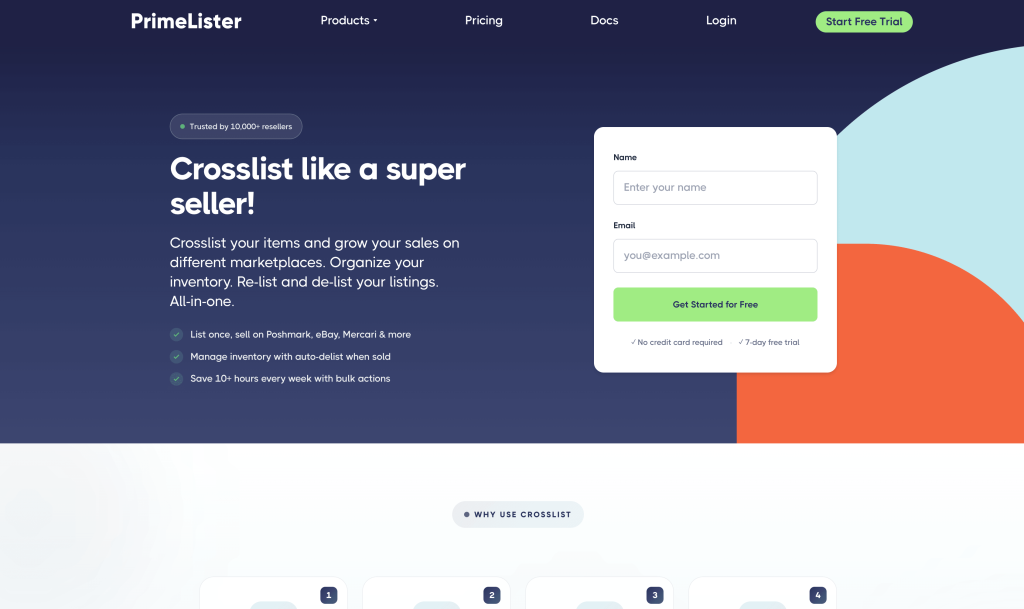
PrimeLister combines crosslisting with automation tools for Poshmark, Depop, eBay, Mercari, Vinted, and Whatnot. Its site shows crosslisting to eight marketplaces, including eBay, Etsy, and Shopify, with automatic delisting after a sale.
Pricing: Prices are set by plan on PrimeLister’s pricing page. You can test it first with a seven-day free trial, and no card is needed.
Watch out for: Like any crosslister, it’s built around single items. Sellers with deep stock still need a way to keep quantities matched.
5. Nifty: best for resellers who want automation bots
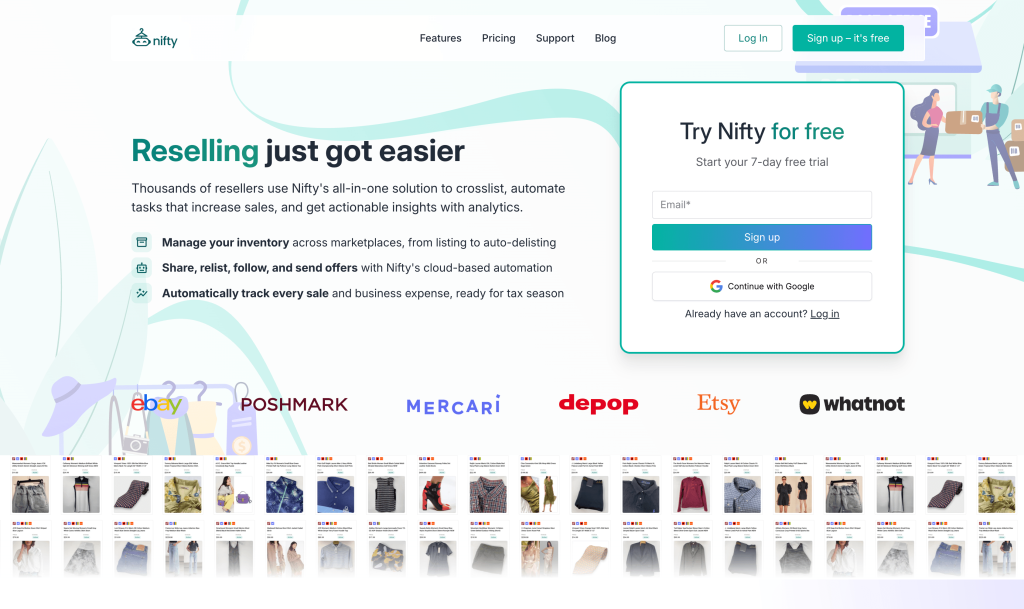
Nifty pairs crosslisting with automation tools for Poshmark, eBay, Mercari, and Depop. Its homepage lists crosslisting to Poshmark, eBay, Mercari, Depop, Etsy, and Whatnot, and auto-delisting runs without Nifty being open.
Pricing: On Nifty’s pricing page, Crosslisting Plus costs $35.99 to $39.99 a month depending on how you bill, for up to 1,500 active items. Bundles with automation start at $69.99.
Watch out for: No Shopify support is listed. Larger closets cost an extra $20 a month.
6. Flyp: best for budget cross-listing
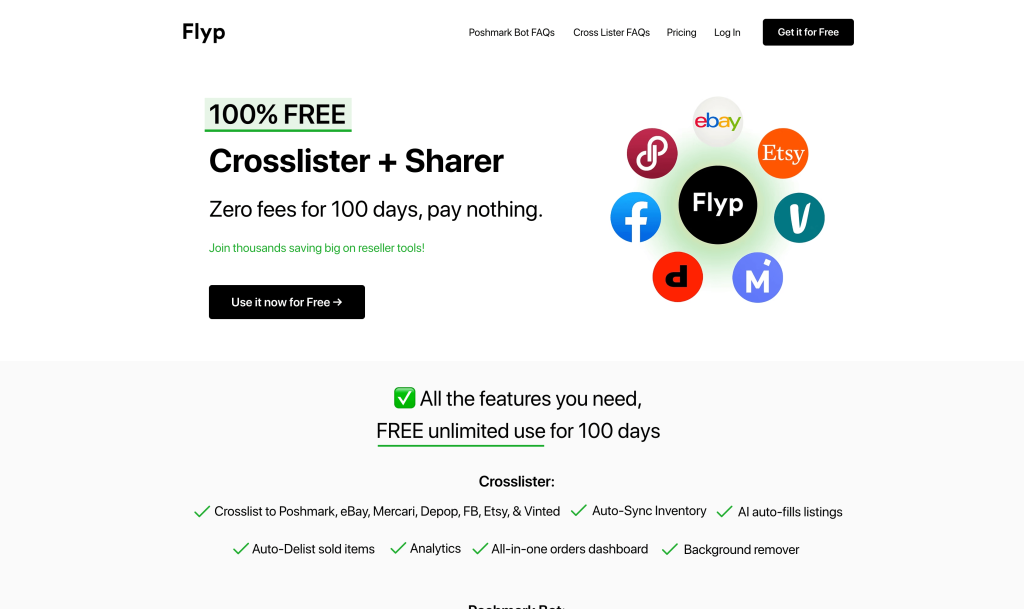
Flyp is the cheapest option here. It lists Poshmark, eBay, Mercari, Depop, Facebook, Etsy, and Vinted as supported marketplaces, and it includes auto-delisting.
Pricing: Flyp’s pricing page says it’s free for 100 days with no card, then $9 a month for everything.
Watch out for: Shopify isn’t mentioned. It’s a cross-lister first, so it won’t keep multi-unit quantities in line across your own store and marketplaces.
How do I choose the right Vendoo alternative?
Choose by the problem you’re solving, not by the tool’s feature list. If Vendoo’s price is the issue, compare cross-listers. If Shopify, TikTok Shop, or in-person sales are the issue, or you sell more than one of each item, you need inventory sync.
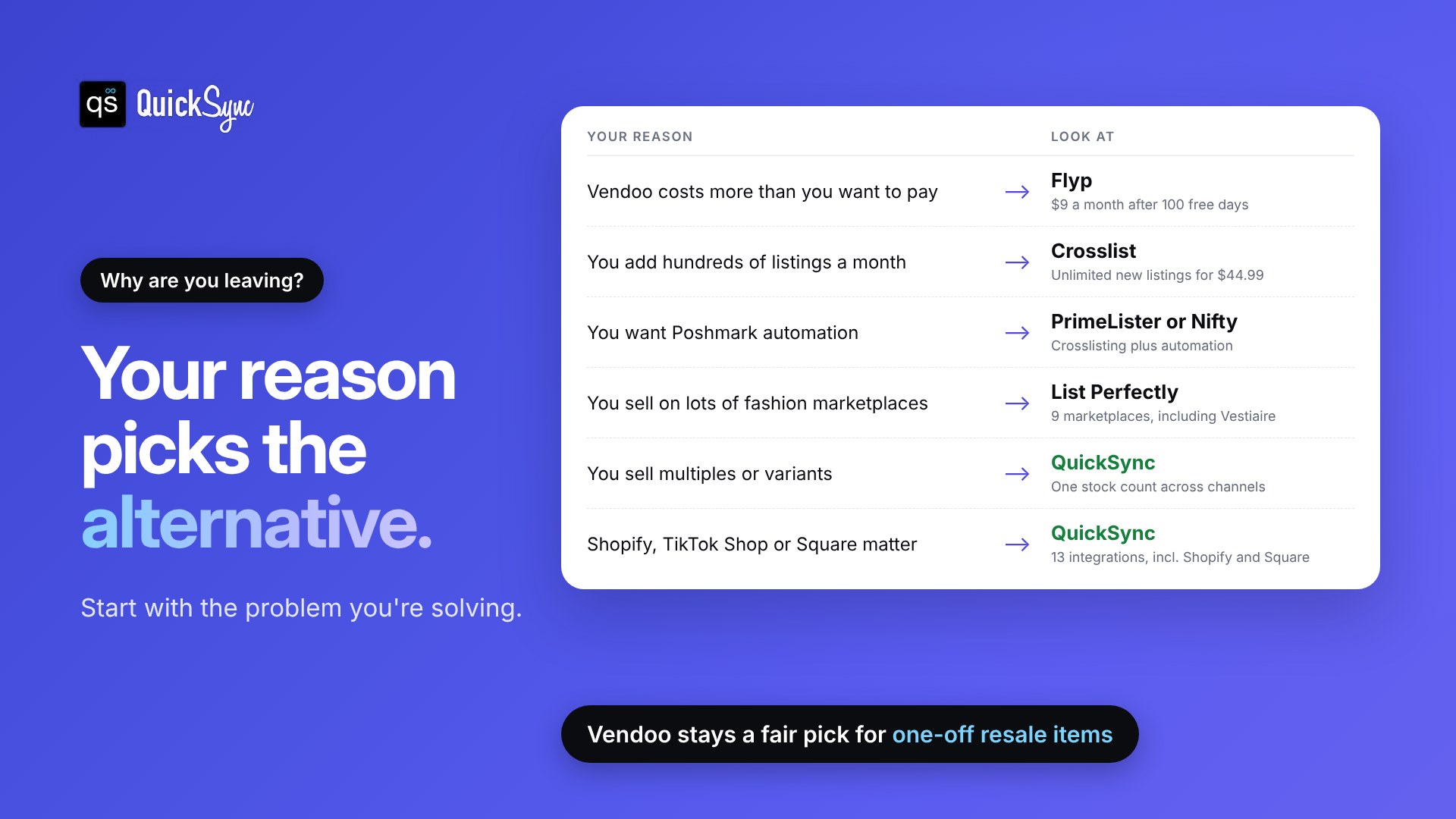
Three questions settle it for most sellers.
Do you sell one-offs or repeat stock? One-offs suit a crosslister. Repeat stock and variants need a shared stock count.
Where do most of your sales happen? If it’s Poshmark, Mercari, or Depop, stay with a crosslister. If it’s eBay, Etsy, and Shopify, and you restock what you sell, an inventory sync tool keeps all three on one stock count.
Do you sell anywhere offline? Craft fairs, pop-ups, and shops run on Square or Clover. A crosslister can’t see those sales. QuickSync connects Square and Clover to the same stock count as your online shops.
How to switch from Vendoo without breaking your listings
Switching tools is where sellers make mistakes, mostly by letting two tools edit the same listings at once. Run the move in this order.
1. Download your inventory first
Vendoo offers downloadable spreadsheets of your inventory. Export one before you change anything, so you have a record of every item and quantity.
2. Check your billing cycle
Vendoo’s yearly plans can’t be changed until the end of the billing cycle. If you’re on annual billing, plan the switch for your renewal date.
3. Match your SKUs
Give every product the same SKU on every channel. Sync tools use SKUs to match listings, so a typo here means a listing that never updates. Our guide on what a SKU is explains how to set them up.
4. Test on a few products
Connect your shops on a free trial and sync five or ten products first. Make a test sale, then check the quantity on every channel.
5. Stop managing those channels in Vendoo
Before you move everything over, disconnect the channels your new tool will manage from Vendoo, or stop using it for those listings. Two tools changing the same listing is how quantities go wrong.
Is Vendoo still worth it?
Vendoo is still worth it if you resell one-of-a-kind items on Poshmark, Mercari, Depop, and Whatnot. Its Starter plan includes unlimited items and auto-delisting for $14.99 a month. It’s a weaker fit if you sell repeat stock, use Shopify as your main store, or sell on TikTok Shop or in person.
Resale keeps growing. ThredUp’s 2026 Resale Report projects the global secondhand apparel market will reach $393 billion by 2030. For sellers in that market, a crosslister is a sensible tool.
But plenty of sellers start as resellers and turn into brands. They source the same product twice, add sizes, open a Shopify store, and take a table at a weekend market. That’s when the job changes from “list this item everywhere” to “keep this stock count right everywhere.” Pick the tool that matches the business you run today.
If that’s you, connect your eBay, Etsy, and Shopify stores and see one stock count across all three. You can sync Shopify and Etsy or connect eBay to Shopify, and the team will connect your first two shops with you.