You found a vintage jacket at a thrift store. You list it on eBay, Poshmark, Mercari, and Depop. It sells on Poshmark, and now three other listings show a jacket you no longer own.
A crosslisting app fixes that. It posts one item to several marketplaces from one form. When the item sells, it removes the other listings for you.
Resale is a big market to sell into. ThredUp’s Resale Report projects global secondhand apparel will reach $393 billion by 2030, growing twice as fast as the wider apparel market. More sellers means more tools, and they’re not all built for the same job.
We compared the six best crosslisting apps on price, marketplaces and how they handle a sale. Every price was checked on each app’s own site in November 2026. We also cover what most comparisons skip: when a crosslister is the wrong tool for your business.
What is a crosslisting app?
A crosslisting app (also called a crosslister or cross listing tool) copies one listing to several marketplaces, such as eBay, Poshmark, Mercari, and Depop. When the item sells on one marketplace, the app detects the sale and removes the listing everywhere else. That second step is called auto-delisting, and it stops you from selling the same item twice.
Most crosslisting apps do three jobs:
- Crossposting. You add photos, title, price, and details once. The app formats them for each marketplace.
- Importing. You pull existing listings from one marketplace into the app, then post them elsewhere.
- Auto-delisting. The app watches for sales and removes sold items from your other marketplaces.
The first two save time. The third saves you from cancellations. On eBay, an order you cancel because the item was out of stock or already sold counts as a transaction defect under the seller standards policy. Go above 2% defects with more than four buyers, and your account drops to Below Standard.
So check two things before pricing. Is auto-delisting included on the plan you can afford? And does the app cover the marketplaces where you actually sell?
The best crosslisting apps at a glance
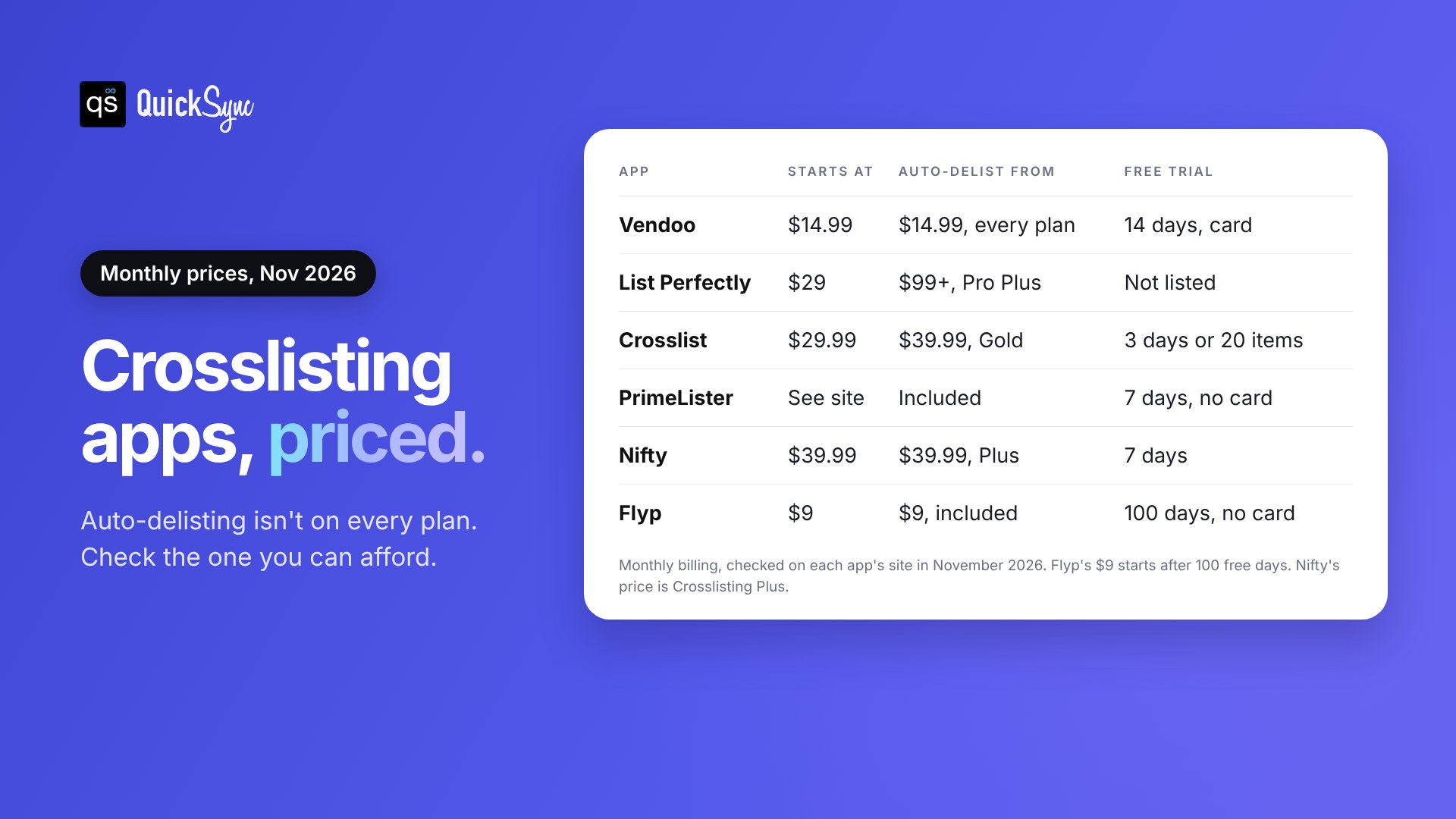
| App | Best for | Starts at | Auto-delist from | Free trial |
|---|---|---|---|---|
| Vendoo | Most resellers | $14.99/mo | $14.99 (every plan) | 14 days, card needed |
| List Perfectly | Fashion marketplaces | $29/mo | $99+ (Pro Plus only) | Not listed |
| Crosslist | High-volume listing | $29.99/mo | $39.99 (Gold) | 3 days or 20 listings |
| PrimeLister | Crosslisting plus Poshmark automation | See pricing page | Included | 7 days, no card |
| Nifty | Crosslisting plus automation bots | $39.99/mo | $39.99 (Crosslisting Plus) | 7 days |
| Flyp | The lowest price | $9/mo after 100 free days | $9 (included) | 100 days, no card |
Prices are monthly billing. Most apps cost less if you pay yearly.
All six crosslist to eBay, Poshmark, Mercari, Depop and Etsy. The differences show up on the other marketplaces:
| App | Shopify | Facebook Marketplace | Whatnot | Grailed | Vinted |
|---|---|---|---|---|---|
| Vendoo | Yes (+$9.99/mo) | Yes | Yes | Yes | No |
| List Perfectly | Pro and Pro Plus | Yes | No | Yes | Lite (no sale detection) |
| Crosslist | Yes | Yes | Yes | Yes | No |
| PrimeLister | Yes | Yes | Automation only | Yes | Automation only |
| Nifty | No | No | Yes | No | No |
| Flyp | No | Yes | No | No | Yes |
“No” means the marketplace isn’t listed on the app’s site in November 2026.
Selling multiples of the same product on eBay, Etsy, or Shopify? Skip ahead to crosslisting app or inventory sync first.
The 6 best crosslisting apps, reviewed
Each app below shows what it’s best for, what it costs, and where it falls short.
1. Vendoo: best crosslisting app for most resellers

Vendoo says more than 81,000 resellers use it. It supports eBay, Poshmark, Facebook Marketplace, Mercari, Etsy, Depop, Shopify, Whatnot, Grailed, and Vestiaire Collective.
Pricing: Vendoo’s pricing page lists Starter at $14.99 a month, Growth at $29.99, and Pro at $59.99. Every plan includes unlimited items. Starter already includes sale detection and auto-delisting on Poshmark, eBay, Mercari, Depop, Whatnot, and Etsy.
Why it stands out: You get auto-delisting, unlimited items, and 10 marketplaces on the entry plan. Only Crosslist lists more. Growth adds AI listing tools and bulk actions on up to 240 listings. Pro adds auto offers and marketplace sharing.
Watch out for: The 14-day trial needs a payment method. Connecting Shopify adds $9.99 a month, billed through Shopify. If you’re thinking of leaving Vendoo, our guide to Vendoo alternatives goes deeper.
2. List Perfectly: best for fashion resellers on many marketplaces
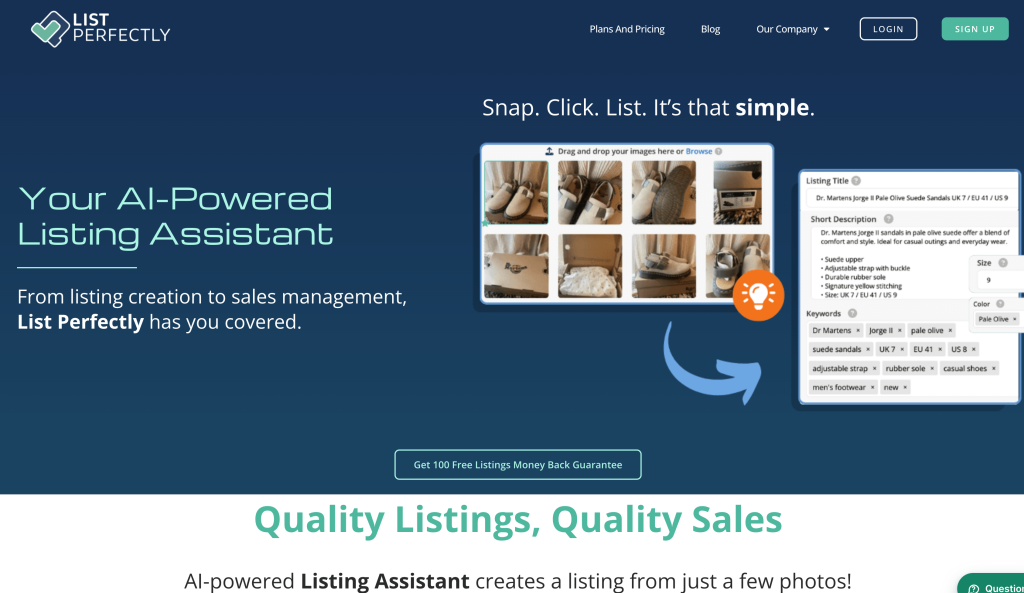
List Perfectly leans toward fashion. Every plan on its pricing page includes Depop, eBay, Etsy, Facebook, Grailed, Mercari, Poshmark, and Vestiaire Collective, plus a lighter Vinted connection.
Pricing: Simple is $29 a month, Business $49, Pro $69, and Pro Plus from $99.
Why it stands out: Vestiaire Collective support is rare. Business adds bulk import, bulk edit, and multiple accounts.
Watch out for: Auto Delist is only included on Pro Plus, so the $29 plan won’t remove sold items for you. Shopify is only on Pro and Pro Plus. On Vinted, sales aren’t detected, so you mark those items sold yourself.
3. Crosslist: best for high-volume listing on a budget
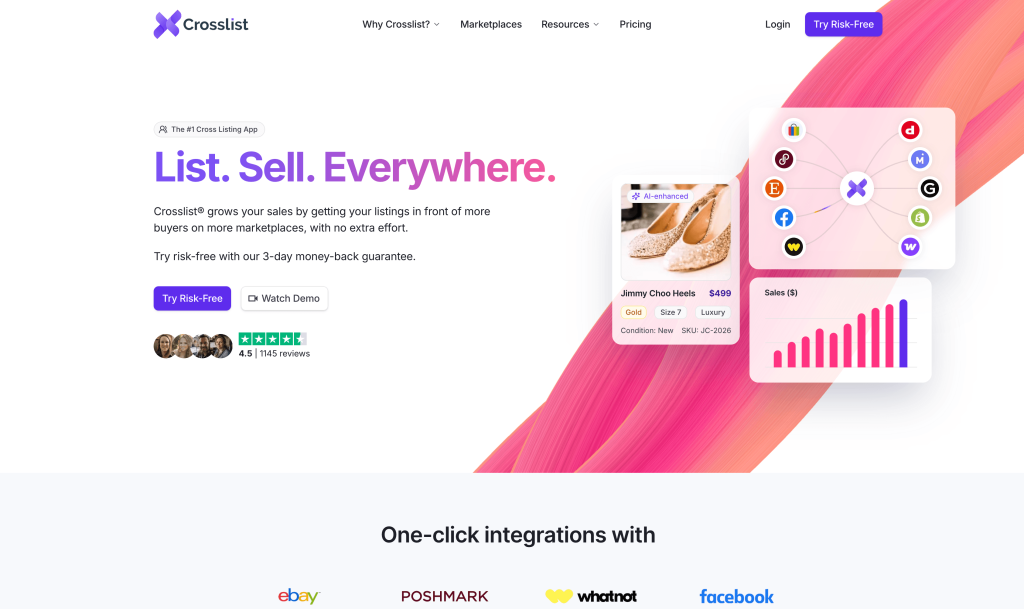
Crosslist says it has more than 50,000 users. It supports eBay, Poshmark, Mercari, Depop, Etsy, Facebook Marketplace, Grailed, Whatnot, Shopify, WooCommerce, and OfferUp.
Pricing: Crosslist’s pricing page prices plans by new listings per month. Bronze is $29.99 for 200, Silver $34.99 for 500, Gold $39.99 for 1,000, and Diamond $44.99 for unlimited. An AI add-on costs $4.99 a month.
Why it stands out: The plans are only $5 apart, so growing doesn’t cost much more. It’s also one of the few crosslisters that covers both Shopify and WooCommerce.
Watch out for: Auto-delisting starts at Gold. The trial is 3 days or 20 listings, whichever comes first. It’s only available in the US, UK, Canada, and Australia.
4. PrimeLister: best for crosslisting plus Poshmark automation
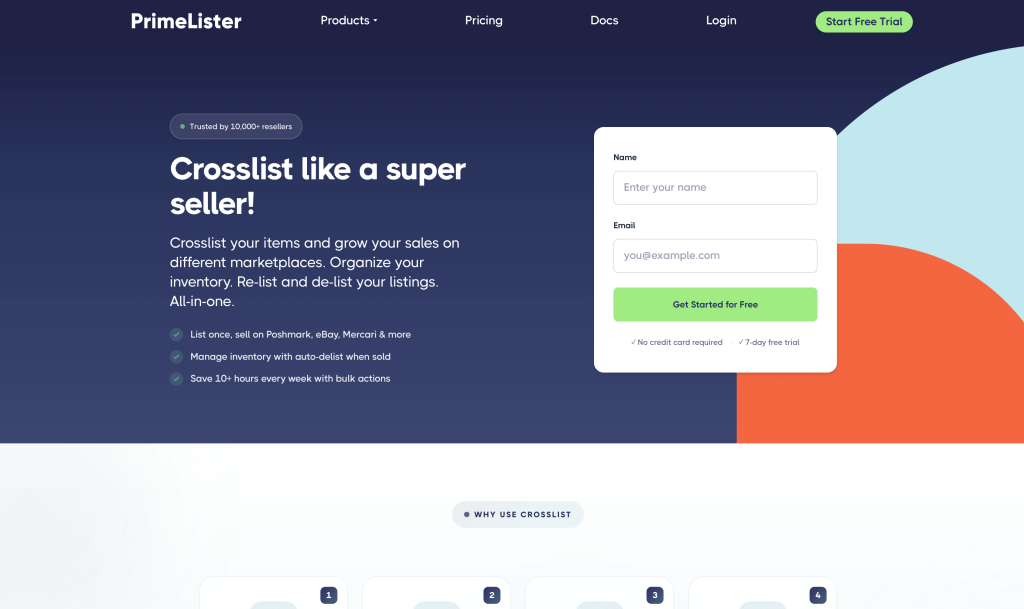
PrimeLister crosslists to eight marketplaces: Poshmark, eBay, Mercari, Depop, Etsy, Facebook Marketplace, Grailed, and Shopify. It detects a sale and delists the item from your other marketplaces.
Pricing: Plans are listed on PrimeLister’s cross-listing pricing page. You can try it for 7 days without a card.
Why it stands out: It pairs cross-listing with separate automation tools for Poshmark, Depop, eBay, Mercari, Vinted, and Whatnot.
Watch out for: Vinted and Whatnot are automation-only, not crosslisting marketplaces. Prices aren’t shown on its homepage, so check the pricing page before you commit.
5. Nifty: best for crosslisting plus automation bots
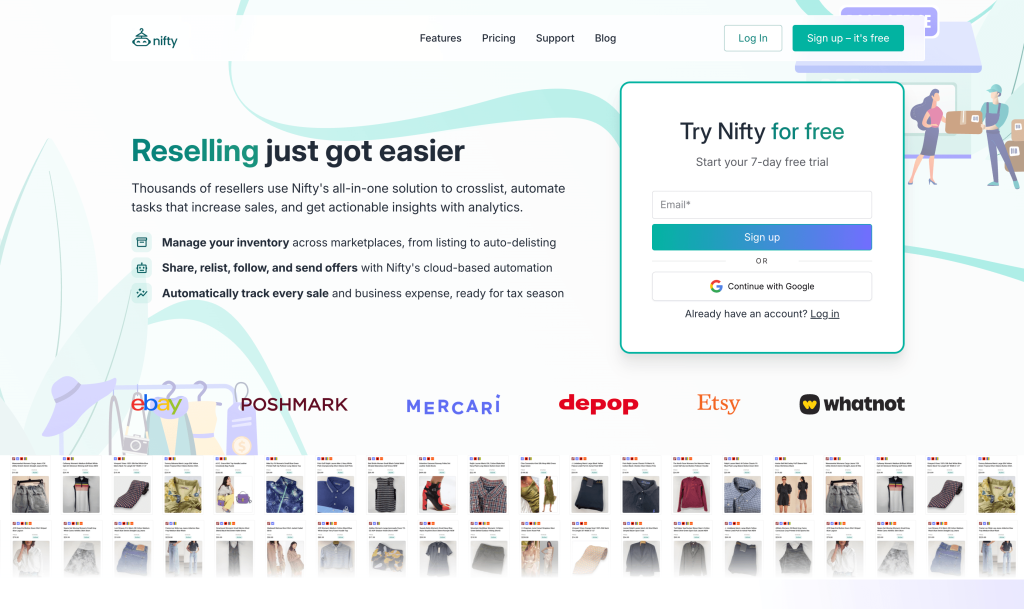
The Nifty crosslister covers Poshmark, eBay, Mercari, Depop, Etsy and Whatnot. Its automation bots cover Poshmark, eBay, Mercari and Depop, and auto-delisting runs without Nifty being open.
Pricing: On Nifty’s pricing page, Crosslisting Plus is $39.99 a month, or $35.99 a month billed yearly. It includes sale detection, auto-delisting, and up to 1,500 active items. Crosslisting Pro is $59.99 for more than 1,500 items. Bundles with automation start at $69.99.
Why it stands out: If you already pay for a Poshmark sharing bot, a bundle puts crosslisting and automation on one bill.
Watch out for: It has the shortest marketplace list here. Shopify, Facebook Marketplace, and Grailed aren’t listed.
6. Flyp: best for the lowest price
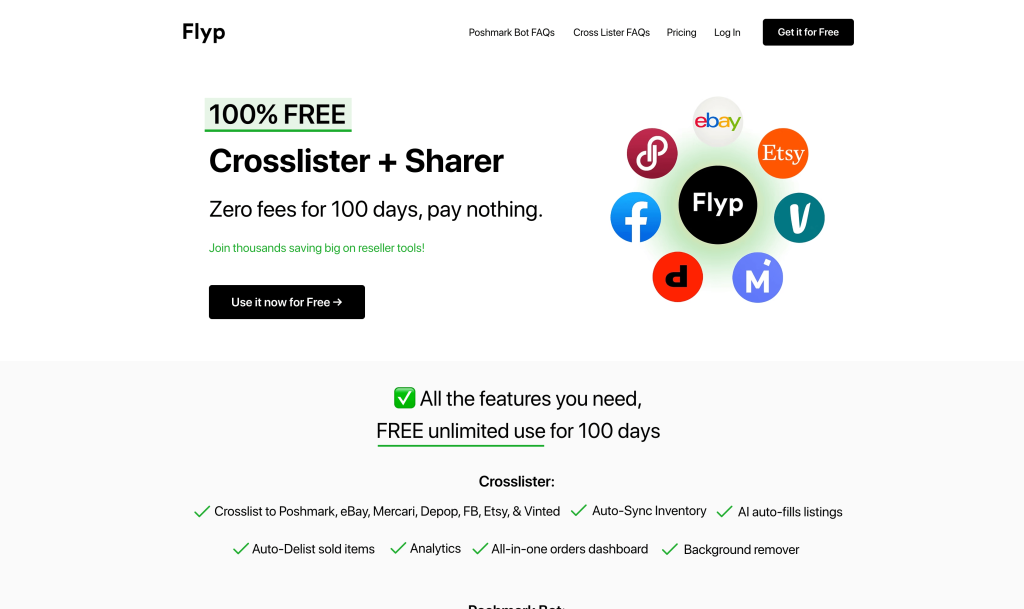
The Flyp cross-lister supports Poshmark, eBay, Mercari, Depop, Facebook, Etsy, and Vinted, and it auto-delists sold items.
Pricing: Flyp’s pricing page says it’s free for 100 days with no card, then $9 a month for everything. There are no tiers.
Why it stands out: It’s the cheapest cross-listing app here by a wide margin. The 100-day free period is long enough to test it properly.
Watch out for: Shopify, Whatnot and Grailed aren’t on its list. It’s built for one-off resale items and doesn’t connect to a POS.
Where cross-listing stops working
Every app above is built around one idea: an item sells once, then it disappears. That fits a thrift find. It doesn’t fit a business that sells the same product again and again.
Here’s what that looks like in practice. A candle maker has 12 jars of one scent on Etsy, eBay, and Shopify. A jar sells on Etsy. Nothing should be delisted, because 11 jars are still for sale. What needs to happen is a quantity change, from 12 to 11, on every channel.
Some crosslisters, like Vendoo, now handle multi-quantity listings. But their core job is still delisting, not keeping a shared count right after every sale. The gap shows up in four places:
- Restocked products. You buy 50 units, not one. Each sale needs to lower the count everywhere.
- Variants. A T-shirt in four sizes and three colors is 12 stock counts, not one listing.
- Shopify as your main store. Your own store holds the real numbers. Marketplaces need to follow it.
- In-person sales. A sale on Square or Clover at a market never reaches a cross-lister.
Miss one update and you sell a jar you don’t have. That’s overselling, and our guide on how to prevent overselling explains why it gets worse with every channel you add.
Crosslisting app or inventory sync: which do you need?
You need a crosslisting app if you sell one-of-a-kind items on resale marketplaces like Poshmark, Mercari, and Depop. You need an inventory sync app if you sell multiple units, variants, or restocked products on eBay, Etsy, Shopify, TikTok Shop, or a POS. Inventory sync keeps one stock count across every channel and updates it after each sale.
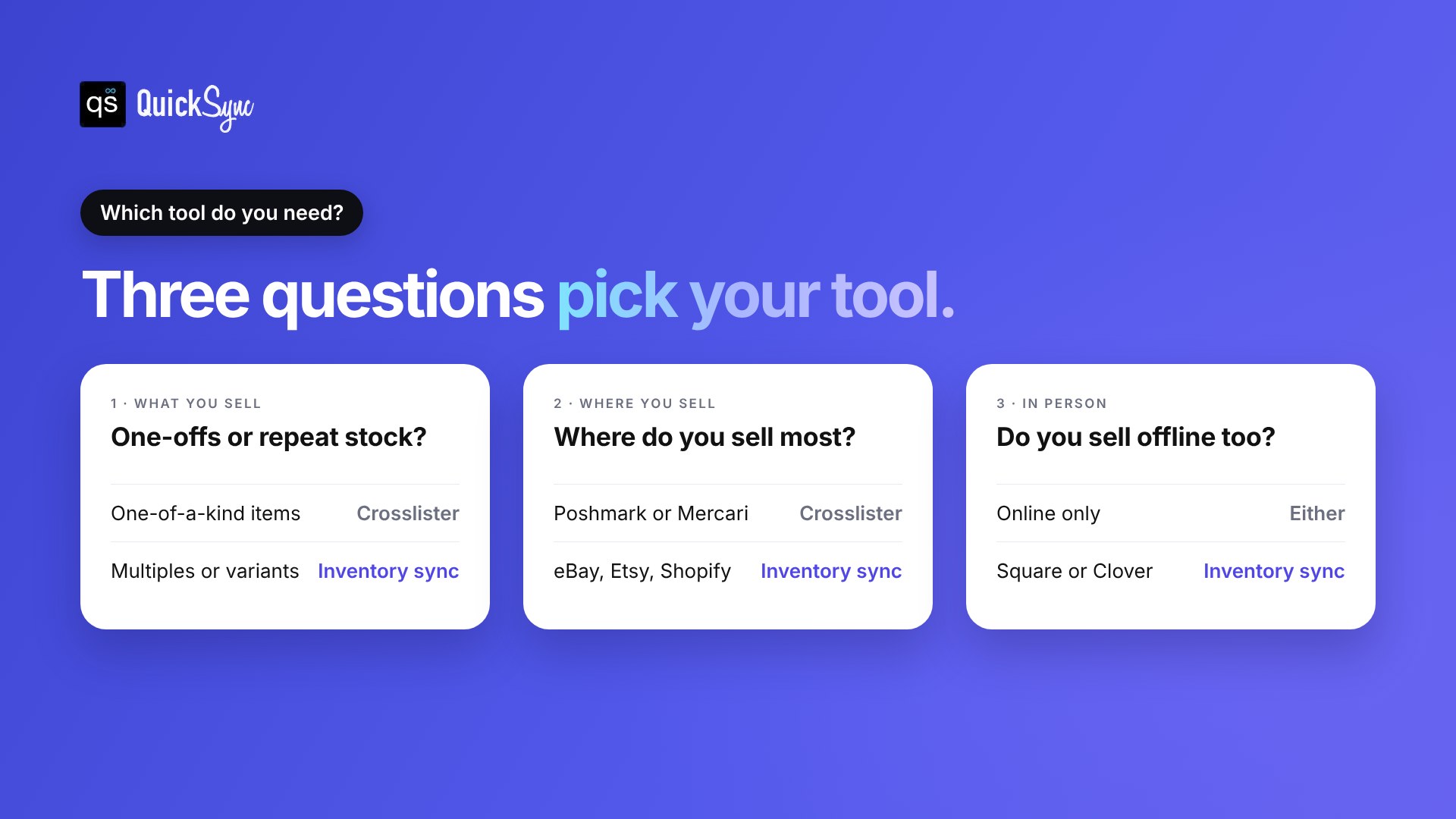
Three questions settle it for most sellers.
Do you sell one-offs or repeat stock? One-offs suit a crosslister. If you’d ever list the same product with a quantity above one, you need a shared stock count.
Where do most of your sales happen? If it’s Poshmark, Mercari, Depop, or Vinted, stay with a crosslister. If it’s eBay, Etsy, and your own Shopify store, inventory sync fits better.
Do you sell anywhere offline? Craft fairs, pop-ups, and shops run on Square or Clover. A cross-lister can’t see those sales. An inventory sync tool can.
If you answered “one-offs, resale marketplaces, online only,” pick from the six apps above. If any answer pointed the other way, read on.
QuickSync: when inventory sync is the better fit
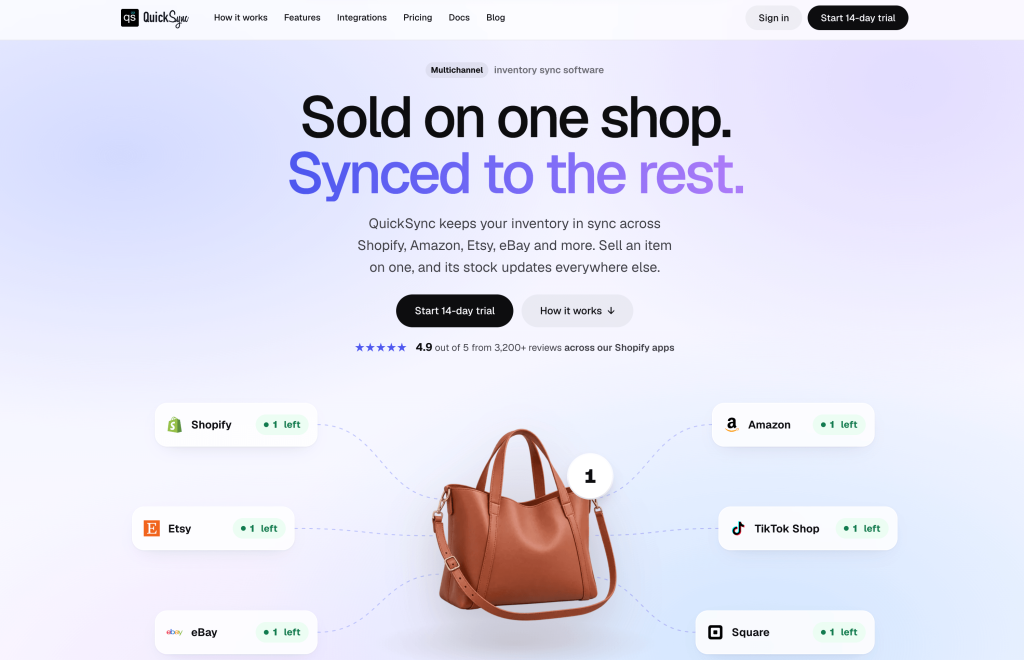
QuickSync isn’t a cross-lister. It’s an inventory sync tool. You connect your shops, choose a Source Store as your baseline, and QuickSync keeps one stock count across all of them. When a jar sells on Etsy, the quantity drops on eBay, Shopify, and every other connected channel.
It connects 13 platforms: Shopify, Amazon, Etsy, eBay, TikTok Shop, WooCommerce, Squarespace, Wix, Square, Clover, Lightspeed, QuickBooks and Xero. Stock syncs both ways on eBay, Etsy, Shopify, TikTok Shop, and the POS systems. On Amazon, it’s two-way for orders you ship and one-way for FBA, according to the integrations page.
Pricing: Every plan on the QuickSync pricing page includes two shops and unlimited orders.
| Plan | Monthly (2 shops) | Items | What it adds |
|---|---|---|---|
| Lite | $19 | 1,000 | Stock sync |
| Pro | $29 | 2,500 | Product sync and order sync |
| Ultra | $69 | 10,000 | Price rules, and we set it up for you |
| Ultra+ | $99 | 20,000 | Dedicated support and priority syncing |
Each extra shop adds the plan price again, up to eight shops. So eBay, Etsy, and Shopify on Lite is $38 a month. Every plan starts with a 14-day trial, no card needed. If you don’t pick a plan after that, the free plan keeps stock syncing for up to 100 products.
Watch out for: QuickSync doesn’t connect to Poshmark, Mercari, Depop, or Grailed. If those are your main channels, a crosslister is the right pick.
Can you use a crosslisting app and inventory sync together?
Yes, as long as each tool manages different channels. A common setup is a crosslister for resale marketplaces like Poshmark and Mercari, and inventory sync for eBay, Etsy, Shopify, and your POS. The rule is simple: never let two tools change the same listing.
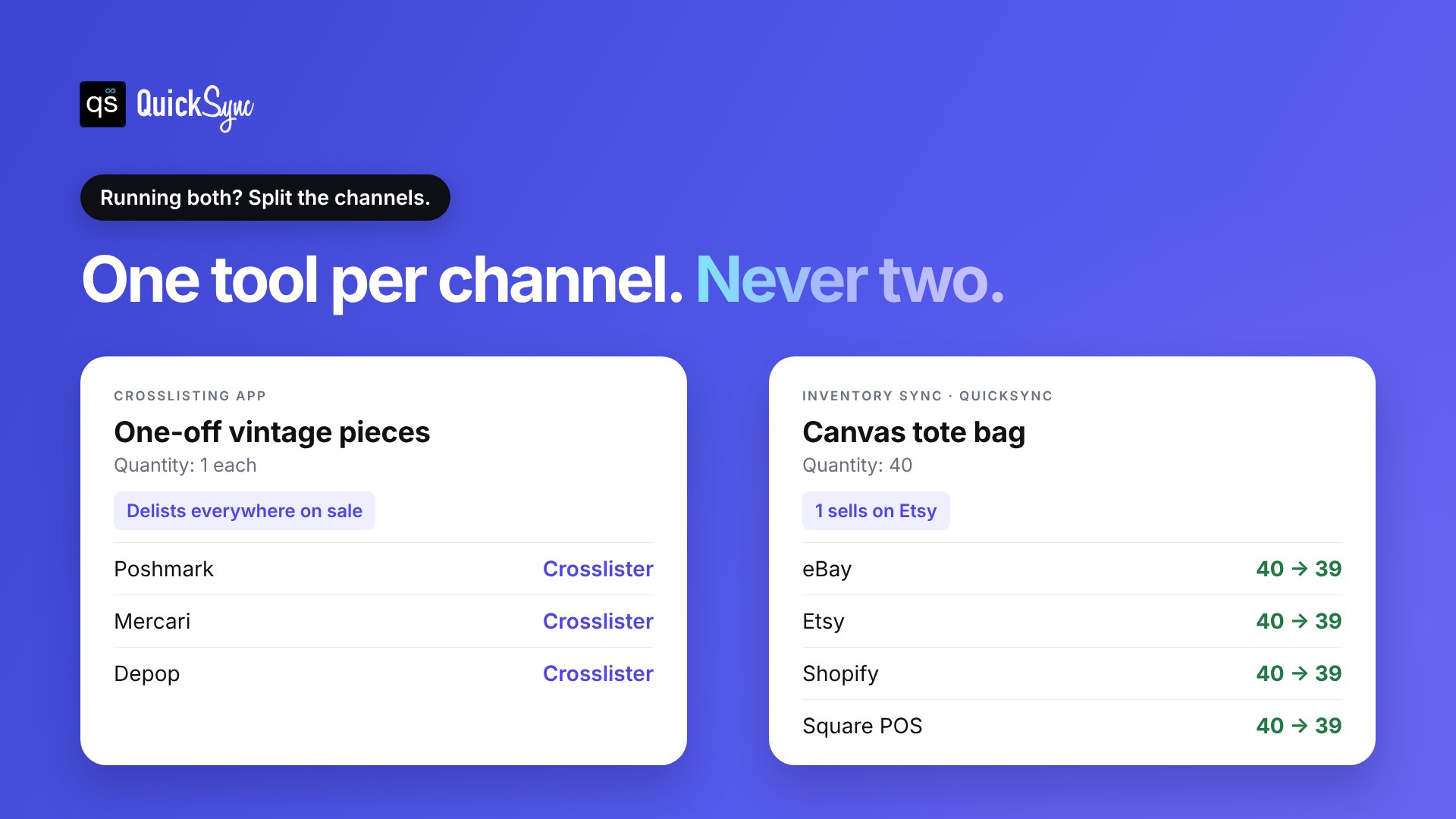
This split suits sellers who sit between reselling and running a brand. Think of a vintage seller who also makes their own tote bags. The one-off vintage pieces go through a crosslister. The totes, with 40 in stock, sync across eBay, Etsy, Shopify, and Square.
Here’s how to set it up without breaking anything:
- Decide which channels each tool owns. Write it down. For example, the crosslister owns Poshmark, Mercari, and Depop. QuickSync owns eBay, Etsy, Shopify, and Square.
- Match your SKUs. Give each product the same SKU on every synced channel, because sync tools use SKUs to match listings. Our guide on what a SKU is shows how to set them up.
- Remove the overlap. Disconnect the synced channels from your crosslister, or stop using it for those listings.
- Test with five products. Make a test sale and check the quantity on every channel before you sync the rest.
How to choose the right crosslisting app
Price matters, but it’s not the first thing to check. Run through these in order.
- List your marketplaces. Rule out any app that doesn’t cover where you sell most. Use the marketplace table above.
- Check auto-delisting on your plan. It’s on every Vendoo and Flyp plan and on Nifty from Crosslisting Plus. It only starts at Gold on Crosslist and Pro Plus on List Perfectly. Without it, you delist by hand.
- Count your monthly listings. Crosslist prices by new listings each month. Nifty’s Plus plans cap active items at 1,500 unless you pay $20 a month more for a larger closet. Vendoo and Flyp don’t cap items.
- Use the free trial on real items. List 10 items, sell one, and time how long the other listings take to disappear.
- Look at the next 12 months. If you plan to restock products, add variants, or open a Shopify store, factor that in now. Switching tools later takes more time than picking the right one today.
Takeaways
- Vendoo is the best crosslisting app for most resellers. It includes auto-delisting and unlimited items from $14.99 a month.
- Flyp is the cheapest crosslisting app. It’s free for 100 days, then $9 a month.
- Crosslist and List Perfectly fit specific needs. Crosslist suits high volume and WooCommerce. List Perfectly suits fashion marketplaces, but auto-delist costs $99 a month or more.
- Crosslisting stops working when you sell quantities. Restocked products, variants, a Shopify store or in-person sales need a shared stock count, not a delist button.
If that last point describes your shop, try inventory sync on your own channels. Connect your eBay listings and Etsy shop, or sync Shopify and Etsy, and watch one sale update every channel. The trial is 14 days, and you don’t need a card.