Selling the same products on Shopify, Etsy, eBay or a shop counter is a good way to grow. It also means every channel keeps its own stock count, and none of them knows what the others just sold. Sooner or later, the last unit sells twice.
The best multichannel inventory management software for most small sellers is a sync tool that keeps one stock count across every channel, priced in a way that doesn’t punish growth. QuickSync, Trunk, Sellbrite, LitCommerce and Nembol are built for that job. If you also need purchase orders and reorder planning, look at Sumtracker or Zoho Inventory. If shipping labels are your bigger job, look at Veeqo. Cin7 Core and Linnworks are for businesses running warehouses or wholesale.
We compared 10 tools on what small sellers actually ask about: what you pay, what the price is based on, which channels each one connects (including Square, Clover and TikTok Shop), and how fast stock updates. Every price below was checked on the vendor’s own pages or Shopify App Store listing on 27 November 2026.
What Multichannel Inventory Management Software Does
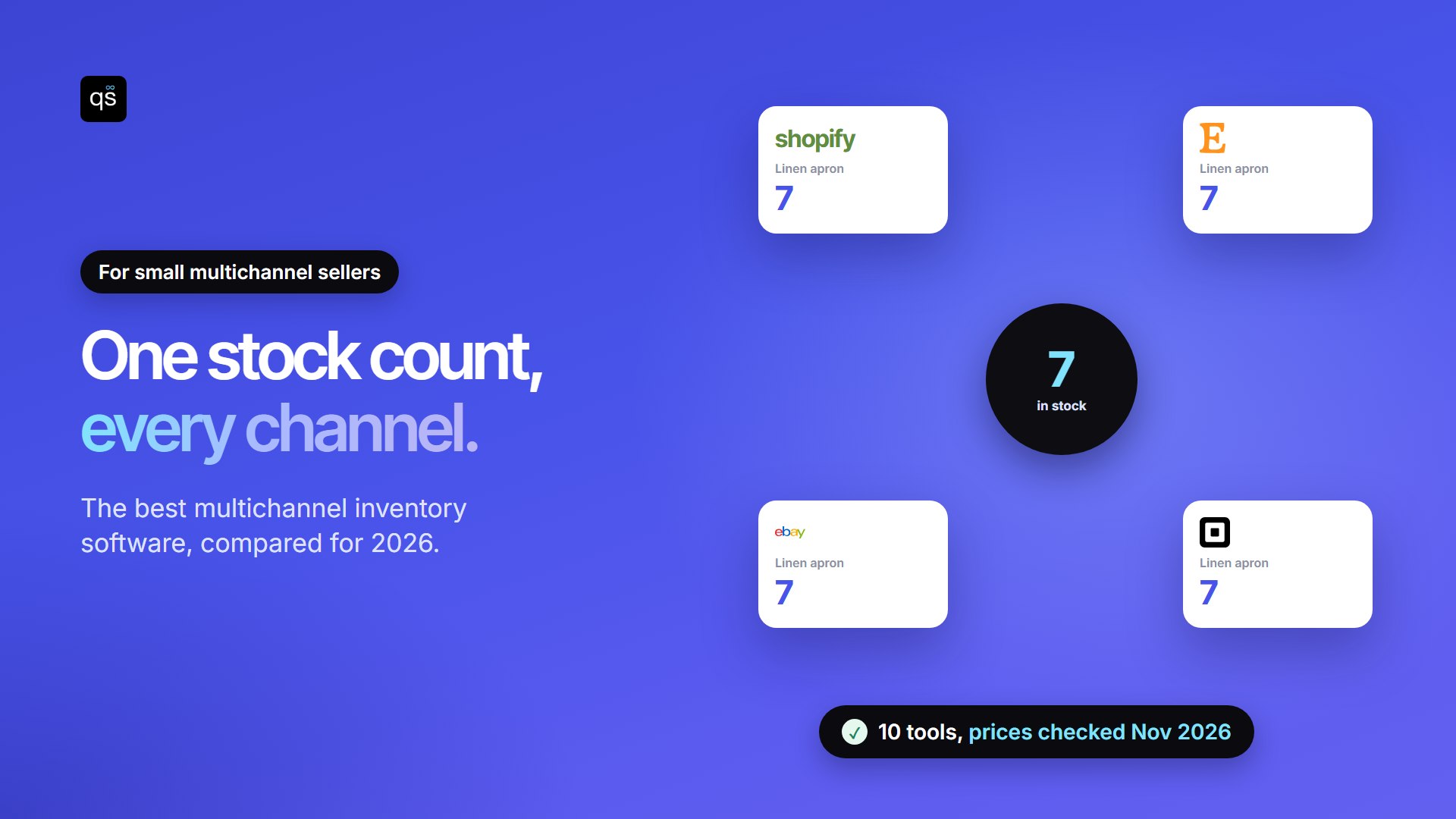
Multichannel (or multi-channel) inventory management software connects the places you sell and keeps one stock count for each product. When an item sells on one channel, the software lowers the count everywhere else. Most tools match products by SKU, so the same item needs the same SKU on every channel.
Tools in this category do one or more of three jobs:
- Inventory sync. Keeps stock counts matched across channels. This is the job most small sellers are hiring for.
- Listing management. Creates and updates listings on each channel from one place.
- Inventory operations. Purchase orders, reorder forecasts, warehouses, picking and manufacturing. This is ERP territory.
The more operations a tool includes, the more it costs and the longer it takes to set up. If you sell on two to eight channels and your main problem is overselling, you probably need the first job done well, not all three. Our guide to omnichannel inventory management covers the concepts in more depth.
The 10 Best Multichannel Inventory Management Tools Compared
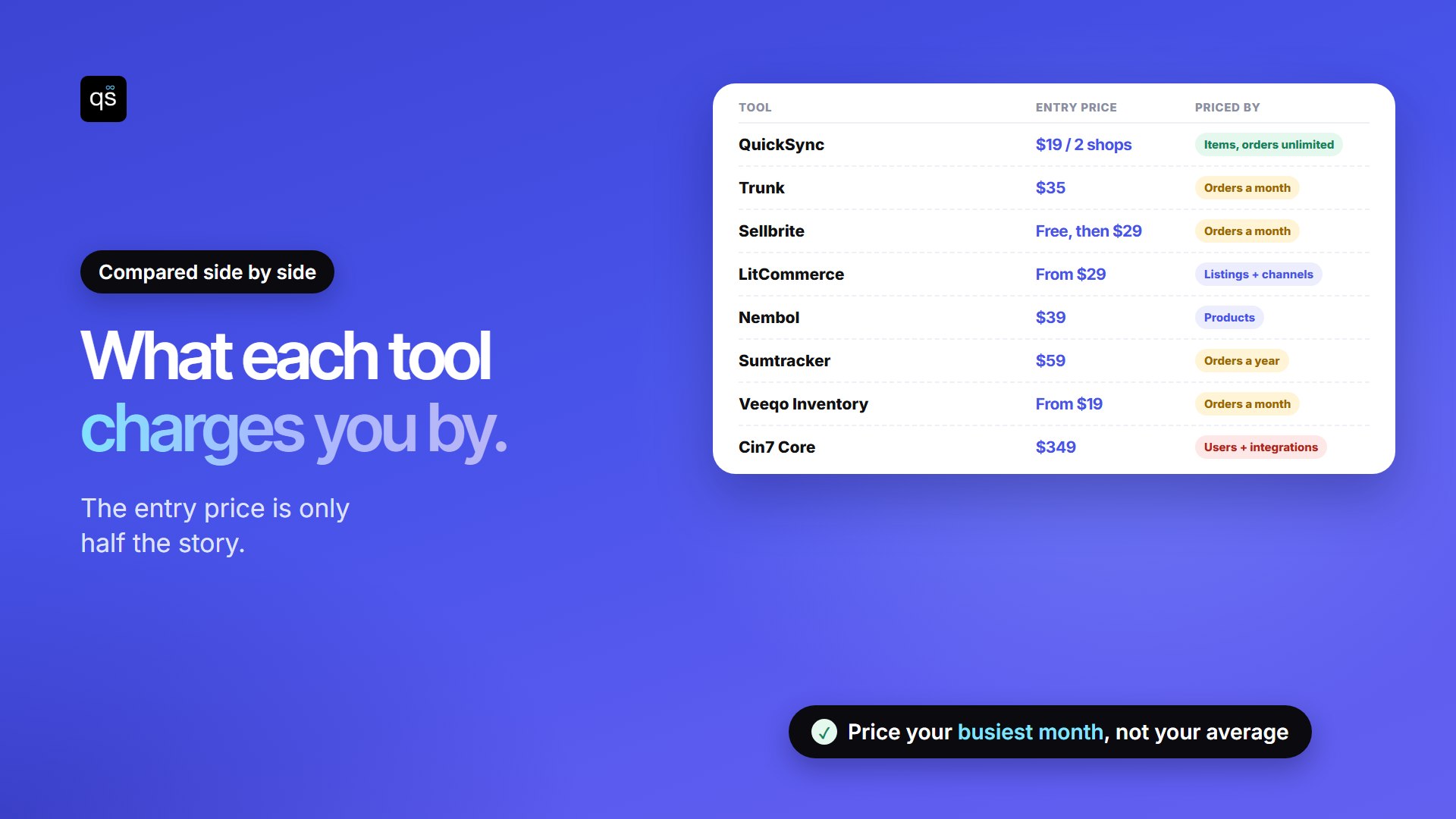
| Tool | Best for | Entry price | Price based on | POS channels | TikTok Shop | Stated sync speed | Free trial |
|---|---|---|---|---|---|---|---|
| QuickSync | One count across marketplaces, stores and POS | $19/mo for two shops | Items; orders unlimited | Square, Clover, Lightspeed | Yes | As it happens or every 2 minutes, by channel | 14 days, no card |
| Trunk | Simple stock sync at low order volume | $35/mo | Orders a month | Square | Yes | “Real-time” | 14 days |
| Sellbrite | Very small sellers and marketplace listings | Free up to 30 orders/mo; paid from $29/mo | Orders a month | No | No | Every 15 minutes (every 2 hours on Free) | 14 days, no card |
| LitCommerce | Listing on many marketplaces | From $29/mo | Listings and channels | Square | Yes | Every 15 minutes | 7 days |
| Nembol | Crosslisting plus stock, by product count | $39/mo | Products | Square | Yes | “In mere seconds” | 14 days, no card |
| SKU IQ | POS stores selling online | $19/mo | Plan and add-ons | Square, Clover, Lightspeed | Yes | “Real-time” | Up to 14 days |
| Sumtracker | Marketplace sellers who also want purchase orders | $59/mo ($50 billed yearly) | Orders a year | No | No | “Instantly” | 14 days, no card |
| Veeqo | Shipping first, inventory second | Inventory plan from $19/mo | Orders a month | No | Yes | “Real-time” | 30 days, no card |
| Zoho Inventory | A full inventory system on a budget | Free plan; paid from about $29/mo billed yearly | Orders a month | No | Not listed | Not stated | 14 days |
| Cin7 Core | Wholesale, warehouses and manufacturing | $349/mo | Users, orders and integrations | No | Not listed | “Real time” | Yes |
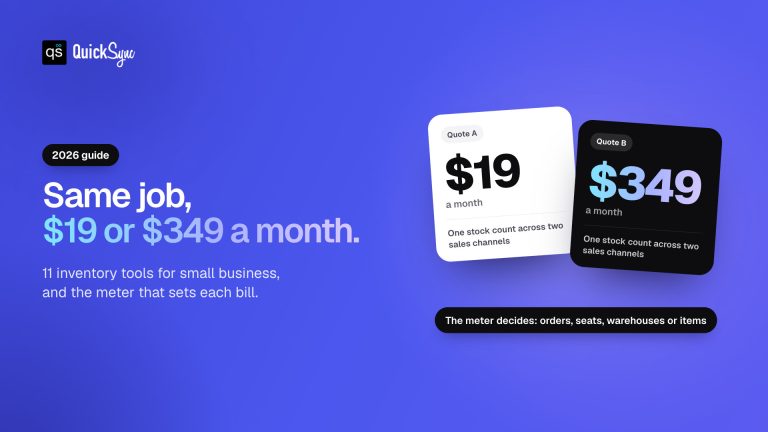
Two things stand out. First, apart from QuickSync, only Sellbrite and LitCommerce publish a sync interval; the rest say “real-time” or “instant” without a number. Second, the tools charge for completely different things, which matters more than the entry price once you grow. We work through a real example further down.
1. QuickSync: best for one stock count across marketplaces, stores and POS
QuickSync is our product, so we’ve kept to facts you can check on our pricing page and help docs, and listed its limits too.
- Price: Lite $19, Pro $29, Ultra $69 and Ultra+ $99 a month. Each plan covers two connected shops, and each extra shop adds the plan price again, up to eight. Yearly billing saves 10%.
- Priced on: items, meaning product variations (1,000 on Lite up to 20,000 on Ultra+). Orders are unlimited on every plan, so a busy month costs the same as a quiet one.
- Channels: Shopify, Etsy, eBay, Amazon, TikTok Shop, WooCommerce, Wix, Squarespace, Square, Clover and Lightspeed, plus QuickBooks and Xero.
- Sync speed: Shopify, Wix, WooCommerce, Square and Lightspeed report each sale as it happens. Etsy, eBay, TikTok Shop and Squarespace are checked every 2 minutes.
- On Pro and above: listings created from your main store, and orders from every channel copied into the store you pack from.
Limits: no purchase orders, reorder forecasting, warehouse picking or shipping labels. Amazon works with US Seller Central for stock you ship yourself; Fulfillment by Amazon stock isn’t synced.
Choose it if you sell on a mix of marketplaces, online stores and a POS, and want a price that doesn’t rise with orders. You can estimate your bill on our pricing page.
2. Trunk: best for simple sync at low order volume
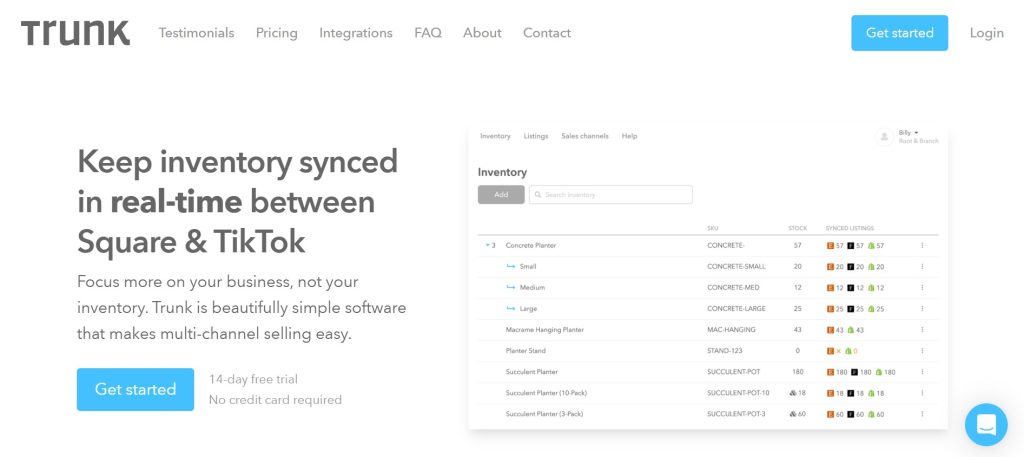
Trunk does one thing: keeps stock in sync. Plans start at $35 (Essential) or $39 (Pro) a month for up to 100 fulfilled orders, then step up with volume: $59 or $79 at 201 to 400 orders, and $279 or $329 at 6,000 to 10,000. There are no overage charges; Trunk moves you up or down a tier each billing cycle.
Channels and listings are unlimited, and it connects Shopify, Etsy, eBay, Amazon, Walmart, TikTok Shop, WooCommerce, Wix, Squarespace, BigCommerce and Square. It’s rated 4.9 from 408 reviews on the Shopify App Store.
Watch for: the bill grows with your orders, and it doesn’t create listings. See our Trunk alternatives for more detail.
3. Sellbrite: best for very small sellers and marketplace listings
Sellbrite, owned by GoDaddy, has a free plan for up to 30 orders a month. Paid plans run from $29 (100 orders) to $179 (2,000 orders) a month, which Sellbrite lists as billed annually, plus $19 for its Fulfillment by Amazon add-on. Going over your order limit moves you to the next tier automatically.
It lists and syncs across Shopify, Etsy, eBay, Amazon, Walmart, WooCommerce and BigCommerce. Its pricing page is unusually clear on speed: inventory syncs every 15 minutes on paid plans and every 2 hours on Free.
Watch for: no POS or TikTok Shop support listed, and a 3.9 rating from 120 Shopify App Store reviews. More in our Sellbrite alternatives.
4. LitCommerce: best for listing on many marketplaces
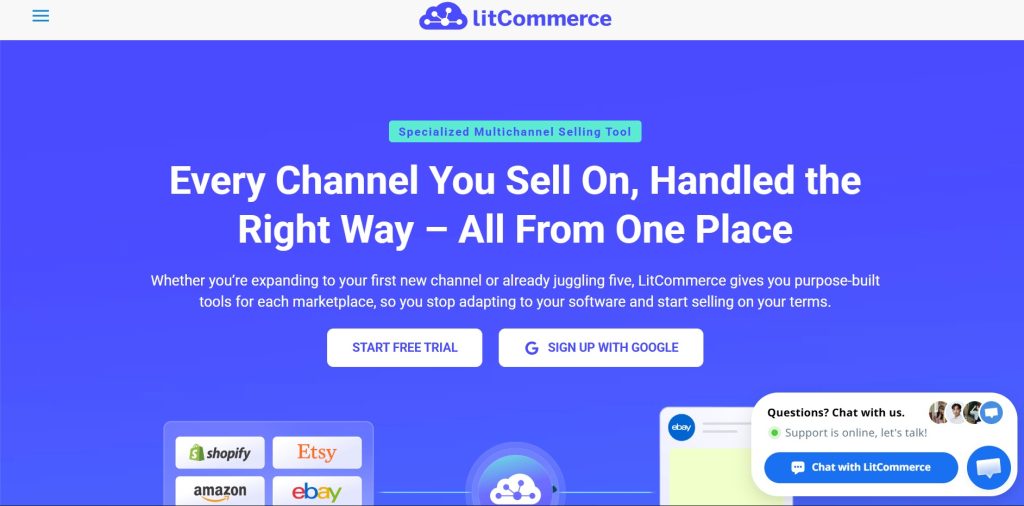
LitCommerce starts at $29 a month for 1,000 listings across 3 channels, with unlimited orders. Above that, the price depends on listings and channels; the next plan’s price isn’t published on its pricing page, and hitting your limit pauses new connections until you upgrade.
It covers a long list of marketplaces, including Temu, Reverb and Faire alongside the usual ones, and it’s rated 4.8 from 993 reviews.
Watch for: its pricing page states an inventory and price sync frequency of 15 minutes, which is slow for one-of-a-kind items. See our LitCommerce alternatives.
5. Nembol: best for cross-listing plus stock, priced by products
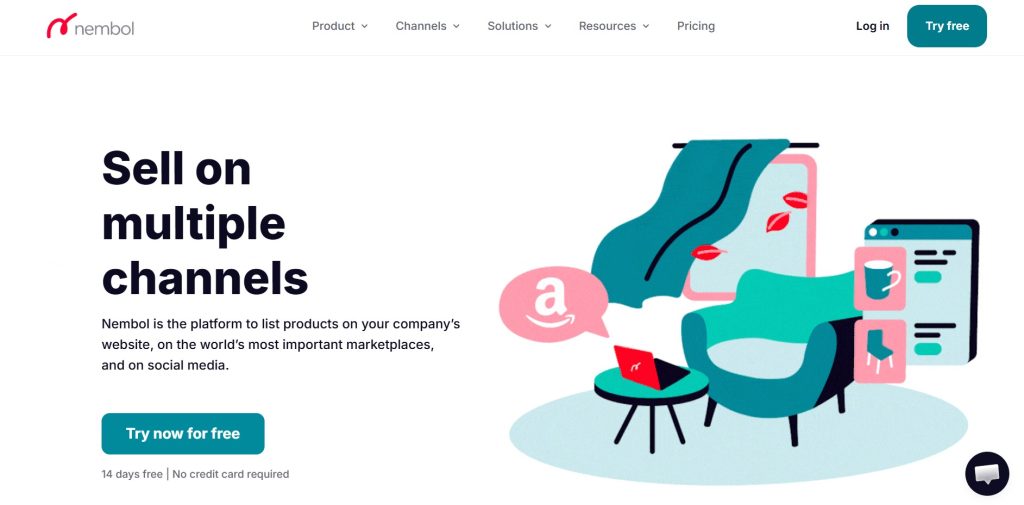
Nembol costs $39, $49, $79 or $129 a month for 200, 2,000, 5,000 or 15,000 products, with unlimited listings and orders, and 25% off yearly. It connects Shopify, Etsy, eBay, Amazon, TikTok Shop, WooCommerce, Wix, Squarespace and Square, and says stock updates “in mere seconds”.
Watch for: the Basic plan allows one account per channel, so a second eBay or Etsy shop means upgrading.
6. SKU IQ: best for POS stores selling online
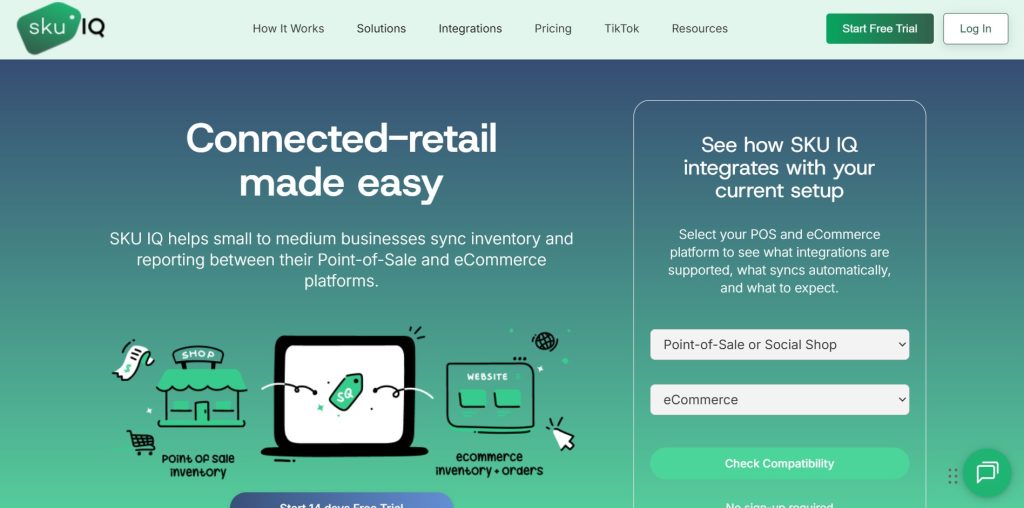
SKU IQ is built around point-of-sale systems: Square, Clover and Lightspeed, connected to Shopify, WooCommerce, Wix, Squarespace, BigCommerce and TikTok Shop.
Plans were $19, $49 and $99 a month when we checked (shown during a Black Friday promotion), and the Basic plan syncs quantities only. Extras such as multi-location sync ($10 per location) and priority syncing ($49) are add-ons.
Watch for: it doesn’t list Etsy, eBay, Amazon or Walmart, so it isn’t a fit if you sell on marketplaces. More in our SKU IQ alternatives.
7. Sumtracker: best for marketplace sellers who want purchase orders
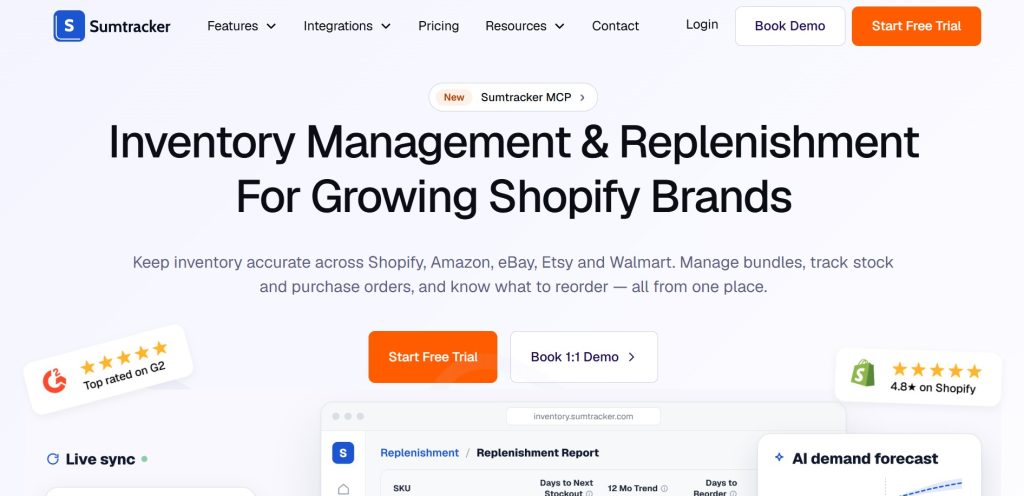
Sumtracker’s Manage plan costs $59 a month ($50 billed yearly) and Replenish $119 ($100 yearly) for up to 5,000 orders a year, rising to $399 and $599 at 100,000 orders. Purchase orders, transfers and forecasting are on Replenish.
It connects Shopify, Etsy, eBay, Amazon (including FBA) and Walmart, with up to 10 channels and 10 warehouses.
Watch for: no POS or TikTok Shop listed, and the order cap is yearly, so a strong holiday season can push you up a plan.
8. Veeqo: best if shipping is your bigger job
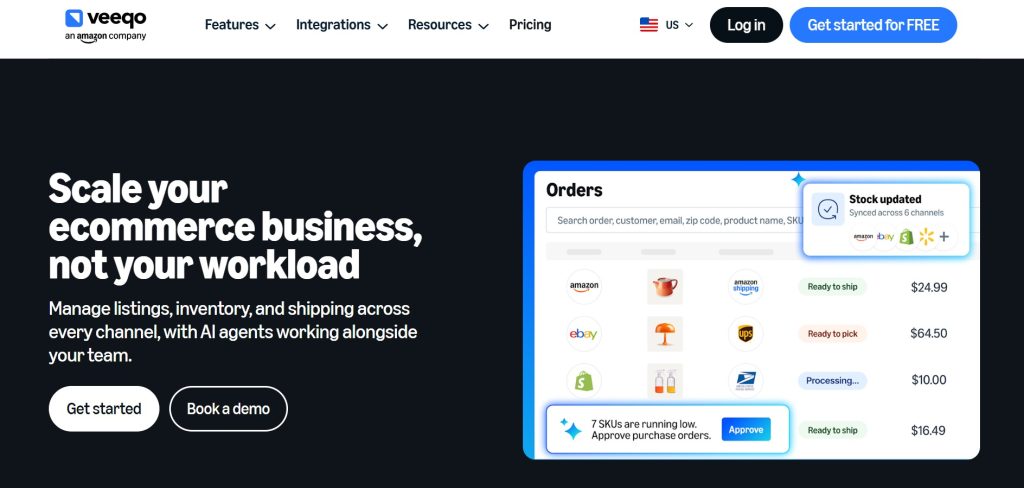
Veeqo, owned by Amazon, is best known for free shipping software. That free Shipping plan no longer includes inventory management, though; inventory sync is on the Inventory plan, from $19 a month based on order volume, with High Volume from $239. Fulfillment by Amazon orders aren’t charged.
It connects Shopify, Etsy, eBay, Amazon, Walmart, TikTok Shop, WooCommerce, Wix and BigCommerce, with Squarespace listed as coming soon.
Watch for: prices above “from $19” aren’t published, and there’s no POS support.
9. Zoho Inventory: best for a full inventory system on a budget
Zoho Inventory is a complete inventory system with purchase orders, warehouses and reports. It has a free plan for 50 orders a month, and Zoho’s pricing comparison lists paid plans from $29 a month billed yearly ($39 monthly) for 500 orders.
Zoho shows different prices in different regions, so check the current US page before you buy. It connects Shopify, Etsy, Amazon and WooCommerce.
Watch for: the lower plans connect one Shopify store, and its Shopify app is rated 1.5 from 9 reviews. See our Zoho Inventory alternatives.
10. Cin7 Core: best for wholesale, warehouses and manufacturing
Cin7 Core is an inventory ERP. Standard costs $349 a month for 5 users, 6,000 sales orders a year and 2 ecommerce integrations; Pro is $599 and Advanced $1,199. It connects Shopify, eBay, Amazon, Walmart, WooCommerce and BigCommerce.
Watch for: only two ecommerce integrations on Standard, and no Etsy or TikTok Shop listed. It’s worth the price when you need batch tracking, manufacturing or B2B, not for stock sync alone. More in our Cin7 alternatives.
If you outgrow these: Linnworks suits high-volume sellers who want order management and automation across 100+ channels. Pricing is quote-only, based on order volume, with an onboarding fee. See our Linnworks alternatives.
What It Actually Costs: One Seller, Priced Six Ways
Entry prices hide how each tool scales. Take a typical small seller: 800 items (counting each size and color), selling on Shopify, Etsy and eBay, with 400 orders a month. Here’s the monthly cost for stock sync on each tool’s own pricing model:
| Tool | How the example is priced | Monthly cost | At 1,200 orders a month |
|---|---|---|---|
| QuickSync | Lite covers 1,000 items and 2 shops; the third shop adds $19 | $38 | $38 (orders don’t count) |
| Nembol | Pro covers up to 2,000 products (Basic, at $39, covers 200) | $49 | $49 |
| Trunk | Essential, 201 to 400 orders | $59 | $129 (801 to 1,500 orders) |
| Sumtracker | Manage, up to 5,000 orders a year (you’d use 4,800) | $59 | Higher plan needed |
| Sellbrite | Pro 500, up to 500 orders | $79 | $179 (Pro 2K) |
| Cin7 Core | Standard: 2 ecommerce integrations included, 6,000 orders a year | $349 + a third integration | Higher plan needed |
The lesson isn’t that one tool is always cheapest. It’s that what you’re charged by decides your bill as you grow. Order-based pricing is cheap when you’re small and climbs with every busy season. Item-based or product-based pricing stays flat as orders grow but rises if your catalog does. Run your own numbers: count your variations, your channels and your orders in your busiest month.
Sync Tool, Inventory System or ERP? How to Decide
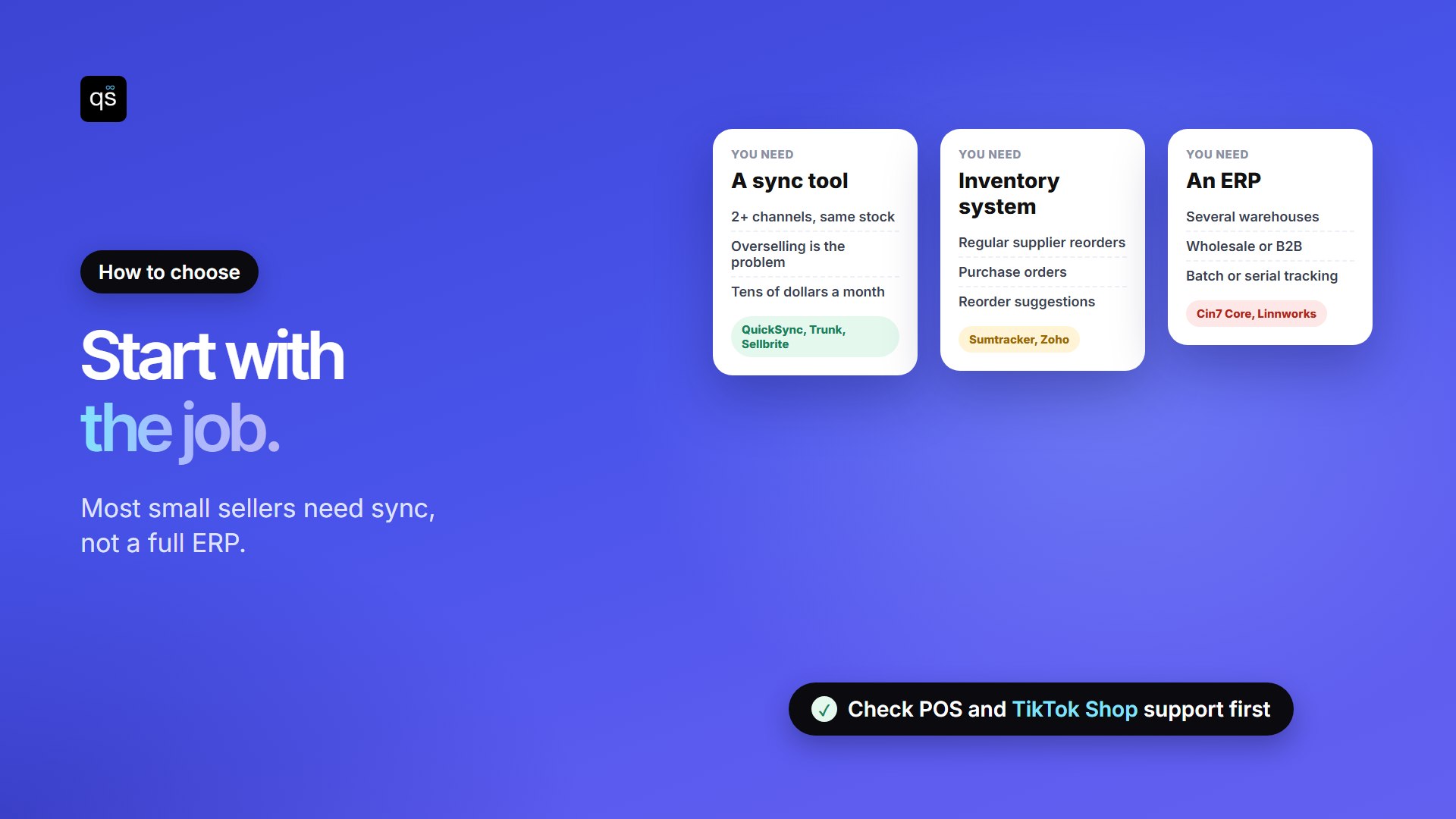
Start with the job, not the feature list. Most sellers fit one of three groups:
- You need a sync tool if you sell the same stock on two or more channels and your main problem is overselling. Look at QuickSync, Trunk, Sellbrite, LitCommerce or Nembol.
- You need an inventory system if you also reorder from suppliers regularly and want purchase orders and reorder suggestions. Look at Sumtracker or Zoho Inventory.
- You need an ERP if you run more than one warehouse, sell wholesale, manufacture, or need batch and serial tracking. Look at Cin7 Core or Linnworks.
Then check these six things against your own setup:
- Every channel you sell on. Include your POS and TikTok Shop. Many tools skip one or the other.
- What you’re charged by. Items, products, listings or orders. Price your busiest month, not your average one.
- Sync speed for your fastest sellers. A 15-minute interval is fine for a 50-unit product and risky for a one-of-a-kind item.
- Sync direction. Confirm that a sale on any channel lowers every other channel, not just one main store.
- Warehouses you don’t control. Fulfillment by Amazon and Fulfilled by TikTok stock is counted by the marketplace. Keep it separate from the stock you ship yourself.
- Setup effort. SKUs must match across channels. A free trial on your real catalog shows problems before you pay.
If You Sell in a Store Too: POS Sync
Most multichannel tools are built for online channels. If you also sell over the counter, check POS support first. In our comparison, only QuickSync and SKU IQ list Clover and Lightspeed. Trunk, LitCommerce and Nembol list Square. SKU IQ doesn’t list any marketplaces, so if you sell in store and on Etsy, eBay or Amazon, it won’t cover everything.
For POS sellers, the store sale matters as much as the online one. QuickSync gets Square and Lightspeed sales as they happen and updates your online channels from there. See how it works with Clover and with all 13 integrations.
Set Up Multichannel Inventory Sync Without Overselling
- Match your SKUs. Give the same item the same SKU on every channel, including each size and color. Keep SKUs short enough for every channel’s limit.
- Pick one starting count. Choose the store whose stock count is right today. The first sync copies its counts to the other channels.
- Leave out stock you don’t ship. Keep FBA and FBT listings on their own SKUs, or off your sync list.
- Test a sale. Sell one low-cost item on each channel and watch the others update.
- Change stock in one place. After a delivery or a stock count, update one store and let the sync carry it.
Selling on specific pairs? Our guides cover Amazon and eBay together, TikTok Shop inventory and Amazon FBM.
FAQs
More on choosing tools: best inventory management software for small business, multichannel listing software and our multichannel inventory management software overview.