
Adding Amazon to an Etsy shop puts your products in front of a different set of buyers. It also means the same candles, prints, or mugs now sell in two places.
Without a link between them, a sale on Etsy doesn’t touch your Amazon quantity. Sell your last unit on Etsy at night, and Amazon can sell it again before you wake up.
An Etsy Amazon integration app fixes that. This guide compares five of them on price, sync speed, and FBA support. Use it to pick the one that fits how you ship.
What is an Etsy Amazon integration app?
An Etsy Amazon integration app connects your Etsy shop and Amazon seller account so a sale on one updates the other. Most keep stock counts the same on both. Some also create listings, import orders, or send tracking back. How well they work depends on whether you ship orders yourself or use FBA.
There are two ways to fulfil Amazon orders, and they change what an integration can do:
- Merchant-fulfilled (FBM): You store and ship Amazon orders yourself, from the same stock as Etsy. An integration can sync this stock both ways.
- Fulfilled by Amazon (FBA): Amazon stores and ships your units. FBA stock sits in Amazon’s warehouses, so it isn’t the same stock as your Etsy shop.
If you ship everything yourself, two-way sync is what you need. If you use FBA, you mostly need your Etsy count to reflect only the units you still hold. Our guide on what Amazon FBA is covers how it works.
What to look for in an Etsy Amazon integration
These details decide whether an app works for your shop:
Two-way stock sync. A sale on either channel should lower the count on the other. One-way sync only protects one side.
How it handles FBA. Some apps read FBA stock, some import FBA orders, and some leave FBA alone. Check what the app does before you connect it.
SKU matching. Most apps match products by SKU, so each product needs the same SKU on Etsy and Amazon. Etsy allows up to 32 characters. QuickSync’s Etsy Amazon page recommends keeping SKUs to 20 characters so they match on both. Our guide on what a SKU is explains the format.
Variations. Etsy allows two option types per listing, like size and colour. A product with three options needs one dropped, or splitting into separate listings, before it can sync.
How you’re charged. Apps charge per order, per listing or per shop. Count your yearly orders and active listings before you compare prices.
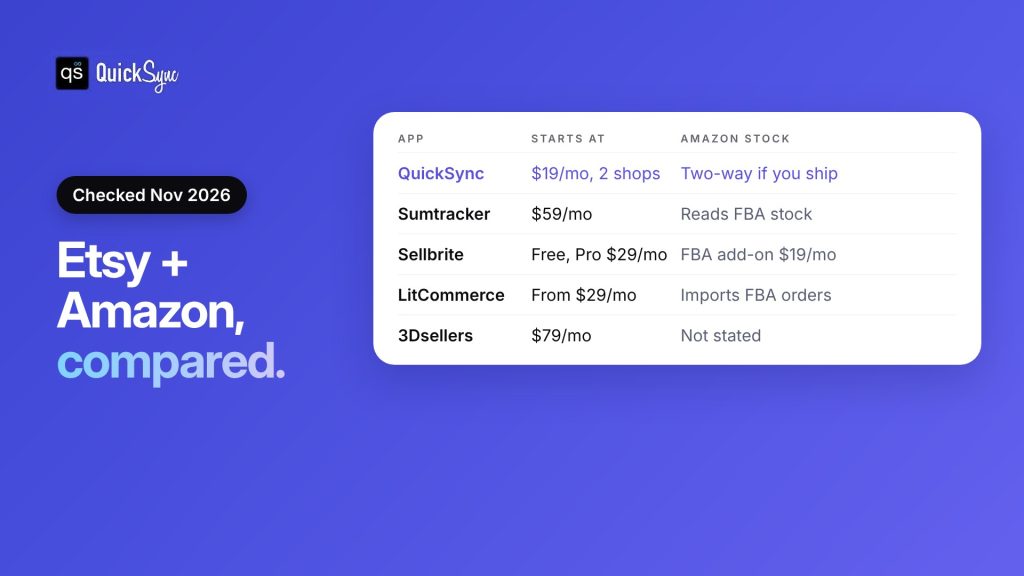
Etsy Amazon integration apps at a glance
| App | Best for | Starts at | Free trial | How it handles Amazon stock |
|---|---|---|---|---|
| QuickSync | Etsy and merchant-fulfilled Amazon | $19/mo for 2 shops | 14 days, no card | Two-way for orders you ship, one-way for FBA |
| Sumtracker | Sync plus purchasing and forecasting | $59/mo (up to 2,500 orders a year) | 14 days, no card | Real-time sync; reads FBA inventory |
| Sellbrite | Low order volumes, many channels | Free (30 orders/mo), Pro from $29/mo billed yearly | 14 days, no card | Every 15 minutes on Pro; FBA add-on $19/mo |
| LitCommerce | Listing on many marketplaces | From $29/mo | 7 days | Every 15 minutes; imports FBA and FBM orders |
| 3Dsellers | eBay-first sellers adding Etsy and Amazon | Professional from $79/mo | 7 days, no card | Etsy and Amazon on Professional only |
Monthly prices, checked on each app’s website in November 2026.
Already know you want stock sync? Jump to the setup steps.
The 5 best Etsy Amazon integration apps, reviewed
Each app below connects Etsy and Amazon in some way. The first one is ours, so we’ve been specific about what it doesn’t do.
1. QuickSync: best for keeping Etsy and merchant-fulfilled Amazon in step
QuickSync is a multichannel selling tool. You connect your Etsy shop and Amazon seller account once, and it keeps stock, listings, prices, and orders in sync automatically across both.
When a candle sells on Etsy, the quantity drops on your merchant-fulfilled Amazon listing too, and the other way around. It matches products by SKU, can copy listings from one channel to the other, and brings orders from both into one packing list. You can also set a different price on Amazon to cover its fees, so you run Etsy and Amazon like one shop.
Pricing: Lite costs $19 a month for two shops and up to 1,000 items, with stock sync. Pro costs $29 a month for up to 2,500 items and adds product and order sync. Ultra, at $69, adds price rules, so Amazon can carry a different price from Etsy. Orders are unlimited on every plan. See the QuickSync pricing page.
Why it stands out:
- Stock syncs both ways for Amazon orders you ship, according to the Etsy Amazon page. QuickSync reads Etsy quantities every two minutes.
- Orders from both channels come into one packing list, and tracking goes back to eligible merchant-fulfilled Amazon orders.
- It can create listings from one channel on the other, for example from Etsy to Amazon, as drafts where supported. Ongoing product updates need Pro.
- It also connects Shopify, eBay, TikTok Shop, WooCommerce, Square, Clover and more.
- Every trial is 14 days with no card, and the team connects your first two shops with you on a free 30-minute call.
Watch out for: QuickSync doesn’t change FBA stock. Amazon owns that count. Etsy only accepts tracking updates where it grants access, so some Etsy orders still need tracking added by hand. Price rules start on Ultra.
Good fit if: you sell the same products on Etsy and Amazon and ship them yourself.
2. Sumtracker: best for sync plus purchasing and forecasting
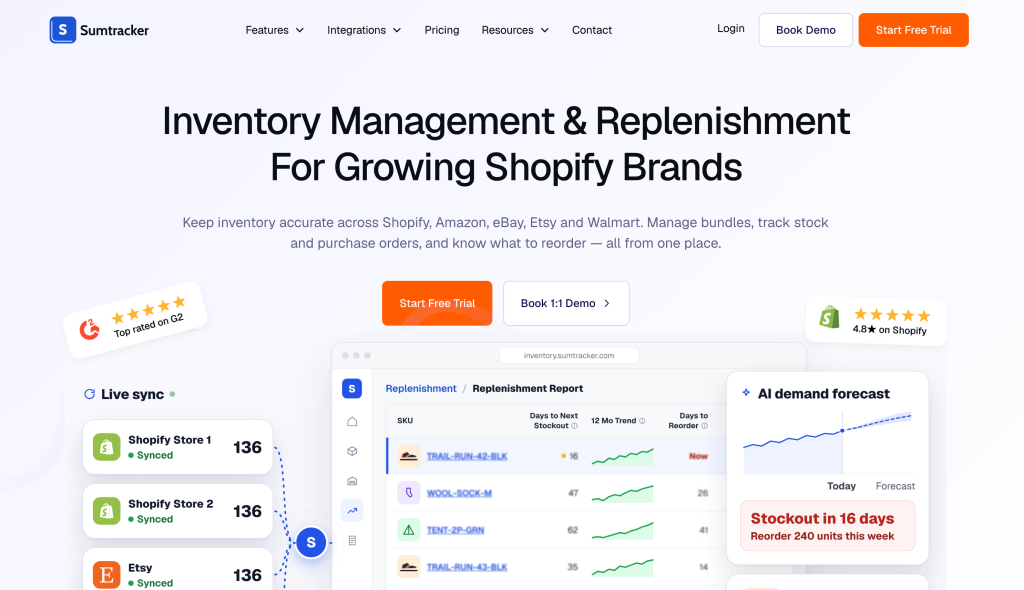
Sumtracker is an inventory tool for Shopify and Amazon merchants that also connects Etsy, eBay and Walmart. It syncs stock across stores and, on its higher plan, handles purchase orders and reorder planning.
Pricing: According to Sumtracker’s pricing page, Manage costs $59 a month ($50 billed yearly) for up to 2,500 orders a year. Replenish costs $119 ($100 yearly) and adds purchase orders, stock transfers and forecasting. Prices rise with your yearly order count. Manage reaches $119 a month at 10,000 orders a year. There’s a 14-day free trial with no card.
Why it stands out: It connects Amazon FBA and FBM, and reads FBA inventory. It also supports bundles and barcode scanning, and Replenish adds a QuickBooks integration.
Watch out for: Sumtracker can’t create listings, so you list on Etsy and Amazon yourself. Pricing grows with orders, so a busy year can move you up a tier.
3. Sellbrite: best free starting point for low order volumes

Sellbrite is a multichannel listing and inventory tool. It connects Etsy, Amazon, eBay, Walmart, Shopify and more, with unlimited channels on every plan.
Pricing: Sellbrite’s pricing page lists a Free plan for up to 30 orders a month. Pro 100 costs $29 a month for 100 orders, Pro 500 costs $79 and Pro 2K costs $179, all billed yearly. FBA orders don’t count toward these limits. An FBA inventory and multi-channel fulfillment add-on costs $19 a month on paid plans.
Why it stands out: The free plan lets you test with a small shop. Paid plans sync inventory and prices every 15 minutes.
Watch out for: Plans are capped by monthly orders. On the free plan, inventory syncs only every 2 hours, and the FBA add-on isn’t available.
4. LitCommerce: best for listing on many marketplaces
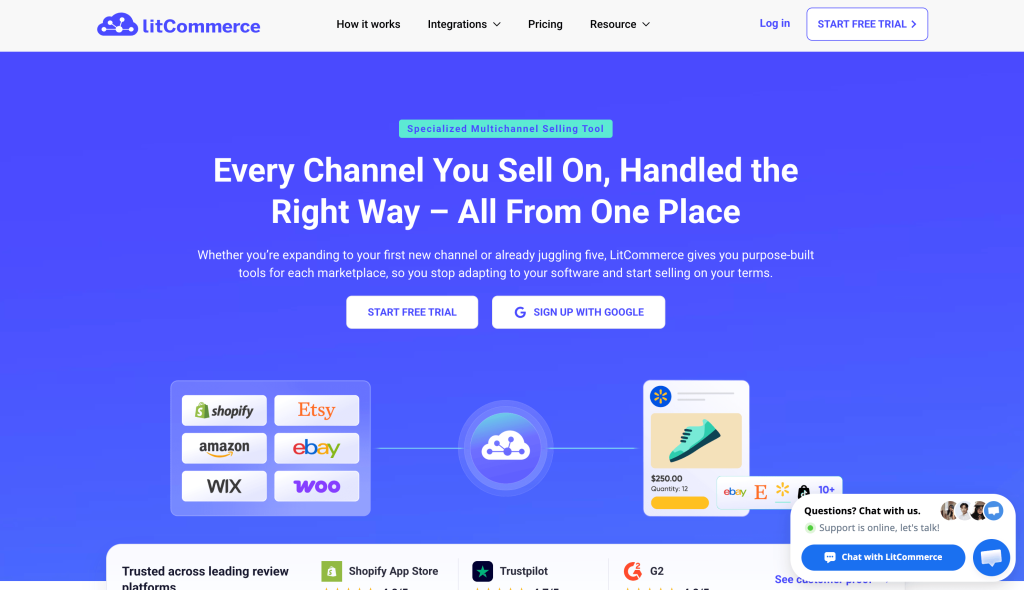
LitCommerce lists products on Etsy, Amazon, eBay, TikTok Shop, Walmart and others from one place. It also syncs inventory and imports orders.
Pricing: Its pricing page shows the Multichannel Listing plan from $29 a month, starting at 1,000 listings and three channels, with unlimited orders. There’s a 7-day free trial.
Why it stands out: It can list on Amazon without an ASIN using a GTIN exemption, and it imports both FBA and merchant-fulfilled orders, according to its homepage.
Watch out for: Inventory and order sync run every 15 minutes. Its site doesn’t say whether FBA stock levels sync, so confirm that if you use FBA.
5. 3Dsellers: best for eBay-first sellers adding Etsy and Amazon
3Dsellers is an eBay-focused tool with listing templates, bulk editing and image hosting. It connects Etsy and Amazon, but only on its top plan.
Pricing: 3Dsellers’ pricing page says Professional is “the only plan that connects Shopify, Amazon, Etsy, Walmart” and other channels. Professional starts at $79 a month ($59 billed yearly) for 2,000 listings. There’s a 7-day free trial with no card.
Why it stands out: Strong listing tools if eBay is also one of your main channels.
Watch out for: You pay $79 or more to connect Etsy and Amazon at all. Its pricing page doesn’t explain how stock syncs between them, so confirm that before you switch.
Which Etsy Amazon integration app fits your business?
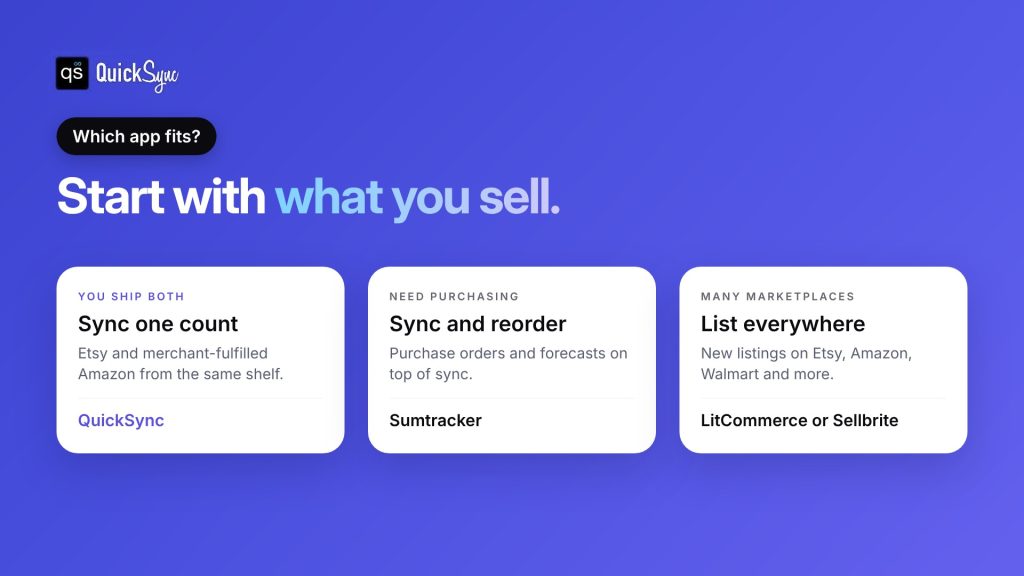
Start with how you ship. If you fulfil Etsy and Amazon orders yourself, choose an inventory sync tool like QuickSync. If you also want purchasing and forecasting, look at Sumtracker. If you list new products on many marketplaces, LitCommerce or Sellbrite cover more ground.
| Your situation | What to use |
|---|---|
| You ship Etsy and Amazon orders yourself | QuickSync |
| Etsy, Amazon and a Shopify store or POS | QuickSync |
| You want purchase orders and reorder forecasts | Sumtracker Replenish |
| Listing new products on many marketplaces | LitCommerce or Sellbrite |
| Fewer than 30 orders a month, testing the waters | Sellbrite Free |
| Most Amazon stock is in FBA | Any of these, but keep FBA units out of your Etsy count |
Here’s what two-way sync looks like for an order you ship yourself:
Selling handmade goods?
If your products are handmade, Amazon Handmade may suit you better than a standard Amazon listing. Our Amazon Handmade vs Etsy guide compares fees and approval, and the same sync rules apply either way.
How to connect Etsy and Amazon
Here’s how to sync Etsy and Amazon inventory with QuickSync. Most of the work is cleaning up your SKUs first.
- Clean up your SKUs. Give each product the same SKU on Etsy and Amazon, and keep it short. Fix any SKU used twice in the same Etsy shop.
- Check your variations. Etsy allows two option types. Split or simplify any product with three.
- Decide what’s FBM and what’s FBA. Only merchant-fulfilled listings share stock with Etsy. Keep FBA units out of the count you sell on Etsy.
- Connect both channels. Log in to Etsy and Amazon and approve QuickSync on each one’s own screen.
- Pick your source store. Choose the channel whose stock counts are right today. QuickSync uses it as the starting point.
- Review the matches. QuickSync matches products by SKU and hands back any it couldn’t pair.
- Test on a few products. Make a test sale on one channel and check the count drops on the other before you turn on the rest.
Final thoughts
Every app here connects Etsy and Amazon, but they handle stock differently. The biggest question is how you ship. If Amazon holds your stock through FBA, Amazon owns that count. Your Etsy shop then only needs to reflect what you still have on hand.
If you ship both channels yourself, two-way sync is the part to get right first. It’s what stops a candle from selling twice. If you want purchasing tools too, Sumtracker adds them at a higher price. If you list across many marketplaces, LitCommerce and Sellbrite cover more ground.
QuickSync keeps one count across Etsy, merchant-fulfilled Amazon and 11 other platforms, with unlimited orders on every plan. You can test it on a few products before you move everything over. Selling on eBay or Shopify too? See our Etsy Amazon integration and Shopify Amazon integration pages.