
Search the Shopify App Store for “amazon” and you get 905 results. Some list your products on Amazon. Some ship your orders. Some only import reviews. Picking the wrong Shopify Amazon integration app can mean weeks of setup and a few oversold orders.
Getting it right matters, because Amazon is built on sellers like you. Independent sellers sold 61% of all paid units on Amazon in the second quarter of 2026, according to Amazon’s own results. Your Shopify store can be one of them without doubling your workload.
This guide compares seven Shopify Amazon integration apps on price, what they sync and who ships the orders. Every rating and price was read from each app’s Shopify App Store listing on 16 October 2026. QuickSync is one of the seven, and each section says where that app is the better pick, ours included.
First, Figure Out Which Shopify Amazon App You Need
Most comparison lists treat every Amazon app as the same thing. They aren’t. Each one is built for one of three jobs, and the job decides the app.
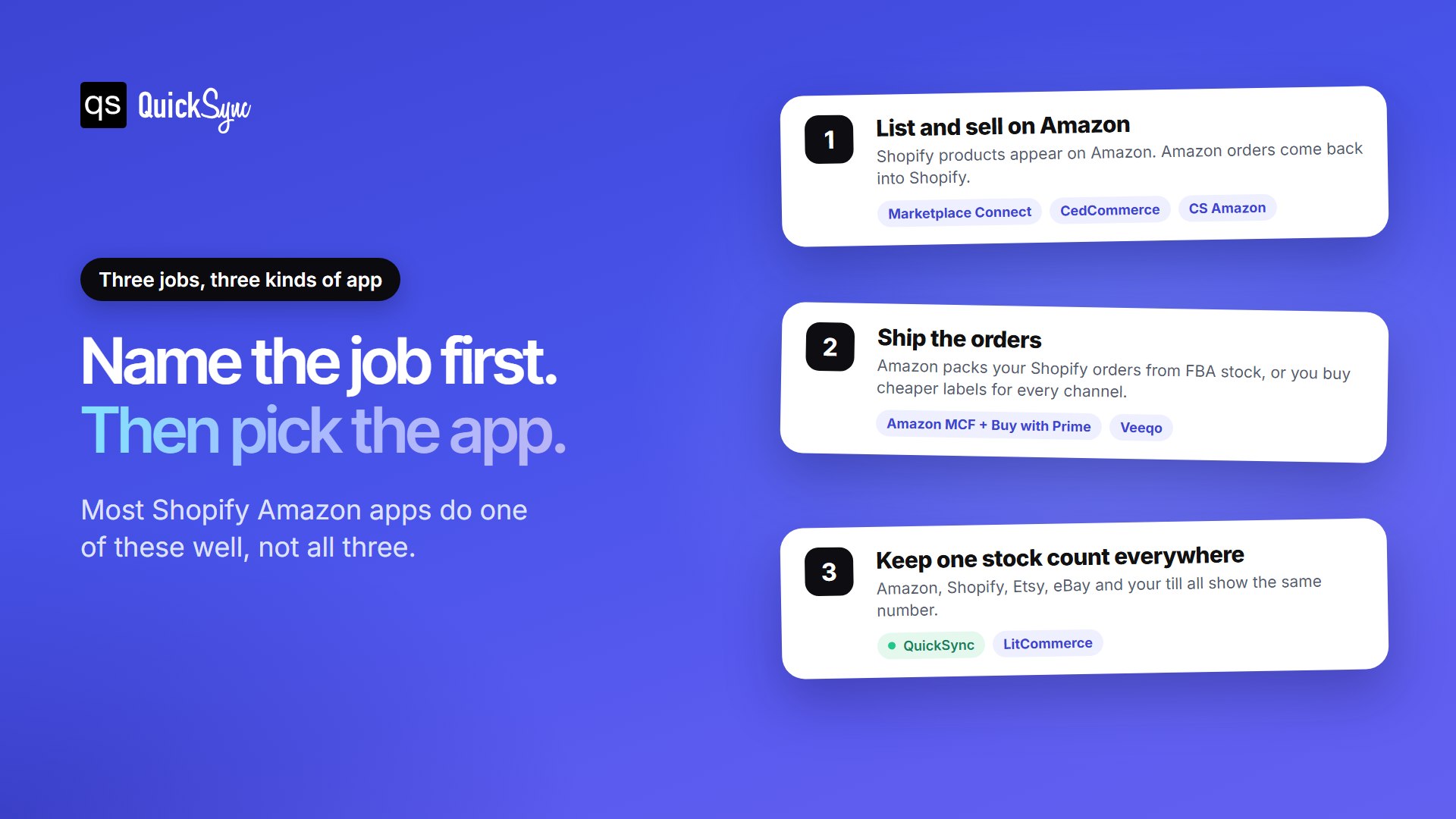
List and sell. These apps put your Shopify products on Amazon and bring Amazon orders back into Shopify. Shopify stays the hub, and Amazon becomes another channel inside your admin.
Ship. These apps deal with the parcel. Either Amazon packs your Shopify orders from stock it already holds for you, or you buy cheaper labels for orders from every channel.
Keep one stock count. These apps matter once Amazon isn’t your only other channel. If the same item also sells on Etsy, eBay or a shop counter, the count has to live somewhere that belongs to none of them.
Knowing the job helps you build a sensible setup, too. Plenty of sellers run one app for listing and another for shipping. Our guide on how to connect Shopify to Amazon walks through the setup itself.
Seven Shopify Amazon integration apps at a glance
| App | From | Rating (reviews) | Built around | Best for |
|---|---|---|---|---|
| Amazon Integration by QuickSync | $19/mo for two shops | 4.9 (1,946) | One stock count across channels | Selling on Amazon and other channels |
| Shopify Marketplace Connect | Free for 50 orders a month | 4.1 (2,125) | List and sell | Amazon as your only other channel |
| CedCommerce Amazon Channel | Free plan, then $19/mo | 4.6 (1,164) | List and sell | Amazon-focused stores on a budget |
| LitCommerce | $29/mo | 4.8 (973) | Listing on many marketplaces | Amazon plus Walmart, Temu and more |
| CS Amazon Integration & Sync | Free plan, then $19/mo | 4.1 (243) | Orders, FBA and MCF | FBA sellers and dropshippers |
| Veeqo | Free, you pay for labels | 4.0 (128) | Shipping and inventory | Shipping a lot of parcels yourself |
| Amazon MCF and Buy with Prime | Fees per shipment | 3.6 (99) | Amazon ships your orders | FBA stock and Prime delivery on Shopify |
Amazon Integration by QuickSync
QuickSync is for sellers whose stock sits behind more than two shops. It keeps one count across Amazon, Shopify and up to six more channels, including Etsy, eBay, TikTok Shop, Square, and Clover. Sell the last unit anywhere, and every other channel drops to zero.
Stock you ship yourself (FBM) syncs both ways. Stock Amazon stores and ships for you (FBA) keeps Amazon’s own count, because Amazon owns those shelves. Existing listings match by SKU, so you don’t re-list anything. Inventory sync costs $19 a month for two shops on Lite. Product and order sync start on Pro at $29. Pricing is based on how many items you sell, never on orders, and the 14-day trial needs no credit card.
Where it falls short: QuickSync doesn’t ship anything, and Amazon won’t accept a tracking number from it. If Amazon is the only place you sell besides Shopify, start with Marketplace Connect below. It’s free for your first 50 orders a month.
Shopify Marketplace Connect
Marketplace Connect is Shopify’s own marketplace app, formerly called Codisto. It lists your products on Amazon, eBay, Walmart and Target Plus, and syncs listings, orders and inventory from inside the Shopify admin. Your first 50 marketplace orders each month are free. After that, it charges 1% of each synced order, capped at $99 a month.
It has the most reviews here, 2,125, but also a 4.1 rating, and 14% of those reviews are one star. Recent reviews from September 2026 describe sync problems. You’ll also need a verified Amazon seller account in the country you want to sell in, according to Shopify’s requirements page. Start here if Amazon is your only other channel.
CedCommerce Amazon Channel
CedCommerce Amazon Channel has the best rating of the list-and-sell apps, at 4.6 stars across 1,164 reviews. It syncs listings, inventory, prices and orders, including FBA and FBM orders on paid plans. The free plan covers 50 orders a month and up to 100 products on one Amazon account.
Paid plans are priced by orders. They start at $19 a month for 100 orders and reach $99 a month for 1,000. That’s good value for a focused Amazon store, but the bill grows as you sell more. It only connects Amazon, so you’d need another tool for other marketplaces.
LitCommerce
LitCommerce is the choice when Amazon is one of several marketplaces. It lists to Amazon, eBay, Etsy, TikTok Shop, Walmart, Temu, Faire and more, with bulk editing and listing templates. It has 4.8 stars across 973 reviews, the second-strongest after QuickSync score in this guide.
Plans start at $29 a month for 1,000 listings on three channels, with unlimited order sync and a 7-day free trial. It’s built around listings rather than in-person sales, so it suits marketplace sellers more than stores with a till.
CS Amazon Integration & Sync
CS Amazon Integration & Sync leans toward the order side. It imports Amazon orders and handles FBA, Multi-Channel Fulfillment and dropshipping flows. The free plan covers 50 orders a month in one region with a 2% fee on imported orders. Basic costs $19 a month for 100 orders. FBA, MCF and Prime support start on Advanced, at $49 a month.
Check the reviews first. It has 4.1 stars across 243 reviews, and 21% are one star.
Veeqo
Veeqo is owned by Amazon and built around shipping. It pulls orders from Shopify, Amazon, eBay, Walmart and over 20 other channels into one queue. US sellers get discounted UPS, USPS, FedEx and DHL rates. It also syncs inventory across those channels.
The app is free, and you only pay for the shipping labels you buy. It has 4.0 stars across 128 reviews, with 17% at one star. It’s worth a look if you pack a lot of parcels yourself.
Amazon MCF and Buy with Prime
Amazon’s own app lets Amazon ship your Shopify orders from the stock it already holds for you. Parcels go out in unbranded packaging to the US, UK, EU, Japan, Canada and Australia. In the US, you can also offer Prime delivery on your Shopify store through Buy with Prime. It’s free to install, and you pay fulfilment fees per shipment.
It’s the lowest-rated app here, at 3.6 stars across 99 reviews. One October 2026 review says it changed the shipping profiles on products that weren’t synced to Amazon. Test it on a few products before turning it on for your whole catalogue.
Which Shopify Amazon integration app should you choose?
- Choose QuickSync if the same stock sells on Amazon, Shopify and other channels, like Etsy, eBay or a till.
- Choose Marketplace Connect if Amazon is your only other channel and you want to start free.
- Choose CedCommerce if you’re focused on Amazon and want a well-reviewed app with a free plan.
- Choose LitCommerce if you list on many marketplaces, like Walmart, Temu and TikTok Shop.
- Choose CS Amazon Integration if FBA and MCF orders are the main thing you need handled.
- Choose Veeqo if shipping costs and label printing are your biggest headache.
- Choose Amazon MCF and Buy with Prime if you want Amazon to ship your Shopify orders.
One rule applies whichever apps you pick. Only one of them should write stock levels to Amazon. If two apps both update the same Amazon listing, each overwrites the other, and the number you see depends on which one ran last. Decide which app owns your stock before you connect the second one. Our Shopify Amazon inventory sync guide covers how to set that up.
Selling on more than Shopify and Amazon?
Most of the apps above treat Shopify as the centre and Amazon as one channel. That works until a third place sells the same stock. QuickSync connects Amazon to Etsy, eBay, TikTok Shop, Square and QuickBooks, so every channel draws from one count. Our guide on syncing Shopify, eBay and Amazon inventory shows how that works with three channels.